Posts Tagged ‘collaboration’

h1

LED Ballroom Dresses

June 27, 2013

Brigham Young University

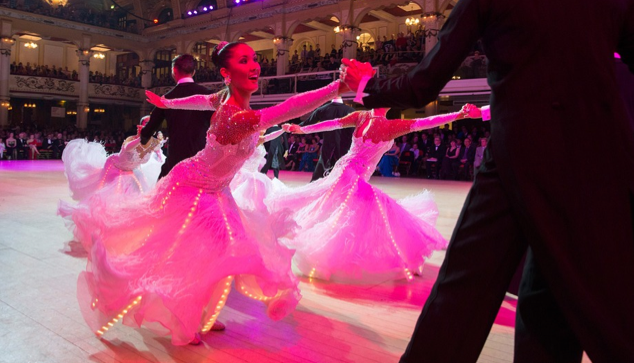
Engineering students from Brigham Young University, about 17 of them, worked closely with students on the dance team to design dresses that had LED lights embedded in them. Each dress included eight LED-light strips, attached to a computer chip and battery. The results, from the year long project, exemplify the great collaboration. Click here for the article and more photographs.

Screen shot 2013-06-23 at 11.56.51 AM

h1

Working Together

February 18, 2013

Finding Common Ground – Peter DeWitt’s blog

imagesNone of us is as smart as all of us. Many of you have heard me say this  Japanese proverb. My friend and colleague retired Maine Alliance for Arts Education Executive Director, Carol Trimble has this family saying We’re a Genius. When I came across this blog post titled Working Together, We Can Produce Genius I thought, I am going to like this blog post written by Robert Garmston and Valerie von Frank. And, I do and recommend it!

The authors point out that working in collaboration is not new. For example, even though Thomas Edison is credited with inventing the light bulb he did not work alone. He worked with several scientists who bounced ideas off each other and collaborated in a large open space. Hmmm… that sounds familiar.

They mention the “shift” happening in schools out of necessity, with teachers working together “combining efforts to work more strategically”. We know this is not a new concept either. But is it happening more in your schools than perhaps 5 or 10 years ago? And, are you involved in the team work?

I’ve noticed that we talk about collaborating in our work but do we know what that means, do we know how it looks? Does it matter who is collaborating? I have many questions about collaboration. If we try it once and it fails do we give up? How do we know which teachers should work together? What is the purpose of collaborating? Will it provide more and better opportunities for student learning and achievement?

The authors suggest these three topics to confront while planning.

  1. The group is (almost) always smarter than its members.
  2. The wisdom of the group can create better decisions.
  3. Who’s in the group matters.

I kept honey bees for several years and was amazed by their habits, behaviors, and how and what they produced. Each bee has their role and the sheer number of bees in a hive, about 30,000, all buzzing around playing their part! Talk about collaboration! I will never forget the first time I went into a bee hive. The bees clearly knew their part and who was supposed to be there. I was clearly a foreigner.

What can we learn from bees and other groups that function in a collaborative environment that have a positive impact on the world? What can we learn from teams who have creatively tackled new ideas and concepts and made a community a better place? Perhaps sharing the blog post Working Together We Can Produce Genius with a colleague or the staff at your school would be a good place to start (or continue) a discussion.

h1

The Math Gates

May 16, 2012

Team teaching art and math works!

The following was written by art teacher, Dona Seegers, and RSU#38 district math coach, Sarah Caban, who created a unique team teaching and student learning opportunity at Mt Vernon Elementary School this year. They provided the following information for this blog post sharing their collaborative work.

We are motivated by the excitement of new ideas for presenting our subjects to the students, are eager to experiment and have infectious enthusiasm.

We are interested in having the students discover how integral math is for an artist and how a mathematician benefits from creative thinking abilities with 2D and 3D design vocabulary and concepts.

Math and art share many core features focused on thinking and problem solving. Students become better at math through visual investigations.

Students and teachers alike benefit with two instructors in the room. Dona and Sarah are better able to address students of all levels and to increase student participation. It personalizes the learning experience and students witness us learning from each other.

Students experience the myriad of connections between disciplines while doing creative movement, making Venn Diagrams, using math manipulatives  and participating in art projects.

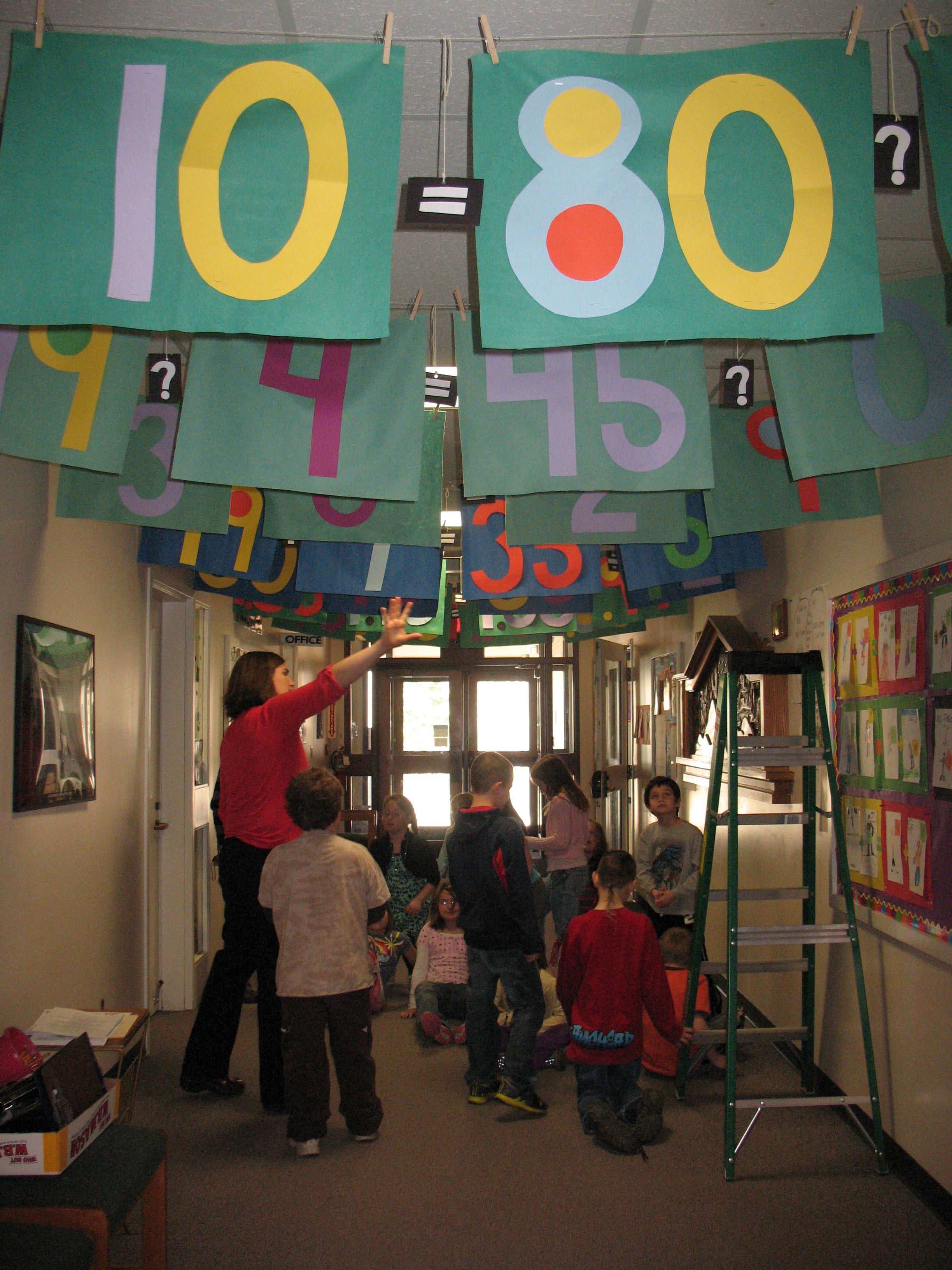
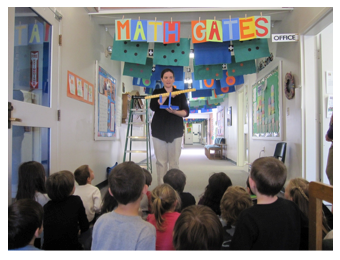
Algebra and Art were the focus for our 3 week interactive hallway installation titled The Math Gates.

Sarah had been reading about the importance of introducing algebraic thinking in the early grades, inspired by Robert Moses who started The Algebra Project.

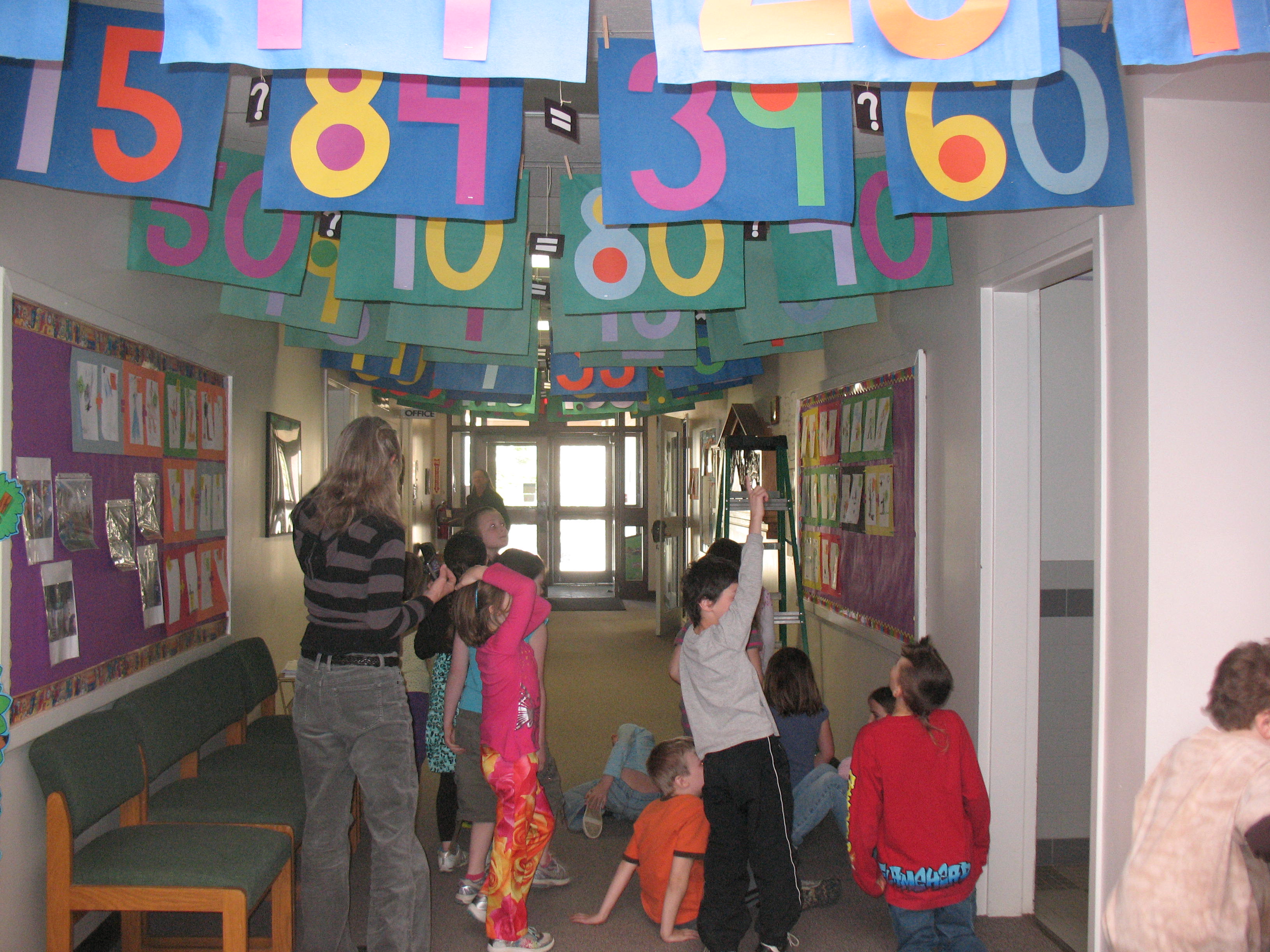
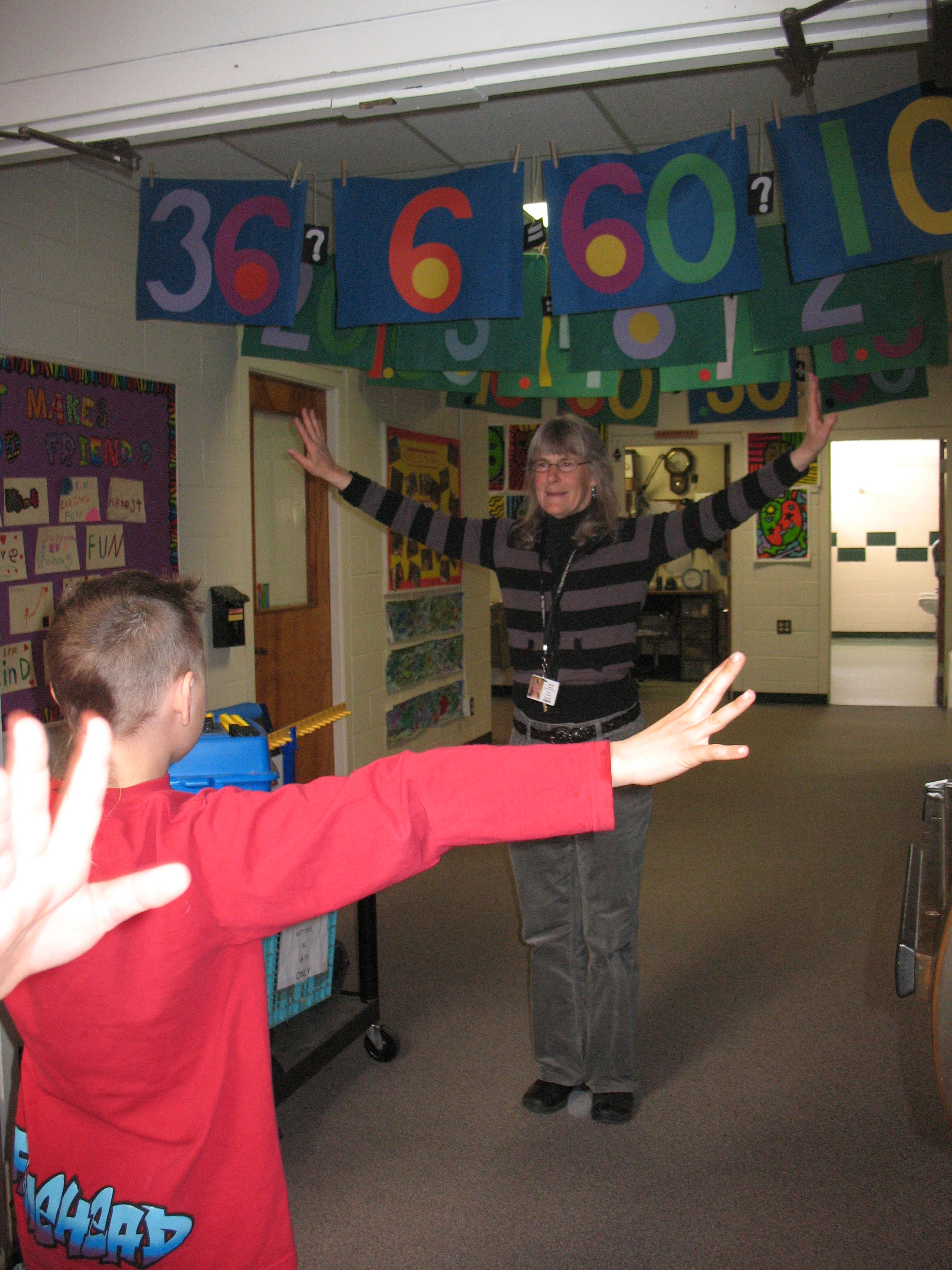
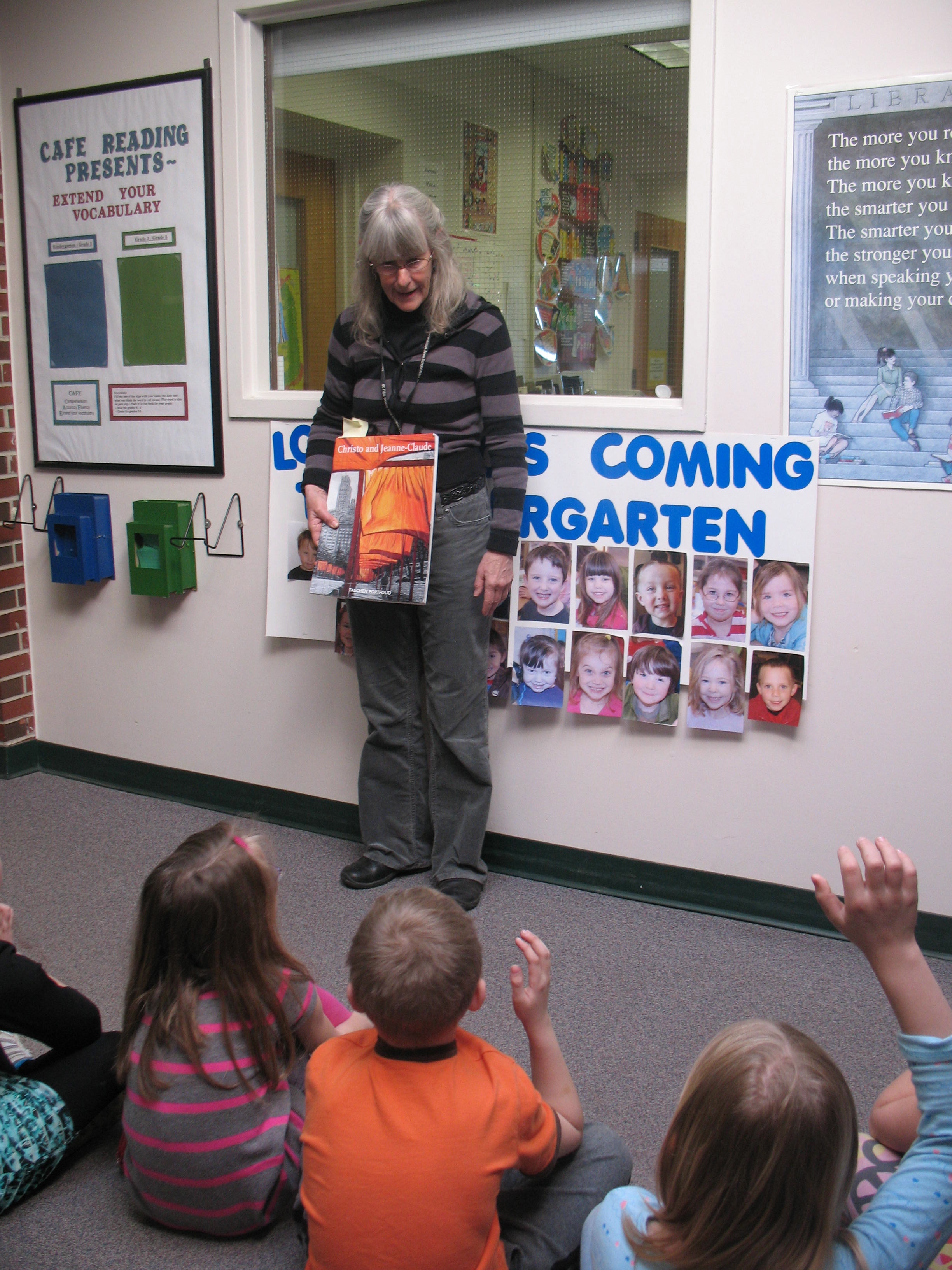
Dona was inspired by Christo and Jeanne-Claude’s 2005 art installation of The Gates in New York City’s Central Park. Students learned to temporarily transform an environment through art installation. With the help of the janitor, Craig Dunn, and the district volunteer coordinator, Nancy Mormon, the front hall became a learning lab for algebraic equations K-5. Cloth flags with dots (K), whole numbers (1-4) and fractions (5) hung four across to demonstrate a variety of equations of increasing difficulty.

Object Lessons: Teaching Math Through the Visual Arts K-5 by math educator Caren Holtzman, and art teacher, Lynn Susholtz, has been a fantastic resource this year and the source for all of our collaborations.

Next year we plan to do a project based on the Fibonnaci sequence including a field trip to an art show on this theme at The Emery Community Arts Center in Farmington.

Student comments about The Math Gates; “You are able to do both tasks at the same time. Math and Art are my favorite subjects so it is double the fun.”  “ Sometimes you do art and sometimes you do math, so it evens out in the end.” “Installation is a lot different because you have never heard of it; you need to know both subjects because they come in useful.” “We don’t have other subjects combined.”

Thank you Dona and Sarah for providing this blog post!

.

h1

COLLABORATION

April 12, 2012

The importance and value of collaborating whenever possible

The Maine Arts Assessment Initiative that got off the ground one year ago has been successful for many reasons and due to the contributions of many people. If I had to identify one, most important reason for the success it would be due to the collaborative efforts of several. I have watched and lived COLLABORATION  for years and years. USM professor Jeff Beaudry and I frequently talk about the “C” word and the importance and value of it. I gravitate towards people who enjoy collaborating.

The season of budgets is upon us and tough conversations and decisions are being had and made by administrators and school boards. I am getting phone calls and emails on the topic.

I believe that collaboration is a foundation for all the work we do as arts educators. Let’s face it the power of the orchestra, band, choral group, dance or theatre performance lies in the collaboration of the collective voices, instruments, and/or bodies.

  • We need to collaborate with our colleagues who are other visual and performing arts educators. We do what we do for the success of all students! We should not be competing for funds or slots in the schedule or work spaces or all those other “things” we need for the success of arts education programs.
  • We also need to be collaborating with educators of other content areas. Three times in my career as an art teacher VPA positions were in proposals for eliminations. Every time the positions were re-instated. The third time it was my colleagues of other content areas who provided their voices. In fact, they collaborated to create the presentation for the school board meeting. You might wonder why… they understood the value and importance of the collaborative curriculum work we did educating all kids. It wasn’t the icing on the cake but an essential part of all kids learning. It was the collective voices and meaningful message that made the difference.
  • Collaborating with administrators. The once every four year arts celebration that we put in my place where I taught brought 4000 people to school. Every administrator attended the event and you can be sure they had smiles on their faces! It was the single event in the districts history that brought people from all backgrounds into the school since all kids participated by exhibiting artwork and performing in the music and theatre groups.
  • Collaborating with community members is ongoing. Inviting them to your classroom to volunteer provides the opportunity for them to be involved and they “feel good” about helping. And, OMG, the opportunities for them to see and understand what happens in an arts classroom is first hand. If they didn’t undersand before that the arts are essential to all kids learning they most likely will after they spend some time in your classroom or on the field trip bus to the art museum or at the music festival or another opportunity. Engaging them in conversation about “what” you are doing and “why” you are doing it brings them to a new level of understand about arts education.

So, how does collaboration get started? In a variety of ways, perhaps one smile, one “hello”, and/or one conversation with one other person. Share ideas, ask questions, listen. My most memorable experiences teaching are when my middle school team designed interdisciplinary units. It was sooooooooo much fun to teach. We had such a good time that the enthusiasm spread to the students and by the way, the learning that took place was incredible. It was pure magic! I couldn’t wait to get to school each day to continue the collaboration.

York High School Music Educator Rob Westerberg has written a blog post called “chopped”. He takes a thorough look and position on the components of what takes place in some school districts during this time of year. If you know Rob you are well aware of how articulate he is. You won’t want to miss reading his latest post on the blog that he and Jarika Olberg collaborate on called Goober Music Teachers.

One of my favorite sayings is an African one: A single bracelet does not jingle. If you don’t already, please find the other bracelets that are all around you and start the beautiful, strong sound that only happens when you collaborate!

h1

Harlow Gallery: Hallowell

March 19, 2012

Harlow Gallery working with visual art educators

Nancy Barron, Program Director at the Harlow Gallery in Hallowell has helped to create a connection with local visual art educators to form a group called Art Educators’ Initiative. Recently Nancy answered questions for meartsed readers. Since this is a great model for other communities please share this post with your local galleries so they can think of possibilities for communities throughout Maine.
Mission Statement: “The Harlow Education Committee mission is to promote the arts through educational partnerships with the community.”

Vision Statement: “The goal of the Harlow Education Committee is to foster creativity by supporting programs and activities that encourage public awareness of, participation in, and appreciation of the arts.”

Tell me about the purpose of the Art Educators’ Initiative group.

The purpose of the Art Educators’ Initiative group is to give art educators a network of peers to problem solve, generate ideas, share professional development opportunities-in short, a support system.

Sounds like a PLC (Professional Learning Community) to me. How and when did this idea form?

Website for classroom workshop, Shalimar Poulin instructing

The idea was an “ah-ha” moment at the Harlow. We have hosted Higher Forms of Art for several years; a show celebrating some of the area’s high school students art work. It is unique because the students not only display their work, but select the work for the show (curate), hang and promote the show. A hands on experience in a real gallery. We always want to engage this high school demographic and brain stormed about how to do just that. We decided to have a young artists celebratory pizza party. We had a sponsor who provided the pizza and requested that the teachers invite up to 6 students and to attend themselves. (60 students were invited). Disappointedly only 3 students came to the party, however; nearly all of their instructors came. With art from these various schools on the walls, introductions were made and the event instantly morphed into a very upbeat networking session for the instructors. The teachers were inspired by their colleague’s lessons and curious about their techniques. Needless to say, the event, though not for reasons intended, was a complete success. I floated the idea to host an “Art Teachers Retreat” to our relatively new, but very eager Art Education committee. They, (some of whom are retired art educators) loved the idea. In May of 2011 we held a focus group compiled of about 15 area art educators, Art Ed committee members and the Harlow staff. We asked the group:

  • Is there interest in having such a group
  • If so, what they would like to explore
  • How often they would like to meet
  • Would they be interested in a blog to communicate between meetings

They liked the idea, were realistic about what kind of commitment they could make (4 times per year), and they came up with a list of focus items which included: website development, clay workshops, behavior in the classroom, and more.

What does your work include?

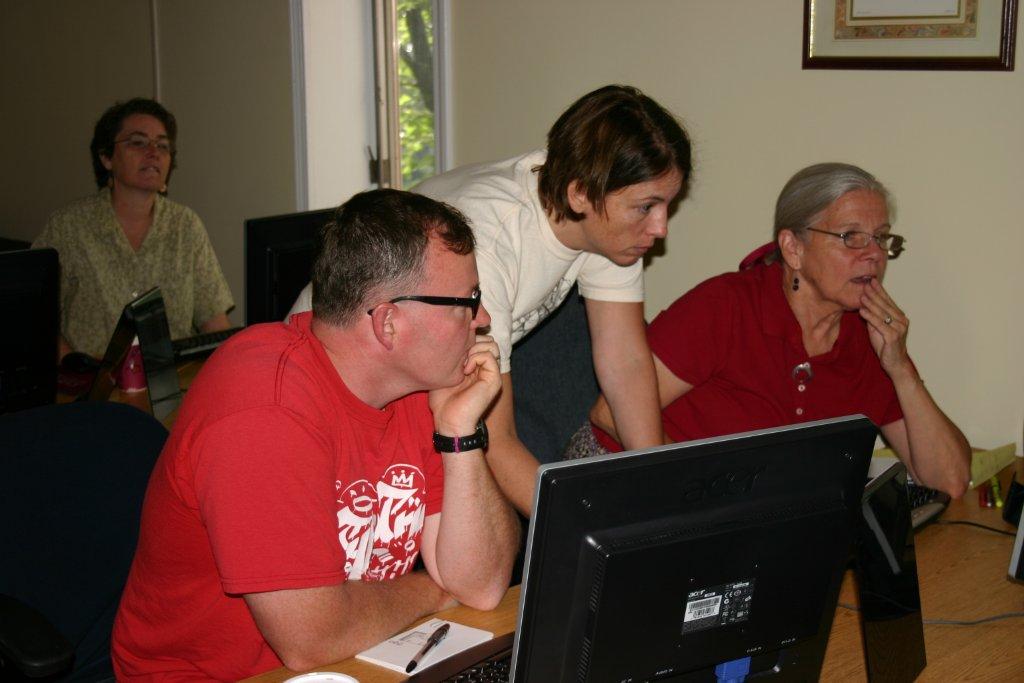
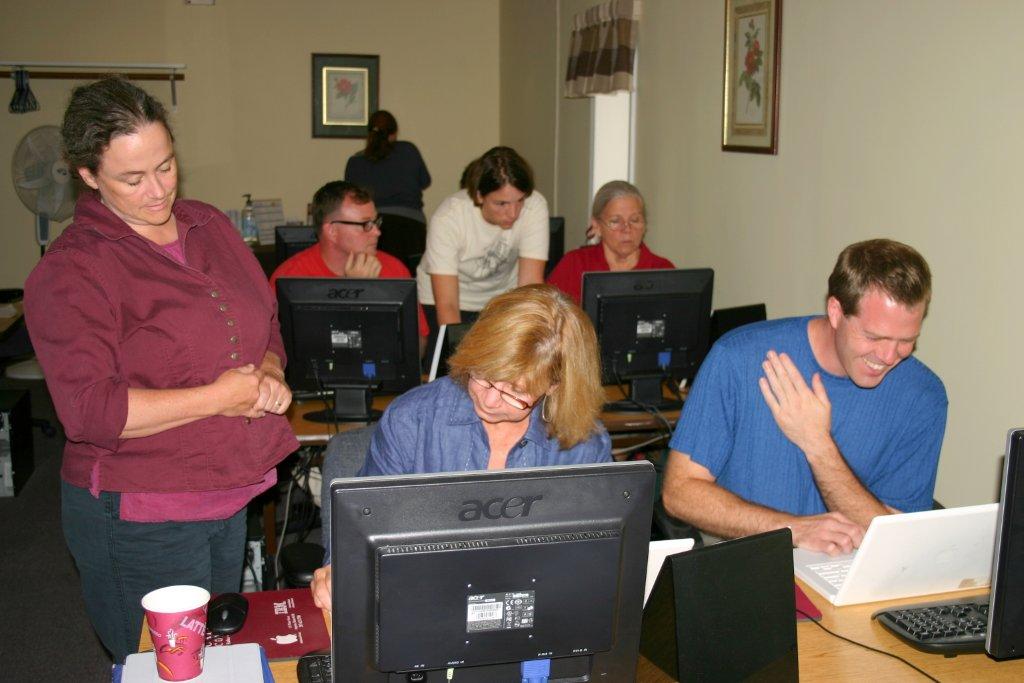
So far, nearly a year later, the group has met for a website for classroom workshop taught by Art teacher Shalimar Poulin-10 educators signed up for this workshop in August of 2011. We have had two meetings since in which a good chunk of time was spent talking about assessments. This piece was a real eye opener for me. This one topic is clearly something nearly every teacher seems to struggle with. Teachers were also encouraged to bring examples of “tried and true” lessons.

Tell me about the teachers who are participating. 

Website for classroom workshop

The group varies from meeting to meeting with between 9 and 12 teachers attending. Our list has grown from 20 to over 30 teachers now.  Many of the teachers on our list have participated in our yearly Young at Art month in March. But we are not limiting the group to school aged children. We have an adult ed instructor and two instructors of adults with mental illness. Instructors are finding us through email blasts to statewide groups. The areas represented are:  Bath (adult ed instructor),Wiscassett, Richmond, Gardiner (and all the schools they serve-Randolf, Pittston, Chelsea), Chelsea, Hallowell, Augusta, Manchester, Readfield, Winthrop, Monmouth, Wayne (Kent’s Hill), and Waterville.

What activities, forums, and/or gatherings have you provided for the teachers?

So far, we have done one off site workshop at Capitol Area Computers and three meetings at the Harlow. We provide snacks… a small gesture with a large impact.

What is your philosophy around the idea of connecting the Harlow Gallery with art teachers? Value to the community, teachers, students, and others?
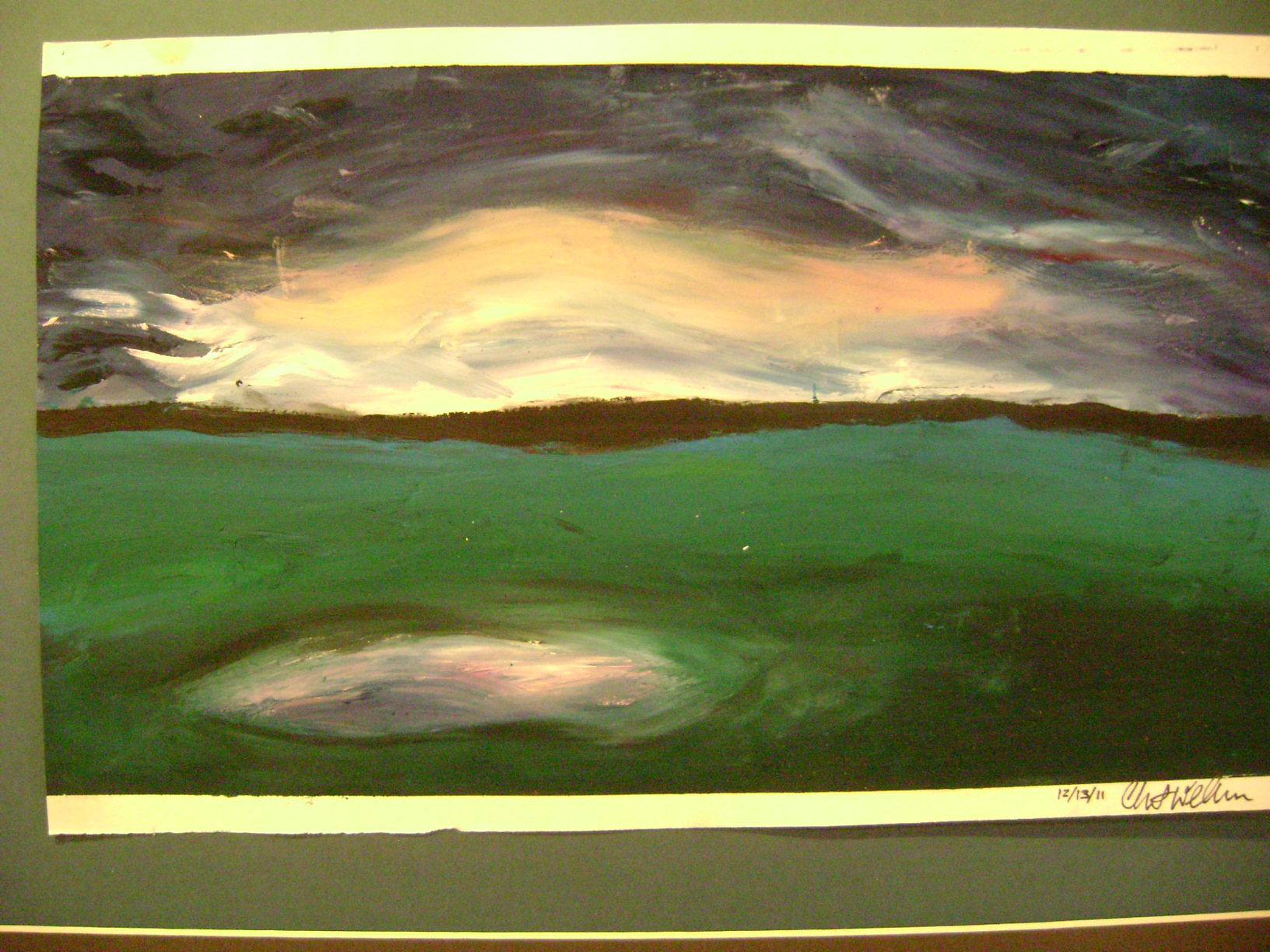
Chantel Wellman, "Blue Rock' Gouche on Paper Cony High School, from this years Higher Forms of Art show at the Harlow Gallery

The philosophy behind the group is: Art teachers are a somewhat under supported group. Every year facing budget cuts-one of our instructors jobs was cut in half last year!  They are very often the only art teacher in their schools-there are not “teams” for them to bounce ideas off from. The Art Educators’ Initiative Group was meant to provide support-for teachers from teachers.

The value to the community will be teachers that, even with the unique challenges they face, will continue to provide the best arts education to students.

The value to teachers will be a support network, for example someone to call during the struggles of trying to understand how to assess a student that doesn’t fit the criteria for a passing grade in art. Professional development: something so important, to keep current with new trends in art education. The importance of this group for students will be art teachers that are fresh and focused.

What do your future plans include for the Art Educators’ Initiative group?

We are currently writing a grant to help support this group both by providing funds for a laptop and LCD for educators to present to one another, and for a series of clay summer workshops. This was one of the original requests from the focus group.

A great big THANK YOU to Nancy for taking the time to answer these questions. If you have others please post them below in the comment section of the blog post or email Nancy Barron directly at kvaa@harlowgallery.org.