East End Community School
Teaching Artist and dancer Elly (Elisabeth) Lovin worked with the Kindergarten students at the East End Community School in Portland during the spring of 2018. They received one of the Maine Arts Commission dance education grants. I had the opportunity of visiting and I was so impressed with Elly’s ability to connect with every student on multiple levels. She doesn’t miss a beat and she is full of positive energy!
Elly’s Reflections… 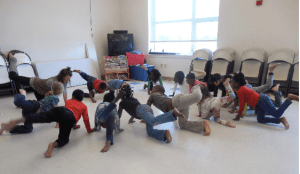 I am so grateful to have had the opportunity to work with the East End kindergarteners for ten weeks this past spring. Not only was it a joyful, memorable and necessary experience for the children, but it changed me as a dance educator and taught me so much about the power of of movement.
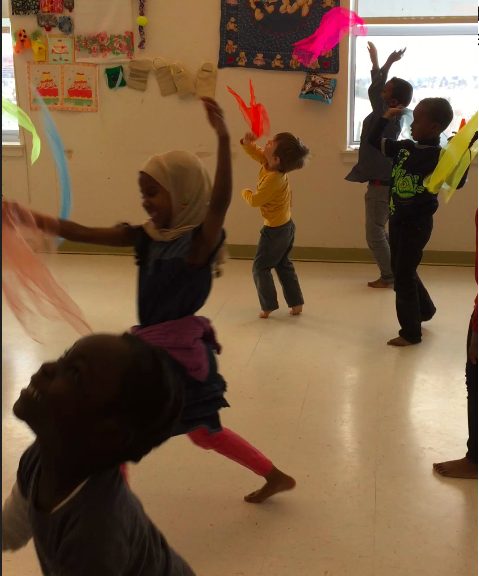
I was able to see each of East End’s four kindergarten classes once a week. We had a large community room to meet in, with a tile floor and big windows overlooking the Back Cove. The children would remove their shoes and socks and join me in a circle. Spending time barefoot is so important, and I wanted to make sure the kids could feel the floor and improve their proprioception by moving without the hindrance of shoes. We always started class in a circle, because I believe this shape is equalizing and 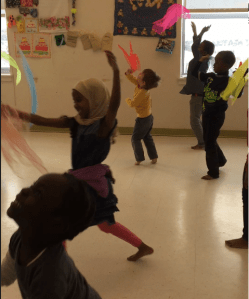 empowering. We could all see each other’s faces, and were all equidistant from the center. In each class we started by reviewing our Agreements (my expectations for a successful class). These were: Keeping our bodies within our kinosphere (space bubbles), Using Movement as our language (voices off) and No Running (though we can dance really fast!). We often began with a sensorial warm-up using different types of touch from head to toe–brushing, tapping, squeezing, rubbing–to get into our bodies and prepare for movement.
In each session, I introduced a different element of movement, loosely based on Rudolf Von Laban’s movement themes. I explained that dance is like a recipe, and there are many different ingredients we can think of adding to our dances to make them more “flavorful.” In the ten weeks, we were able to study the following dance “ingredients:” space, an awareness of body parts & whole, time/tempo, locomotion, levels, weight, flow, shapes, and relationships.
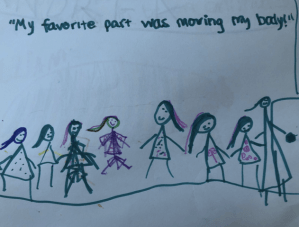
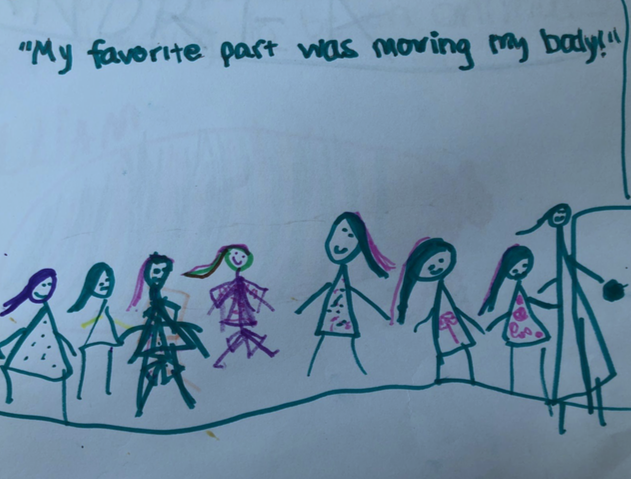
“My favorite part was moving my body.”
After introducing the day’s theme, we would move into a locomotive dance. Beginning with walking, we would pay close attention our pathways on the floor, moving in the general space without bumping into one another, and really seeingthe other dancers in the room. The walking dance would build into other forms of locomotive movement–marching, skipping, sliding, galloping, bear crawling, etc.
We practiced dance skills like leaps, hops and jumps, and then explored the movement theme of the day with dance games and explorations. At the end of each class I tried to allow a brief moment of “settling” back into stillness, for reflection and sharing standout moments from the class, and to honor our bodies for all they can do for us.
I saw so many little moments of change in the students. From week to week, confidence blossomed around both physical skills and creative expression. For those 45 minutes, children with little or no English were able to participate on a level equal to their peers, as everyone worked to communicate through movement, watching, mirroring, and generating physical responses to the movement messages around the room. I honestly couldn’t always predict which children could not understand a lot of English–until the classroom teachers told me.

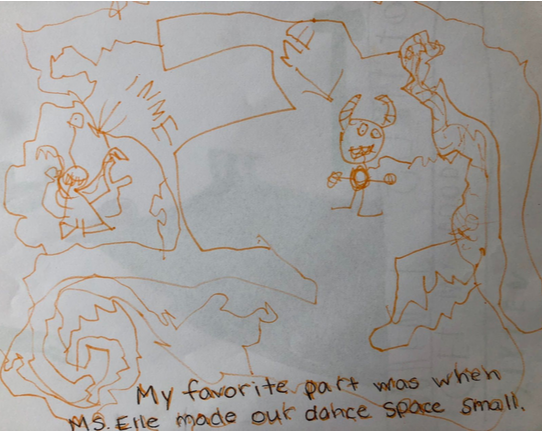
“My favorite part was when Miss Elly made our dance space small.”
A moment that really stood out to me happened during the sixth or seventh week of class. One student always came to class with a manipulative to work with. I assume he was experiencing difficulties with anxiety and attention. He would join us, but with his manipulative, and it seemed that for the first month or so of classes, he could not stay for the full class. At some point, he would become disinterested and leave the space with an aide. Gradually, he was able to stay for the full class, with a few breaks to use his manipulative. Then one day, I noticed that he had brought his manipulative into our opening circle but as we got up to begin locomotion, the object had been pushed to the side wall, where it remained for the rest of class. And then, the next week, he came to class without his object. He was able to stay engaged for the full class, and every time I looked at him, he was smiling and joyful in his moving body.
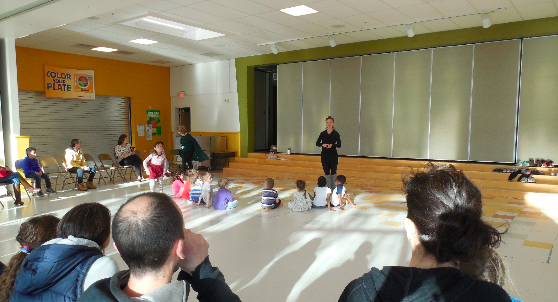
As a culmination to the project, we hosted an evening “open class” in East End’s beautiful cafeteria space, with floor to ceiling windows that overlooked the sun setting over the Back Cove. About 20 children came, and approximately 45 parents and grandparents. We demonstrated a full class, with several of the children’s favorite dance explorations from the past ten weeks. We finished with a game called “Art Museum,” but instead of dividing the children into groups to play, we invited the parents to be the museum-goers. The children spread out and made shapes with their bodies, staying still as statues or sculptures. As soft jazz played, the parents were invited to come to the museum, but in our museum, you don’t just look at the art. As the parents looked at each sculpture, they had to mimic the same shape with their bodies, from head to toes to facial expressions. The exploration lasted ten minutes or so, and it was really beautiful to watch. In children’s interactions with adults in their community, how often are they being talked at or guided or expected to follow the adults? What an opportunity to be truly seen by so many grownups–and be the one that all of the grownups must follow! I love this movement game because of the empathy sparked by the simple act of looking at another human being, studying the shape they are making, and mirroring what you see with your own body.
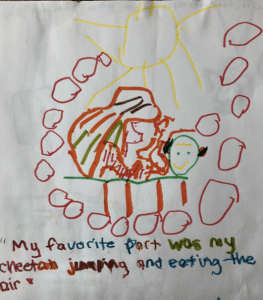
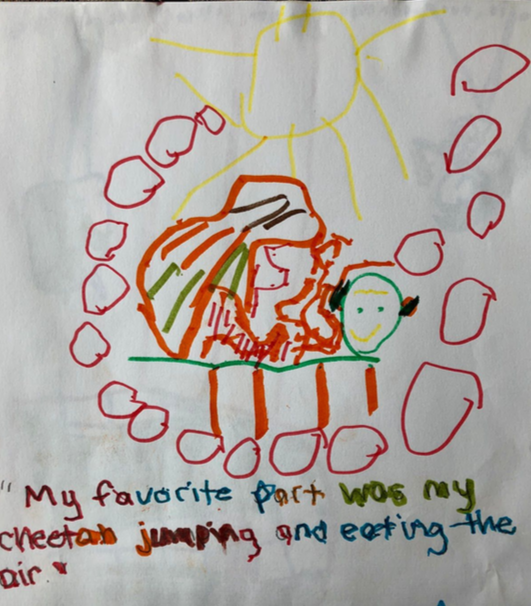
“My favorite part was jumping and eating the air.”
After the “performance,” many parents expressed their gratitude for the project. One little boy’s father came up to me excitedly and said “This has been so great… now we have dance parties at home!” Another dad asked “Who do we have to talk to? All kids should have this experience in school.” I wholeheartedly agree. Who do we talk to?
I don’t know what the future outcomes from this project will be. Will Maine schools begin to integrate dance into their educational philosophies–just as music and art hold a place in public education? Will my students continue to move through their lives with agency over their kinospheres and respect for others’ space boundaries, and enjoy creating dances to express themselves? All I can do is plant the seeds. This teaching experience has furthered my confidence in my philosophy: I believe movement is a human right, and as such am committed to furthering dance education for children in my community.

Teacher PD with Elly
Elly collaborated with kindergarten teacher Kathy Gray to plan, write and implement the Dance Education grant that they received from the Maine Arts Commission.
In Kathy’s words…
When I first responded to Elly’s invitation to work with her to apply for the Dance Education grant, I was excited about the possibilities, but really had no real background or knowledge of what that might look like! As we began the process of writing the grant, I began to learn about the many ways dance would support the youngest learners in our school not only to creatively express themselves, but to also listen in many ways, develop motorically, become aware of their body in space and develop many basic concepts through movement. All of these are basic Kindergarten foundational learning skills.
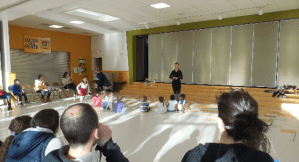
Parent night performance
Two thirds of the children in my class are English language learners and several have little or no ability to communicate in English. But oh how fluent they were in communicating through dance! They were all totally engaged and danced with smiling and joyful faces! I had especially hoped that dance would allow all the children, regardless of language or motor abilities, opportunities to be creative and competent
and it DID!
Dance classes supported core development and strength as well as balance. I had great concerns about one child’s development – fine motor as well as gross motor and
awareness of body in space. By the end of the dance education sessions, this child had made remarkable progress. He is no longer bumping into children or furniture.
He is no longer needing daily reminders about giving space to the peers sitting beside him. His focus and overall fine motor control has greatly improved.
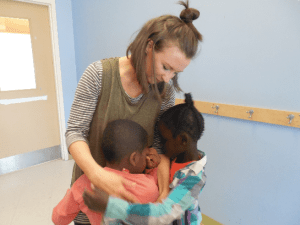
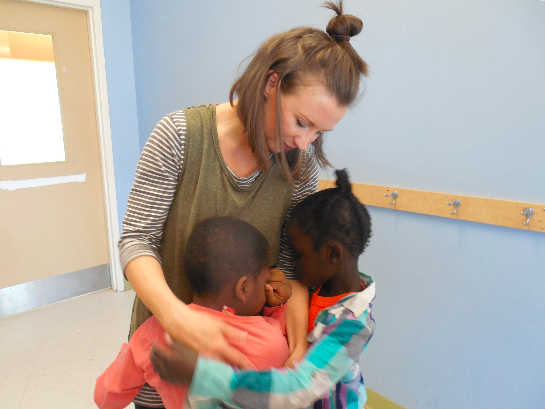
Children saying good-bye to Elly
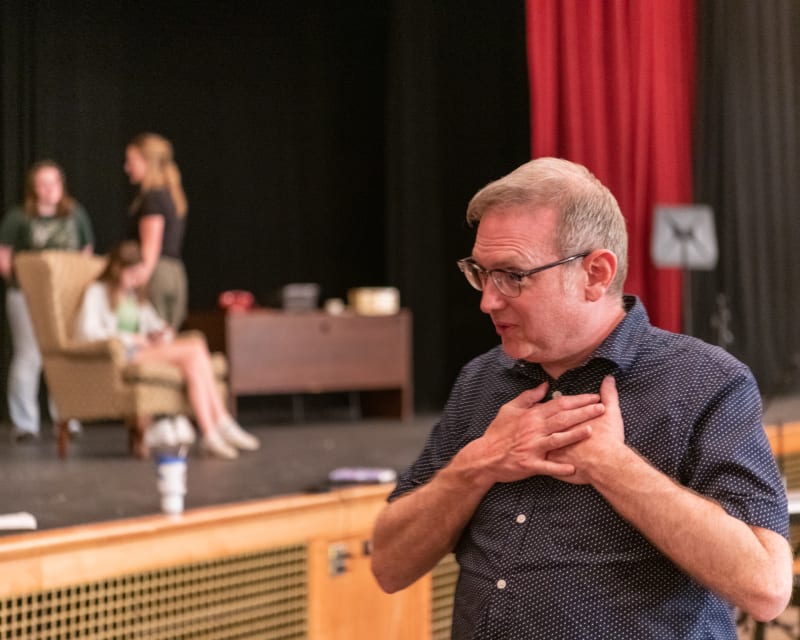
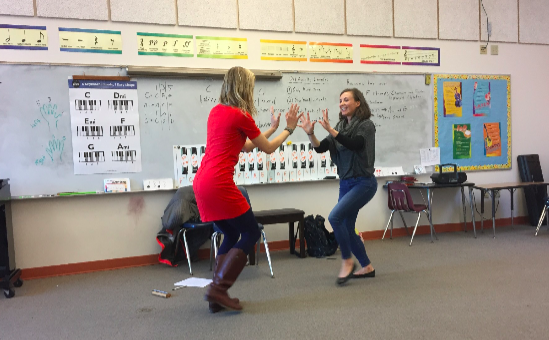
Another facet of this grant was on-going PD for our K staff. I have learned so much and have begun to use some of the dance strategies in our classroom. Creating our bubble of space, calming our body from toe to fingertips, traveling at different speeds and zones. District professional development was offered by Elly and staff came from 4 other schools and included pre-K and K teachers, an OT therapist and an OT intern and a grade 3-4 teacher.
This has been such a valuable element of our K students’ learning that I can’t imagine not having it as a permanent part of our curriculum! I think our administrative staff is looking to find ways to make this happen at least for our K students if not for others as well.
The MAC Dance Education grant funds are provided by a performance held each November at Thornton Academy by a collaborative group of school dance programs and community dance programs from southern Maine. The grant will be available again during the winter of 2019. If you’re interested in applying please read the guidelines posted on the MAC site from last year.




 me arts ed