Posts Tagged ‘Hampden Academy’

h1

Hampden Academy Bronco

May 24, 2012

Galloping bronze

On Friday, May 18, 2012, the Bangor Daily published an article on the new Hampden Academy Bronco that is being created for the high school scheduled to open for students in September. Artist and Hampden Academy graduate, Forest Hart has created a wonderful opportunity and gift for the students and community.

Thank you to Art teacher (and arts assessment teacher leader) Leah Olson for sending this post that includes the experience that students and staff had throughout the process of creating the bronco.

“A great teacher never strives to explain his vision. He simply invites you to stand beside him and see for yourself.” (Raymond Inmon)
It was with mixed emotions that we completed our last visit to work on the New Academy Bronco sculpture on Saturday, May 12. It has been a wonderful experience for faculty and students. I organized and carried through many scheduled trips which were attended by various faculty and administration. As a first year Hampden Academy Art teacher, I see very clearly that the loyalty of alumni is strong. I feel very fortunate to be a part of Hampden Academy’s past, present and future! It is an experience that will always bring a sense of pride in what our mascot is about! My interpretation:

Freedom of expression – Freedom to be lifelong learners – Freedom to take education that is offered and go for it!

May 5

The work we did on Saturday, May 5th, consisted of placing shims (pieces of metal) along the seams of the sculpture that are used to separate parts of the plaster mold. We also worked on making “birds nests” from hemp that is like hay to hold the plaster mold.


The Master Mold – Getting ready for bronze –  A mold is a container used to shape material. The clay bronco was divided into multiple sections by inserting thin flat metal strips (shims), on end, into the surface of the soft clay. Next a rubber material was brushed onto each side of the dividers. The rubber flows and forms into every detail of the sculpture. Several coats are applied, being careful not to completely cover the metal shims. The shims keep the rubber sides from sticking together. After the rubber has dried, wet plaster (with the hemp “nests” we just made) will be put on top of the rubber. The plaster will  harden to form a casing around the flexible rubber to maintain its shape once the clay is removed. When the plaster has hardened, the mold is opened at the shims dividing the sculpture. The clay bronco is removed. It will leave two halves which when joined back together form a container/cavity in the shape of the bronco that will be used to pour liquid bronze in.  

May 12

When we arrived at the studio, the Bronco was completely encased with a white rubber coating.  Quite a shock as I was used to seeing the gray clay.  The goal of the 24 hour day was to get the sculpture completely covered with plaster.  The studio was set up for beginning the process of adding the plaster. Officer Stewart, James and I worked outside making “birds nests” from hemp that is used to create a strong plaster mold. Jacob worked with the other men adding the plaster to the Bronco. My son had the fortunate job of unwrapping the small bronze sculptures from the foundry that are sold in gallery spaces. He was also busy taking pictures with his IPad so he could document his experience. I think he took about a hundred pictures and then he learned about “editing”.
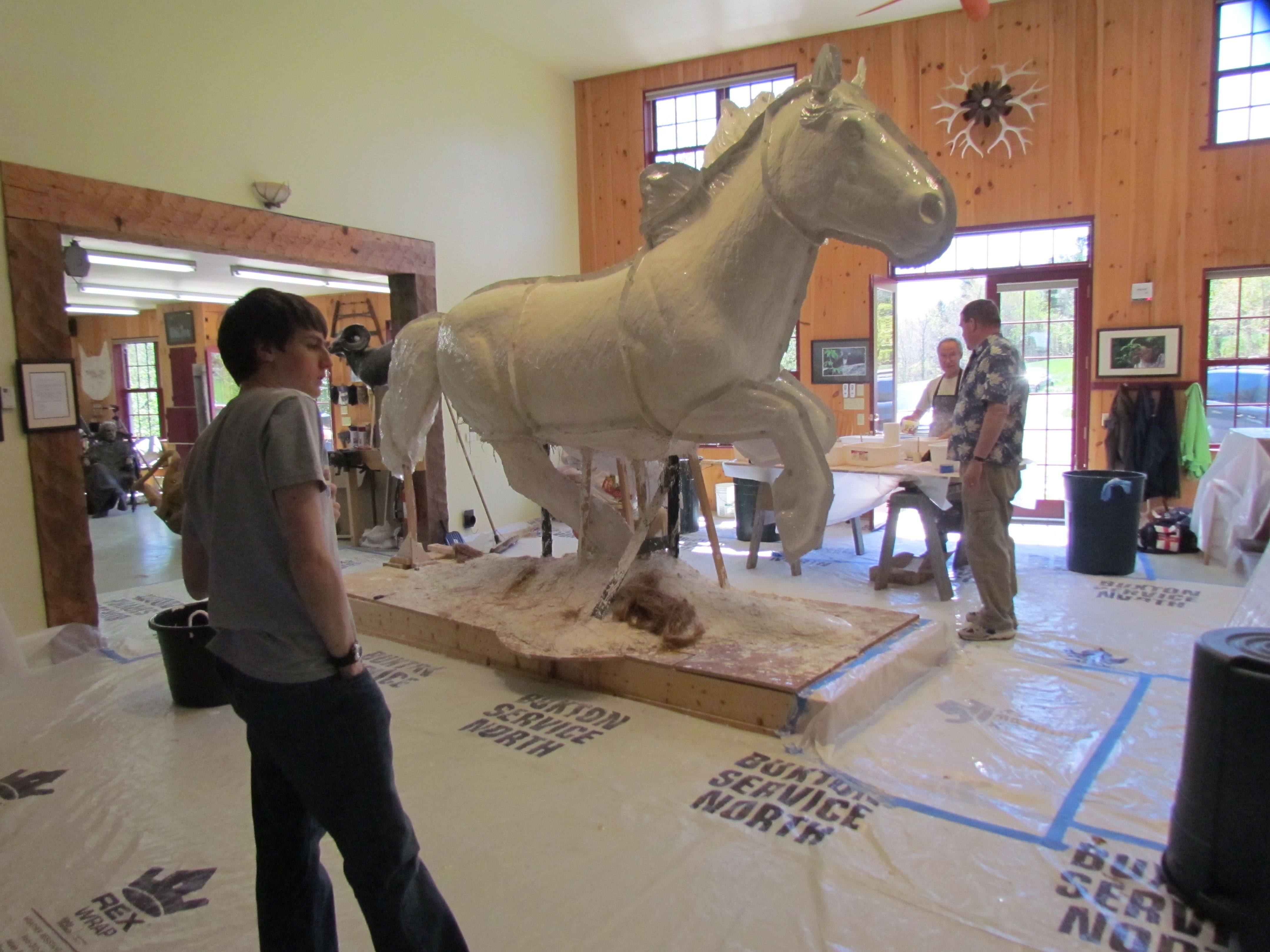

Once the Bronco is sent to the foundry in Colorado, it will take up to two months before it is returned. Not sure if the sculpture will be in place when school opens in the fall. So many factors in the final steps make it difficult to predict when the unveiling event will take place.


I have learned a great deal about sculpture and the importance of the arts in communities. Mr. and Mrs. Hart welcomed us into their studio space to be a part of something great. They understand that the sculpture experience is important to promote as education, advocacy for the arts, respect for nature and pride of community.  
From the bottom of our “H(e)arts” – THANK YOU!

Links below to other information about the sculpture and Mr. Hart.

Here is a link to the Hart’s website.
http://www.foresthart.com/workinprogress.html

This link will take you to an impressive article written about him.
http://www.angelispress.com/TMR/Issues/03dec/dec03art2.htm

Hampden Academy Students Build a New Bronco – http://www.wvii.com/stories.html?sku=20120402154045

h1

In Today’s News

May 18, 2012

Galloping bronze sculpture

Read in the Living section of the Bangor Daily News today, May 17th, about the work of sculptor Forest Hart and how he is connecting with students from Hampden Academy to create the sculpture for their new school. Article written by Robin Clifford Wood. Click here for the article.

h1

One Teacher’s Voice

December 17, 2011

Standards Based Assessment in the Arts

Leah Olson, Hampden Academy Visual Art Educator

This post was written by Leah Olson, Hampden Academy Visual Art Educator and posted on her new blog called Maine Art Education 421 Skills. It is a reflection from the webinar she participated in as a teacher leader in the Maine Arts Assessment Initiative. The webinar was on Standards Based Assessment in the Arts. You can listen to the archive of the webinar by clicking here. If you have questions about the post please contact Leah at lolson@sad22.us

Three webinar topics:

  1. Development within National Standards work
  2. Connection to Maine Learning Results
  3. Exploring Standards-Based Assessments in the Arts

The conversation revolved around three questions:

  1. What is good assessment?
  2. Why is this important?
  3.  Where can one find resources to help guide the process?

After hearing myself speak on this webinar…….I thought, “Is THAT what I sound like?!”. Anyway, here is a sample I wanted to communicate during the webinar that has worked for me in the past.

  • 1st Day -Students are given the goals of the lesson.  Students see the overall goal of a Maine Learning Result Standard in a lesson/unit and the objectives listed that help support it.
  • Students see previous student work from the same lesson.
  • Students point out the previous lesson work that resembles a 4,3,2 scale in skill.  They talk about the ‘evidence’ that supports their thoughts about a student work. Did they follow directions?  Did they demonstrate good craftsmanship?  Did they demonstrate unique ideas for the project? What work demonstrates that the student did not meet the standard and why?  What could they do to meet it?
  • Students are then given the project rubric.  When they see that the comments they made about previous student work is in writing, they feel a bit empowered.  I let them know they can add comments on the rubric that reflect their thoughts throughout the rubric.

I use checklists a lot along the way for students to check off for time management purposes and evidence of tracking work.

The rubric for a lesson should be clear to the student.  I’m not a fan of general rubrics that scale creativity in a general way.  In my opinion, it should say, “you have met the criteria of demonstrating creativity because you………..”.  How can we expect a student who is taking our art class to meet the standard when the goal and process of meeting it is so vague?

About Involving Student Centered Learning in the Assessment Process
There are many different ways teachers can include students in the process of assessment. I have always liked this quote:

“It is better to lead from behind and to put others in front, especially when you celebrate victory when nice things occur. You take the front line when there is danger. Then people will appreciate your leadership.”
Nelson Mandela

Leading from behind has been a new philosophy I attempted about 3 years ago for a variety of reasons……but that’s another post someday.

Collaboration……..
Assessment gains the most strength when

  • there is ongoing discussion about the school district’s curriculum
  • the standards are guiding force of the curriculum
  • assessments are ongoing and changing but never loses sight of the previous two points.
  • students provide evidence that fits the above statements with self reflective comments
  • teachers give feedback to a student that gives him/her choices to improve their weaknesses and acknowledges strengths

The standard is in place, you teach from a curriculum, and then you have an assessment that provides accountability of the leadership from various view points – including from a student’s perspective.  Why involve a student in the assessment?  Too much work?  Not enough time?  In my experience, the investment of this wastes less time.  Less power struggles, less discipline issues, student motivation in projects increases and quality improves.

It also means I can educate parents more about what their son or daughter is learning.  It provides more knowledge for the parent to communicate with their child about learning new things.  It provides more critical thinking skills that would allow for more involvement in their child’s education. This is powerful. As a parent, I appreciate the standards based rank card because it educates me what my children are learning.