Posts Tagged ‘Maine arts assessment initiative’

h1

Another Teacher’s Story: Patti Gordan

April 15, 2014

Raymond Elementary School music educator

This is the sixth blog post for 2014 and the third phase of the Maine Arts Assessment Initiative of this series sharing arts teachers’ stories. This series contains a set of questions to provide the opportunity for you to learn from and about others. I had the pleasure of visiting Patti’s classroom last week; grade 5 and 6 strings and kindergarten general music class. It was a wonderful morning. I was reminded of the combination of skills it takes to be an elementary music teacher. The fast pace of the class, the attention to the needs of small children, and the energy level is truly amazing. All of this with music learning at the heart!

IMG_3609Patti Gordan has been teaching for 31 years, the past 30 of those years in Raymond.  For the last four years Raymond has been part of RSU#14, Windham/Raymond, so she now also teaches in Windham. During her 31 years she has taught K-8, General Music, Chorus, Band and Orchestra.  Her present assignment is K-4 General Music, 3rd/4th Grade Chorus and 5th & 6th Grade Orchestra. Patti is teaching approximately 350 students.

What do you like best about being a music educator?

 I love watching my students’ faces light up when they are feeling the joy of expressing themselves through music.  I love their enthusiasm and their eagerness. Music means everything to me and I love sharing that with my students.

What do you believe are three keys to ANY successful visual and performing arts education?

The most important key to success is be passionate about teaching and to continually improve my craft. I am always striving to learn. The second key to success is to have “decision makers” (administration, parents, school board) who are committed to providing best practice in arts education for our students. The third key to success is to have the time and resources necessary to provide best practice.

How have you found assessment to be helpful to you in your classroom?

Before I began authentic, individual assessment of my students’ singing skills in General Music class I assumed that most of my students could match pitch in their full singing range. After all, when I listened to the class as a group it sounded pretty good. When I started assessing them individually I was shocked to discover that approximately 25% of my students were carrying the rest of the class. I started using these individual assessments to inform my instruction and also started having the students do self-assessments of their singing skills so that they could make their own plan for improvement. The percentage of students who can match pitch in their full singing range has risen to 85% by the end of 3rd grade.  I have expanded these methods to assessing their beat/rhythm skills and literacy skills as well.

What have been the benefits in becoming involved in the arts assessment initiative?

It has been very exciting to meet other arts educators with the same passion for improving their teaching and assessment methods. I have loved bouncing ideas off of the other teacher leaders and I come away with new energy and enthusiasm every time we meet.

What are you most proud of in your career?

I guess I’m most proud of always wanting to learn more about being a music teacher. I’ve never felt like I know all I need to know. If ever I’ve begun to feel that way I’ve always then gained a bit more wisdom to realize I still don’t know what I’m doing. I am also proud of helping 30+ years of students experience the joy of music. I now teach many children of former students and I am so happy when I hear those parents share fond memories of music class and when they express their happiness that I will be teaching their children.

What gets in the way of being a better teacher or doing a better job as a teacher?

I get frustrated when I hear lip service that the arts are just as important as math and ELA, that they’re “CORE,” but then are not treated as equal. The truth is that there is no way that any K-4 General Music teacher, no matter how expert, can give students a true, standards-based music education, using the Maine Learning Results or the new Common Core Standards, in 45 minutes per week.

What have you accomplished through hard work and determination that might otherwise appear at first glance to be due to “luck” or circumstances?

From 2000 to 2010 I worked with a group of teachers and administrators at my schools that were dedicated to providing quality arts education programs to students in Raymond, through sufficient class time, resources and optimal schedules.  By 2010 students had music class twice a week for 45 minutes in grades K & 1, and 5 through 8, and once a week for 45 minutes plus a 30-minute chorus rehearsal, during the school day, for grades 3 and 4, and a remedial singing class in addition to their regular 45-minute General Music class for 2nd graders who were having trouble finding their head voice or matching pitch. Sadly, since consolidation, some of that has been chipped away.

Look into your crystal ball: what advice would you give to teachers?

Keep learning! It’s the best way to stay fresh, prevent teacher burnout and give your kids the best possible experience.  Also, keep trying to make little improvements in your program. It can be overwhelming to look at your program as it is and think of what it should be. Plug away, bit by bit to improve the students’ experience and before you know it, 30 years later, your program will have grown by leaps and bounds!

If you were given a $500,000.00 to do with whatever you please, what would it be?

Too bad you can’t buy time. I’d get my masters degree, buy a bunch of small violins to give my 3rd or 4th graders a “pre-orchestra” experience, buy more puppets for General Music class (you can never have enough puppets.), buy some additional technology for the music room, pay some bills and take some trips (Scotland, Germany, camp across America).

Imagine you are 94 years old. You’re looking back. Do you have any regrets?

No. If you can’t fix it, regrets are a waste of time. Learn from the experience and don’t’ make the same mistakes again.  Make new ones.

I’ll probably be one of those little old ladies who gives music lessons and home baked cookies.


h1

Webinar Archive CC and the Arts

April 11, 2014

April’s MAAI Webinar

This post was provided by music educator Rob Westerberg.

The second of a series of four webinars for phase 3 of the Maine Arts Assessment Initiative was held on Tuesday, April 8, entitled “Common Core and The Arts”. Catherine Ring and I facilitated what ended up being a pretty full hour with guests Marcia McCaffrey, Arts Consultant at the New Hampshire Department Of Education, and Jenni Null, Fine Arts Coordinator in S.A.D. #61. The dialogue focused around three broad topics:

  1. what is the Common Core and what are it’s origins,
  2. how does it tie in to Visual and Performing Arts, and
  3. how do we confront authentic concerns and questions we have around it all?

A focal point of the webinar was a resources page on which we provided live links (those links are still live in the archived webinar, which you can access at the end of this blog post) to abundant information on the Common Core, practical connections to the Arts and yet even more links that can assist Arts teachers, informing their work at integrating Common Core. As those links were shown, we had a rich conversation that included articulating the difference between “enrichment” and authentic integration. We also spent time addressing specific concerns from the field, stating that some have been coerced into sacrificing their own work to accommodate ELA prompts and increase math achievement scores. Others have had their face time with students slashed so those students can receive remedial help in other subjects. Rather than skirt these issues, confronting them head on brought about many insights and ideas for moving forward.

It became apparent that the issues we confront here in Maine have less to do with the Common Core than practical implementation of them in local controlled school districts. In short, it is evident that the Common Core standards hold many promises for all of us in Maine, including the potential for exciting collaborative work in the Arts. But implementation of this requires much prep work and a commitment to ideals that squarely place the focus on students, not programs. Successful implementation will require “intentionality” and school leadership where a broad understanding of how the arts appropriately contribute to the Common Core is present.  There is not only a place for the Arts at the table, but the scenario exists in which we potentially play a larger role than ever before in the development of our students in the 21st Century.

As Marcia McCaffrey pointed out, the College Board has come out with a Review of Connections Between the Common Core and National Core Arts Standards Conceptual Framework and specific ways to approach alignment.  Marcia provided an overview of this research which will be posted at http://mainearts.maine.gov/Pages/Education/MAAI-Webinars in the near future.

On Wednesday, May 7, we will be holding our third webinar in which we will be discussing how the Arts are impacted by the Maine law mandating Proficiency in all subject areas – including the Arts – and what that will look like for us as we move forward. No doubt it will tie into additional Common Core topics as well as the revision of the National Core Arts Standards that will be released in early June. Please plan on joining us from 3:30 to 4:30 on that first Wednesday of May. In the meantime, you can access the archive of the April 8 webinar at http://stateofmaine.adobeconnect.com/p7qnkdt5lp2/. In the near future along with Marcia’s presentation there will be a Meeting Plan which you can use individually or with your colleagues, along with additional information on the Maine Arts Commission website at http://mainearts.maine.gov/Pages/Education/MAAI-Webinars.


h1

Another Arts Teacher’s Story: Linda McVety

April 8, 2014

 MSAD#61 Lake Region School District Music Educator

This is the fifth blog post for 2014 and the third phase of the Maine Arts Assessment Initiative of this series sharing arts teachers’ stories. This series contains a set of questions to provide the opportunity for you to learn from and about others.

IMG_3477Linda McVety is the K-5 general music and grade 3 literacy intervention teacher at MSAD #61, Laken Regiona School District. She has been teaching for 34 years and 25 in her present position at the Songo Locks Elementary in Naples. Population: 495 students.

What do you like best about being a music/art/drama/dance educator?

The best part about being an elementary music teacher is that I have the potential to reach children and give them the gift of music. When asked what I teach I always say “I teach children first.” I can have fun every day and give joy through music to children that may not have a lot of positive in their lives. I want my students to realize that they will have music throughout their lives.

What do you believe are three keys to ANY successful visual and performing arts education?

  1. Support from administration and community
  2. A teacher that believes in the importance of the arts in every child’s education
  3. A teacher who understands the way children learn and can develop his/her lessons and assessments to reach most of her students.

How have you found assessment to be helpful to you in your classroom?

  1. It helps to keep me organized and focused on the goals that I want to accomplish at each grade level
  2. Rubrics help me empower my students to take ownership of their learning

What have been the benefits in becoming involved in the Maine Arts Assessment Initiative?

Sharing and communicating with arts colleagues has been invaluable. I have been able to see what programs are around the State of Maine and have a give/take relationship with my colleagues.

What are you most proud of in your career?

Watching students have that “aha” moment-that says “I love this music” or “I understand this music”. Showing my students my love for playing the cello.

What gets in the way of being a better teacher or doing a better job as a teacher?

  1. All of the extra duties
  2. Attitudes of people who only think of the arts as a “prep” time and not as a valuable part of the educational community
  3. No enough time to plan and put valuable lessons together

What have you accomplished through hard work and determination that might otherwise appear at first glance to be due to “luck” or circumstances?

Having 3 wonderful and successful sons is my #1 accomplishment!

Students that come to school because they love music class.

Look into your crystal ball: what advice would you give to teachers?

  1. Learn discipline techniques but find a way to have fun
  2. Learn and practice collaborating with classroom teachers-find the time to communicate with them
  3. Find another arts colleague to bounce off ideas with and design lessons with-don’t keep yourself in isolation
  4. Go to workshops created by other arts educators-never stop learning

 If you were given a $500,000.00 to do with whatever you please, what would it be?

 I would take a few students around the world to see music, art and dance in different cultures.

 I would buy instruments for students who could not afford them.

 Imagine you are 94 years old. You’re looking back. Do you have any regrets?

Sometimes I forgot to use music as my own saving grace and distressing mechanism. I don’t regret anything in raising my wonderful sons and giving them great educational opportunities, however I do regret not traveling to see more of the world.


h1

Common Core and the Arts Webinar

April 7, 2014

Maine Arts Assessment Initiative Webinar to be held – April 8

Rob Westerberg and Catherine Ring will be hosting their second webinar in a series of four for 2014 as part of the Maine Arts Assessment Initiative (MAAI).  The webinar entitled Common Core and the Arts will take place on Tuesday, April 8, 2014 from 3:30 – 4:30.  Primary discussions will be based around:

  • Clarification of Common Core, it’s origins and implementation
  • Connections to Visual And Performing Arts
  • Ramifications for our programs

The overarching goals of this webinar will be to demystify the Common Core as it pertains to Arts programs in Maine. Strategies for linking with it as well as strategies for maintaining and building on our capacity to reach our own students in our own subject areas will be discussed as well.

Guests will include ….

Marcia McCaffrey, Arts Consultant from the New Hampshire Department of Education and Jenni Null, Fine Arts Coordinator, School Administrative District #61 (Lake Region School District: Bridgton, Casco, Naples, Sebago). The duo will provide valuable ideas, information and food for thought!

IMG_0012

Marcia McCaffrey

Jenni Null

Jenni Null

To join the meeting, go online to http://stateofmaine.adobeconnect.com/maaiapril2014/. Please click here for more information about other webinars and the Maine Arts Assessment Initiative. For best success please join the system 10 minutes early to make sure you can hear, and use a hard-wire connection (not wireless).

Please be sure to join for what promises to be an engaging, insightful hour on the topic that will continue to impact every one of us as arts educators in the state of Maine! One contact hour is available for participating. If you miss the session live it will be archived afterwards for your viewing. Please watch the blog for the link to it.

Screen shot 2014-04-04 at 12.20.10 PM

Rob Westerberg and Catherine Ring

Maine Arts Assessment Initiative, an initiative of the Maine Arts Commission and the Maine Department of Education, with partners: ACTEM (Association of Computer Technology Educators of Maine), District 3 Music Educators, MAAE (Maine Alliance for Arts Education), MAEA (Maine Art Education Association), MECA (Maine College of Art), MMEA (Maine Music Educators Association), MLTI (Maine Learning Technology Initiative), New England Institute for Teacher Education, and USM (University of Southern Maine).


h1

Another Arts Teacher’s Story: Suzanne Goulet

April 1, 2014

Waterville Senior High School visual arts teacher

This is the fourth blog post for 2014 and the third phase of the Maine Arts Assessment Initiative of this series sharing arts teachers’ stories. This series contains a set of questions to provide the opportunity for you to learn from and about others.

A Visual Art Educator at Waterville Senior High School, her business card reads, “Suzanne Goulet. Art – Traditional, Digital and Emerging Media.” In 1990, after hiking the Appalachian Trail and managing a small ski area, she thought that it was time to begin teaching. In those 24 years she has taught and created classes of all levels; Introductory to AP.

A registered Maine Guide, Suzanne enjoys sharing her love of the outdoors with her students by advising the Outing Club and is a volunteer sign maker with the Maine Appalachian Trail Club and the International Appalachian Trail Club Chapter. She is currently lucky enough to have an eagle’s nest in view of her classroom studio and is eagerly awaiting this year’s clutch.

What do you like about being a visual art educator?

I remember someone telling me that an engineer’s job is different all the time; that it changes every day; and are presented with new problems to solve constantly. Educating has the same benefit. There are no recipes that will be successful with all students, so one must craft an approach and deliver. Lots of medias to explore and creations to be made – before you made it…. it did not exist.

What do you believe are three keys to ANY successful visual And performing arts education?

  1. Trust – Essential between students and teacher. Creating and performing are personal and strategies for accepting criticism can be taught and nurtured.
  2. Understanding – The Arts have different goals (and benefits) that are a bit more complicated to measure achievement and require patience from students, teachers, administrators and the community.
  3. Quality – A continued quest to perform at a high level and to always be learning and seeking.

How have you found assessment to be helpful to you in your classroom?

Assessing is all about taking stock; figuring out where you are and then making a plan for where you want to go and how to get there. Striving for a culture of self-starters with initiative and the confidence to ask for help and collaborate, I have found quality assessments are great ways to scaffold students to meet these goals (which sometimes are shifted).

What have been the benefits in becoming involved in the arts assessment initiative?

Have been provided the opportunity to meet and work closely with colleagues that are striving for quality – personal and statewide. My perspective of our rural state with lots of nooks and crannies is now transformed to a layout of creativity and excellence.

What are you most proud of in your career?

How divergent the careers and paths of my students are: Industrial designers, film makers, public relations experts, attorneys, environmental engineers, botanists, ornithologists and parents…of children that I am now teaching!  Usually the above statement is enough, but I have been blessed with having some pretty amazing teachers throughout my own learning experience. Honoring these educators, remembering what they did for us – for me – by striving to do the same for my students is a goal I strive for…to make a difference.

A number of years ago, Waterville SHS started a Renaissance Award program to recognize student achievement and growth. At the end of the first year, an inaugural educator award was given…I was truly surprised to be the first recipient. The greatest honor of that award is that the nomination came from a very quiet student that took the time to let others know that she truly appreciated the work that we do. It was at that moment that I realized the overwhelming power of quality relationships…and the legacy to my teachers.

What gets in the way of being a better teacher or doing a better job as a teacher?

            The need for sleep.

Seriously, there is always something more that can be done. Instruction, curricular and support services are best when unique for each student…and requires time…and the need for sleep gets in the way.

What have you accomplished through hard work and determination that might otherwise appear at first glance to be due to “luck” or circumstances?

Envisioning, imagining and striving for quality. Building strong foundations takes time and a lot of calculus is employed to improve the timing of converging forces.  Here is one of my favorite movie quotes to help illustrate, (From Star Trek (2009))

Scotty: [back to Spock Prime] The notion of transwarp beaming is like trying to hit a bullet with a smaller bullet wearing a blindfold whilst riding a horse.

Everything is possible…..want something to happen…..just tell me that it is not possible (does this make me sound stubborn…..or optimistic?)

Look into your crystal ball: What advice would you give to teachers?

You don’t have to be a “Teacher Leader” to be a Teacher Leader. A rose by any other name…….

Take the time to develop quality relationships with your students. Consider a three minute “talk in the hall”, a random can of “Moxie” or nominating and taking the time to recognize quality in students – academic and personal.

If you were given $500,000.00 to do with whatever you please, what would it be?

Education – I have five nieces filled with wonder and energy and have always dreamed of a school (education) experience on a bus (even got my Class B license for this). Drive west to study the history of US expansion and its’ impacts, calculate travel approximations, recreate with region specific adventure, enjoy cultural music, play, write, write, draw, draw, photograph and dance. Would love to do this with students and nieces!

Nurturing a Spark – Some know that I “go west” each summer for rejuvenating wanderings. I have challenged former students to find me….the award is a dinner of their choosing – none have yet succeeded….though three came close (less than one mile away) in a remote section of Montana……would use the funds to offer a week in a remote lodge with ranch cooking!

Creating the Space – An addition to my current studio classroom. About 30 feet out….three stories high (so my upstairs colleagues could look down in to our atrium). Did I mention that the roof would be a clear dome so we can watch the eagles? An integrated ramp would be a part of the space so that all students would have access to the fruit tree that is also growing here. If this could not happen….then I would settle for a direct door to the outside in my current studio classroom…a nice set of French doors!

Time Travel – How much is a helicopter?…..this would give me more time (here’s the sleep thing again). Quick trips to Lewiston and Smithfield. Love it!

            Space Travel – Yeah…I’d go.

Imagine you are 94 years old. You’re looking back. Do you have any regrets?

No big ones……just little ones. Still have lots of plans and dreams. Continuing to suck the marrow out of life – why wait?

h1

Another Arts Teacher’s Story: Beth Lambert

March 24, 2014

Carrabec High School Performing Arts Teacher

This is the third post for 2014 and phase three of the Maine Arts Assessment Initiative of this series sharing arts teacher’s stories. These blog posts contain a set of questions to provide the opportunity for you to learn from others.

imageBeth Lambert teaches about 100 students in grades 7 and 8 Unified Arts and grades 9-12 Performing Arts in MSAD #74, Carrabec. This is her second year teaching at this school district.

What do you like best about being a performing arts teacher?

The best part about being a theater educator is challenging my students’ perceptions about their world and about themselves. I get to provide them with an outlet for emotions, thoughts, and dreams that they might not otherwise have means to express. In my class, a student can become another, explore a new role, try out and experiment with various personal choices and solutions to very real problems- problems from their own life, or problems faced by characters in literature or historical figures, in a safe environment.

What do you believe are three keys to ANY successful visual and performing arts education?

  1. Support from administration and community.
  2. A teacher who understands the importance of making and maintaining authentic connections with his/her students.
  3. A teacher who can make the art real for the students- someone who understands what her community needs and offers art as a means to make life richer.

How have you found assessment to be helpful to you in your classroom?

Clear rubrics take the guess-work, and often, much of the fear, out of performing for a grade. Students know exactly what they are expected to be able to do and when they are ready to show me that they can do it, they are assessed. Students are in more control of their own learning and success.

What have been the benefits in becoming involved in the Maine Arts Assessment Initiative?

Without a doubt, the greatest benefit has been getting to know, work with, and learn from such an able group of arts educators.

Additionally, it is has allowed me the opportunity to do targeted work on my classroom from an arts educator’s perspective.

What are you most proud of in your career?

My students.

What gets in the way of being a better teacher or doing a better job as a teacher?

All the non-teaching stuff that teachers must do takes them away from teaching and becoming better teachers. Also, ourselves- sometimes we get in our own way.

What have you accomplished through hard work and determination that might otherwise appear at first glance to be due to “luck” or circumstances?

Everything.

Look into your crystal ball: what advice would you give to teachers?

Always remember that we are here for the students- make your choices based on what is best for them and do right by them. The rest with fall into place.

If you were given a $500,000.00 to do with whatever you please, what would it be?

I would build my students the performing space they deserve and would set up scholarship programs so that I never again have to see a child’s dream fade because they couldn’t pay.

Imagine you are 94 years old. You’re looking back. Do you have any regrets?

No. Every road, no matter how broken, crooked, or difficult, has brought me to where I am today and I wouldn’t want to be anywhere else!


h1

Workshop at MECA

March 23, 2014

Maine College of Art, Portland

EVite-AmyCousins_final

h1

Another Teacher’s Story: Judy Fricke

March 18, 2014

Featuring one teacher’s journey as an arts educator

This is the second blog post for 2014 and the third phase of the Maine Arts Assessment Initiative of this  series of blog posts telling arts teachers’ stories. This series contains a set of questions to provide the opportunity for you to read the stories and to learn from others.

DSCN0239Judy S. Fricke is an Early Childhood (EC) Music Specialist at the Main Street Music Studios in Bangor, Maine. Judy has been an EC Music Educator for twenty years, first in Collierville, TN and for the last four years in Bangor. In those twenty years she has had opportunities to work with children ages one month through five years in parent/child class settings and with children one year to five years old in a large preschool of 350 students. At Main Street Music Studios in Bangor she has 23 students who attend age-bracketed classes with a caregiver. She uses John Feierabend’s First Steps in Music curriculum as the basis for all of her classes since studying with him 19 years ago.

What do you like best about being a music educator?

While working with our youngest learners, I will never tire of watching the “light bulb” gleam in their eyes as they feel the rhythm in bounces or anticipate the tickle at the end of a tickle rhyme. I will never lose the joy in watching a one year old gain control of his or her arm muscles and begin to play a drum with a steady beat, or of listening to a three year old gain control of his or her voice muscles and begin to “echo sing” dead on pitch. I also will never get tired of watching the confidence grow in the parents of these children as they learn how to interact musically with their little ones.

What do you believe are three keys to ANY successful visual and performing arts education?

The three keys I would consider highest on my list for a successful arts program would be:

  1. Unbridled passion for what you teach
  2. A safe, exciting, and encouraging environment in which to teach
  3. A wicked good sense of both humor and humility

How have you found assessment to be helpful to you in your classroom?

As an independent instructor of the very young, formal assessment is not part of my program. Yet, informal assessment has been part of my day to day lesson planning since the beginning. By tweaking my planning based on the specific ages of my students I am able to deliver developmentally appropriate activities for various physical, mental, and attention levels.

What have been the benefits in becoming involved in the arts assessment initiative?

The MAAI has given me the opportunity to meet and interplay with arts teachers and early childhood educators from around the state. I am sure I would never have had that opportunity on my own. Thank you Argy for this gift.  MAAI has made me much more aware of my place, or lack there of, in the incredibly complex world of arts education in the state. I have felt more connected, as well as more alone, in the last year as I worked beside fellow educators. We need more early childhood arts folks involved in MAAI. I need collaborators on my level so that the important work of laying the foundations for the K-12 programs does not feel as much as an afterthought, but more of the beginning of something wonderful.

What are you most proud of in your career?

I was teaching in Tennessee long enough to see children that I had in preschool excel in high school music programs and continue on to study music in college. I cannot take complete credit for these achievements, but when I would see them as young adults and they would raise and lower their arms while making a slide whistle sound, I know I had made an impression. A good impression can bring an exceeding sense of pride.

What gets in the way of being a better teacher or doing a better job as a teacher?

I teach in a lovely old downtown building. The other teachers with whom I work have private studio rooms for private lessons. I teach in the lobby because it is the only space large enough for my classes. Therefore, we have folks walking through the classes, stopping to ask questions, and opening and closing the door to let in very cold air. These physical issues often get in the way of my teaching, but trying to handle it in stride and continue to love what I do makes up for it. The people I work with are professional musicians and teachers and are so supportive of my program, I know I am a better teacher because I am there.

What have you accomplished through hard work and determination that might otherwise appear at first glance to be due to “luck” or circumstances?

I believe finding Main Street Music Studios on-line from Tennessee was a brilliant stroke of luck! I was just looking for any kind of employment in the downtown area so that I could walk to work once we moved to Bangor. Yes, having the 16 years of experience to bring with my proposal for the early childhood program here helped, but the fact that Bangor had the Studio for me to be a part of was definitely luck!

Look into your crystal ball: what advice would you give to teachers?

I believe the word I would most like to share with fellow teachers is “collaborate”. If you are a K-6 teacher, and you have a PreK program in your school, find out what you can do with the EC teachers to help them with their goals for the arts – in doing so, you are only enhancing your programs. Same goes for high school teachers – work with your middle school counterparts. Middle school folks work with your elementary counterparts. In doing so, everyone will be working toward the same ultimate goal – that of giving every student the best arts experiences possible in a way that makes sense to both the programs and the students.

If you were given a $500,000.00 to do with whatever you please, what would it be?

If I were given $500,000.00 to do with as I please, I would make an endowment to the University of Maine Systems for the purpose of creating an Early Childhood Music Education program and a Music Therapy program. Then I would ask to teach in the Early Childhood program and I would take classes in the Music Therapy program.

Imagine you are 94 years old. You’re looking back. Do you have any regrets?

If I have the fortune to live until I am 94, I hope I am still able to bounce little ones on my knee and sing soft lullabies to them when they are tired. If I can do this, I will not have any regrets.

Well, I might regret that I never got that $500,000. And so might a lot of very young children.

h1

hART rocks Professional Development

March 12, 2014

Hancock county art teachers gather for professional development opportunity – March 28ARTatheCORE copy

h1

Mega-regional Workshop at USM

March 11, 2014

March 7 – in Lisa Ingraham’s words…

On Friday I attended the Maine Arts Assessment Initiative (MAAI) Mega-Regional workshop at USM, this time as a participant rather than a teacher leader. I got to take it all in without a focus on preparing for my own workshop. I met many arts educators I haven’t had the opportunity to spend time with before, quite a few with a similar elementary visual arts background. And I finally got to attend other teacher leaders’ workshops that I have been dying to see since first hearing about them at last summer’s MAAI Institute!

100_3195

MAAI teacher leaders Amy Cousins, Jennie Driscoll, Brian McPherson

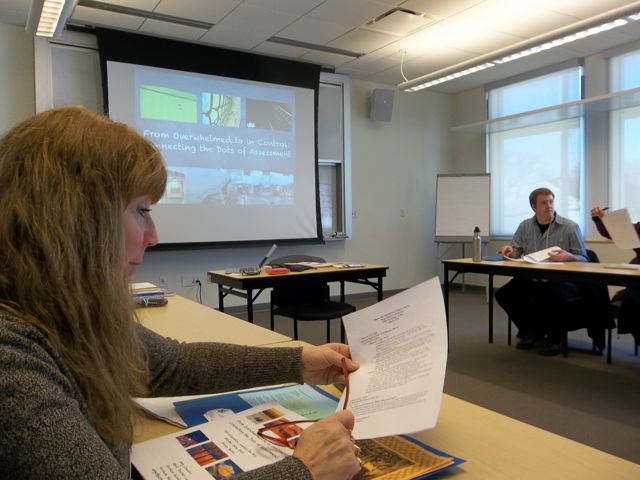
There were a couple of big take-aways from the day for me. The first was as a result of Amy Cousins’ workshop “From Overwhelmed to in Control: Power Standards Help Connect the Dots”. Before the session was over I began mentally planning for when I could really dive into power standards (most likely this summer), and I realized that while I have done a substantial amount of work around the what, why, and how of assessment since the MAAI Institute, it is an ongoing process. While “ta das!” regarding student learning should be celebrated, as a life-long learner I then look toward the next step. Thanks Amy for showing me the next step!

My second take-away was as a result of another participant’s comment that when she thinks about her curriculum, she considers what she would like her students to know and be able to do as adults. This changed my view of the art curriculum from the five years I get to spend with them from kindergarten through grade four and extended it ahead into the future. It left me with the question, “What kind of relationship would I like my students to have with the visual arts as grown-ups?”

100_3166Time with visual and performing arts teachers is always creatively well spent. The day was filled with questions and answers both small and large. I look forward to the Mega-Regional workshop April 11th at the University of Maine, Orono!

THANK YOU Madison Elementary School and Maine Arts Assessment Initiative teacher leader Lisa Ingraham for contributing to the Maine Arts Education blog!

For more information and to register for the April 11 workshop at UMaine, Orono please go to http://mainearts.maine.gov/Pages/Education/MAAI-Mega-Regionals-Orono#orono