Posts Tagged ‘Maine arts education’

h1

Maine International Conference on the Arts

June 6, 2018

USM – September 27, 2018

THIRD BIENNIAL MAINE INTERNATIONAL CONFERENCE ON THE ARTS

Join the Maine Arts Commission at the University of Southern Maine Portland Abromson Community Education Center, where we will explore art making, arts education, capacity-building strategies and skills, and more – all specifically for Maine artists, arts educators, and arts organizations.

Please join us Thursday, September 27 at USM in Portland for the opening reception with entertainment at 5 p.m., followed by Maryo Gard Ewell’s 7 p.m. keynote.

Schedule and Early Bird registration

Thursday, September 27 | 10 a.m. – 7 p.m. 

      • Pre-conference Sessions – Discussions on Rural Community Development, professional development for Arts Educators, and Maine craft and traditional art apprenticeships  
      • 5 p.m. to 7 p.m. – Opening Reception: A celebration of the arts with keynote speaker and performances
      • Keynote Speaker Maryo Gard Ewell– Rural Community Development in and Through the Arts

Friday, September 28 | 7:30 a.m. – 5 p.m. 

      • 7:30 a.m. – Continental Breakfast/Networking
      • 8:15 a.m. – Maine Artists Idea Lab : 6 speakers using the fast-paced and engaging pecha kucha-style format will knock your socks off with their newest innovations. Confirmed speakers include Lucas Richman, Music Director, Bangor Symphony Orchestra; Rene Johnson, Executive Director, Theater Ensemble of Color; Erin McGee Ferrell, Visual Artist; Kaitlyn Young, 2018 Maine Teacher of the Year; Jeremy Frey, Passamaquoddy basketweaver;
      • 9:30 a.m. to 4:30 p.m. – 20 professional development sessions in 5 tracks running concurrently
        • Leveraging Investment. Learn to attract and leverage greater investment through corporate sponsorships, development planning, capitalization and more
        • Visibility. Discuss ways to increase awareness of creative opportunities, as well as their value to communities and local economies. Participate in a new, two-part workshop by MICA 2016 superstar Matt Lehrman, “Opportunity Everywhere, Parts I & II. Or attend a dynamic session hosted by DataArts/The Cultural Data Project on ways to connect your data to stories about your mission and impact, for more effective communications with key stakeholders
        • Arts Education. Participate in sessions on fostering PK-12 arts education and lifelong learning programs, including Creative Aging and Traditional Arts
        • Cultural Tourism. Gather the information you need to enhance experiences and leverage cultural tourism. Hear from organizations on their successes creating experiences outside of traditional venues, or attend a Rural Community Arts Development session facilitated by Maryo Gard Ewell.
        • Building Capacity. All you need to know on strategies for sustainability and increased impact, from an intensive on strategic planning with Julie Richard to a session on The Role of the Arts in Communities in Crisis.
      • 12:30 p.m. – Maine Arts Awards Luncheon hosted by ArtsEngageMe
      • Pop-up performances throughout the day
h1

Marshwood Middle School

June 4, 2018

Performing tomorrow

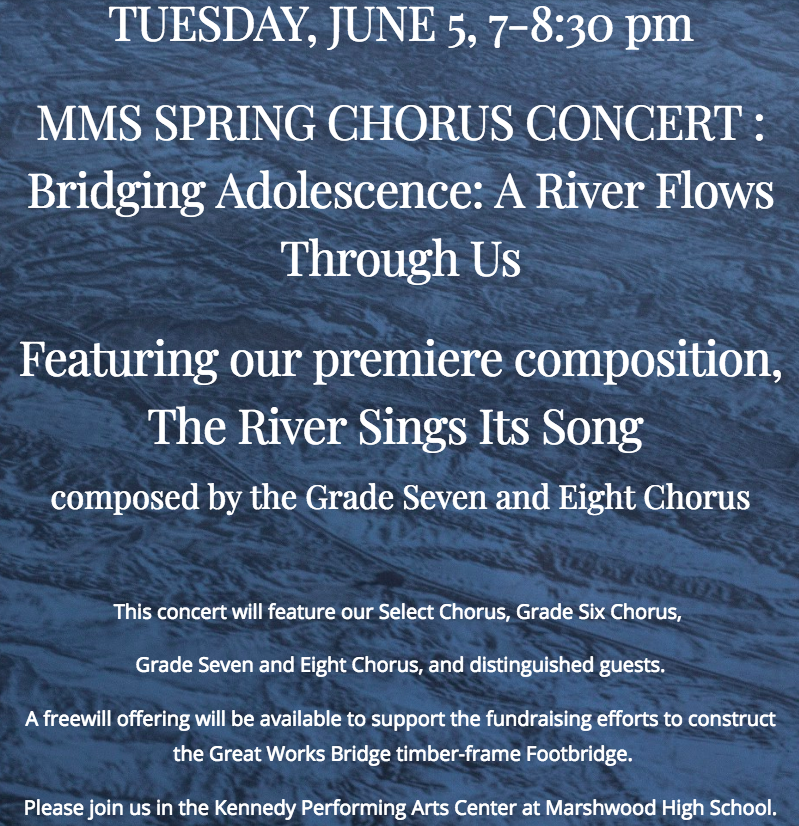
Maine Arts Leadership Initiative participants, teacher leader Kris Bisson and teaching artist leader Brian Evans-Jones have collaborated on a project that will be premiered tomorrow night, June 5 at Marshwood Middle School.

The premiere performance of “The River Sings its Song”, funded by the Marshwood Education Foundation will take place on Tuesday, June 5, from 7:00 – 8:30 p.m.
Marshwood Middle School’s seventy-six member chorus has worked the entire school year to research, discover, and collaborate to create a unique curriculum-based study of our local community through the Great Works River and Bridge in South Berwick, Maine. The students worked with artist-in-residence, Brian Evans-Jones, to create their thoughts and then with their Choral Director, Kristine Bisson, to take their words and compose an original piece of music to be sung by the Grade Seven and Eight Marshwood Middle School Chorus.
The students are donating $200.00 from their annual Middle School Talent Show to the Great Works Bridge Brigade to help support the fundraising efforts of the Brigade to build a timber-frame footbridge where the bridge once was accessible. They will be presenting the check to members of the Brigade this Tuesday evening at the concert.
h1

MALI Teacher Leader Story: Dorie Tripp

May 29, 2018

Music Educator 

This is one of several blog posts in 2018 that include stories of the Maine Arts Leadership Initiative (MALI) Phase 7 Teacher Leaders and Teaching Artist Leaders. This series includes a set of questions so you can learn a little bit about each leader. CLICK HERE  for more information on MALI. CLICK HERE  for more information on the 93 Teacher Leaders and 8 Teaching Artist Leaders. CLICK HERE  for Arts education resources. CLICK HERE  for the MALI Resource Bank. Search in the “search archives” box on the bottom right side of this post for past teacher leader stories. Thank you Dorie for sharing your story!

Dorie Tripp is a National Board Certified Teacher in Early/Middle Childhood Music. For the last nine years she has taught PK-5 general music and beginner band in RSU #38, (Maranacook Schools). She splits her time between Manchester and Readfield Elementary Schools where she teaches approximately 400 young students each week.

What do you like best about being a music educator?

The great thing about being a music teacher, is having the privilege to watch my students develop over time, and create a love for music that will last them a lifetime. I have the pleasure of teaching my students year after year, for as many as seven years. I love that I get to help plant the seeds for love and success in the performing arts. It gives me so much pride when I see my students in Middle or High School concerts, musicals, and festivals. Watching my students shine, find their voice, feel accepted, or even find a passion is what keeps me going.

What do you believe are three keys to ANY successful visual and performing arts education?

There are so many aspects to a successful performing arts education, which makes it difficult to pinpoint any one thing. As we all know, educational strategies and practices aren’t “one size fits all” and what works for one school community may not be appropriate for another. I know this from experience, as in the last nine years of my career I have worked in two very different communities. One being a large, urban school district with challenges like over-crowded schools, homelessness and poverty, and overcoming language barriers (to name a few). The other a small, rural district, small class sizes, and a high level of community involvement. Both do a tremendous job to address challenges and celebrate successes every day, but often in very different ways. If I had to choose three overarching themes, however, I could easily name community, collaboration, and advocacy.
Dorie presenting at the MALI Mega conference, Oxford Hills, March 2018

How have you found assessment to be helpful to you in your classroom?

I have found assessment to be helpful as an informative teaching tool. The moment I shifted my thinking in using assessment solely to “grade” my student’s achievement to tracking student growth, my practice has become much more effective. I use formative assessment every day in my classroom to understand what my students are learning, to solve problems, and provide more practice with the skills embedded in our curriculum. I use assessment data to differentiate my instruction to the needs of my students, guide my unit plans, and adjust my pacing. I have absolutely gained a more focused picture of my students, and how they learn as individuals.

What have been the benefits in becoming involved in the Maine Arts Leadership initiative?

I started with the Maine Arts Leadership initiative as a music teacher just looking for quality professional development (PD). I have always had great luck with workshops at Maine All-State Festival, but I wanted PD that I could attend earlier on in the school year. I found myself at a MALI mega conference, and was not disappointed! I was able to network with other local teachers, while taking away information and strategies that I could apply in my classroom right away, before the end of the school year.

After that, I became curious about the Teacher Leadership Initiative, and filled out an application for Phase 7. When submitting my application, I had no idea how much growth I would make as an educator in just one year. The support I received from MALI has been incredible. I was able to create a personalized plan of action, which included sharing my elementary teaching practices with others in a workshop, and saw it come to life. Through this process, I have found a network of supportive colleagues who inspire me to contribute all I can to the profession. For me, personally, the greatest benefit is that I have found my voice, and have been empowered to use it.
What are you most proud of in your career?

I am most proud of my students. Although I have been in this profession for nine years, I am still humbled by my students. They grow, and learn, and change into these amazing human beings with talents and ideas that just blow me away. It’s really nice to realize that you’ve had a role in that, even if just a very small one.

What gets in the way of being a better teacher or doing a better job as a teacher?

The more obvious things that get in the way of doing a better job or being a better teacher is time and money. I feel like all educators, no matter the content area, can relate. The less obvious thing that gets in the way is the lack of collaboration or idea sharing with other educators. It’s easy to stay inside our own little bubble, and never open ourselves to other ideas or partnerships. I believe that reflective practice is best when it’s combined with observations and mentorships with other great teachers. This is often difficult to practice as arts educators, however, because even if we want to branch out and team up with/learn from others, so many of us would have to go outside our school or district. Not all of us have other colleagues in our buildings who do what we do. This is why organizations like MALI are so beneficial. We need the time and resources to get together with other educators to share ideas, network, and work together on projects that can/will help us do our jobs better.

What have you accomplished through hard work and determination that might otherwise appear at first glance to be due to “luck” or circumstances?

As you can probably tell, I am a big fan of educator collaboration and support. I try to team up and work with others, in and outside the arts, whenever I get a chance. During my concerts each year, the majority of my school staff come back and volunteer their time to help me with set up, the shuffle of students, and tear down. I always hear “You’re so lucky to have such supportive parents, colleagues, and administrators”. Yes, it’s true that I am lucky, but I also work really hard for this fortune. I strive to maintain positive work relationships with my colleagues. I volunteer to help out with other events that are not music related. I try to stay flexible and understanding when other school activities disrupt my schedule, just like my events sometimes disrupt others. I share activities and materials with other classrooms, collaborate on cross-curricular activities, and volunteer to cover a duty now and again. I even give private saxophone lessons to our evening custodian once a week, as a small token of thanks for all the extra work he puts in setting up and tearing down equipment for our six performances each year.  All of this is extra work, but I understand that without this collaborative environment, I am just one person, and would not be able to complete all of my tasks alone. All of this is in the best interest of my students, and ultimately my program.

Look into your crystal ball: what advice would you give to teachers?

I would say, don’t get too caught up on standards and assessments. They are important factors of what we do, but they aren’t everything. They are just tools we use to see and reach the big picture goals. Listen to your students, and don’t be afraid to make learning fun. Make it feel good for students, and they will develop a life-long love for music.

If you were given a $500,000.00 to do with whatever you please, what would it be?

After paying off some school debt (I know I’m not alone here…), I would definitely use it to help students access music. I would purchase instruments and pay enrollment fees for students to participate in music festivals, camps and programs. My family went through great hardships when I was growing up, and I was fortunate to have a music teacher who made sure that those financial troubles would not interfere with my musical potential. I am so grateful for her, and others who made it happen. Without them, I would not be the music educator that I am today.

Imagine you are 94 years old. You’re looking back. Do you have any regrets?

I try not to have regrets. All things that have happened in my life were for learning purposes. However, I hope that I won’t look back and worry that I spent too much time working about professional evaluations and certification requirements, and that I can say I always worked hard to give my students what they deserve.

 

h1

Teaching Artist Professional Development

May 28, 2018

MAC offers workshop June 22

Teaching Artists Brian Evans-Jones, Karen Brooks, Tim Christensen, and Dana Legawiec

PreK-12 Teaching Artist Professional Development Workshop

The Maine Arts Commission (MAC) invites Teaching Artists to a one day professional development opportunity on Friday, June 22, 2018, 8:45 a.m. – 3:30 p.m. The workshop will take place at Viles Mansion/Governor Samuel Cony House, 71 Stone Street, Augusta. The cost is $25.00 and the workshop is limited to 20. REGISTRATION is available.

Whether you are a veteran teaching artist looking to build on your practices and expand your reach in the PK through grade 12 environment, or a new teaching artist looking to be included on the Teaching Artist Roster and start working in the schools or community arts programs – this workshop is for you!

PURPOSE

Teaching Artists Tim Christensen, Tom Luther, Brian Evans-Jones

The workshop is focused on the role and benefits of a teaching artist. We will address how to structure and market a residency as well as tips for communicating and collaborating with educators (including teachers and administrators), and community arts representatives.

OUTCOMES

  • Information on applying your expertise as an artist to the structuring of your lessons and residencies.
  • Hands-on experience in relating the learning standards and assessments to your work.
  • Participation in sessions that are planned to fit your needs as a teaching artist.
  • Promoting yourself and your work as a teaching artist.

WORKSHOP FACILITATORS

  • Argy Nestor – Director of Arts Education, Maine Arts Commission
  • Brian Evans-Jones – Poet and Creative Writing Teacher and Maine Arts Leadership Initiative (MALI) Teaching Artist Leader
  • John Morris – Teaching Artist/Dance Educator, member of MALI Design Team
  • Kate Smith – Pre-K-3 Music Educator Central Elementary School, So. Berwick, member of MALI Design Team
  • Kris Bisson – Grades 6-8 Music Educator Marshwood Middle School, MALI Teacher Leader

John Morris

Learn more about the MAC Teaching Artist programand visit the Teaching Artist roster.

5.5 teacher contact hours are available for attending all day on June 22.

NOTE: In order to apply for the MAC Teaching Artist Roster, artists are required to attend the workshop on June 22. The Commission will be accepting applications for the roster in the fall of 2018.

If you have any questions please contact Argy Nestor at argy.nestor@maine.gov.

If you need a special accommodation to fully participate in this event please contact Kathy Shaw at kathy.shaw@maine.gov by June 8.

h1

MALI Teacher Leader Story: Danielle Sullivan

May 22, 2018

Music Educator

This is the one of several blog posts in 2018 that include stories of the Maine Arts Leadership Initiative (MALI) Phase 7 Teacher Leaders and Teaching Artist Leaders. This series includes a set of questions so you can learn a little bit about each leader. CLICK HERE for more information on MALI. CLICK HERE for more information on the 93 Teacher Leaders and 8 Teaching Artist Leaders. CLICK HERE for Arts education resources. CLICK HERE for the MALI Resource Bank. Search in the “search archives” box on the bottom right side of this post for past teacher leader stories. Thank you Danielle for sharing your story!

Danielle Sullivan teaches music, band and chorus at Etna-Dixmont School. This is her second year at the school and her 8th year teaching. Danielle teaches general music PreK-6th Grade, 4th grade band, 5-6 grade band, 7-8 grade band, 5-6 grade chorus, 7-8 grade chorus and jazz band.  There are about 230 students in the school.

What do you like best about being a music educator?

I love seeing students do something they thought was impossible.  At the beginning of the year they believe that there is no way they’ll be able to play/sing this song and by the end of the year (quarter, semester…) they’re able to. It’s wonderful to watch.

What do you believe are three keys to ANY successful visual and performing arts education?

  1. Administrative and community support are huge. Without support you’re always fighting for what’s right.
  2. Teachers who care
  3. Students who want to learn

How have you found assessment to be helpful to you in your classroom? 

I love hearing students play and sing alone. The student and I learn so much about their ability when they play alone. Quiet and shy students who either need more support or other opportunities can be lost in a large group if they never sing/play alone.

What have been the benefits in becoming involved in the Maine Arts Leadership initiative?

I love all the new people I have met and the ideas we share.

What are you most proud of in your career?

I am most proud of teaching young students to love music. If you can get them young then you have them for life. Being able to teach young children to love music is of the utmost importance to me.

What gets in the way of being a better teacher or doing a better job as a teacher?

All the other duties that aren’t teaching; paperwork, curriculum work, meetings, emails. Doing all these other things makes it harder for me to find time to do research new lesson ideas and work with colleagues.

What have you accomplished through hard work and determination that might otherwise appear at first glance to be due to “luck” or circumstances?

Having older students who consider themselves ‘musicians’.  All of the students that come through the music room door are musicians. When they are young (as is the case at my school) they don’t have a choice; everyone has music class.  But as they get older (middle school and high school) they are no longer required to take music, band and chorus are optional. Having a strong music program with a lot of older students may seem like luck, but if you get students to consider themselves musicians then they will seek out music when it’s no longer obligatory.

Look into your crystal ball: what advice would you give to teachers?

Don’t be a workaholic! It doesn’t benefit you or the students!

If you were given a $500,000.00 to do with whatever you please, what would it be?

For school, I would buy enough instruments so that any student who wanted to play and couldn’t afford it could use a school instrument.

Imagine you are 94 years old. You’re looking back. Do you have any regrets?

Not learning the banjo earlier in life.

h1

Call for MALI Teaching Artist Leaders

May 16, 2018

Application available – Deadline Wednesday, June 13, 2018

Maine Arts Leadership Initiative, Year 8

Visual and Performing Arts Teaching Artist Leader Application

Teaching Artist Leaders, MALI Summer Institute, August 2017

Join us for a GREAT opportunity! The Maine Arts Commission invites you to be a part of    the Maine Arts Leadership Initiative (MALI). Now in its eighth year, MALI offers a unique opportunity to learn and network with teaching artists and PK through grade 12 visual and performing arts educators from across the state. MALI is looking for teaching artists interested in leading and in taking a close look at effective teaching and learning in the arts. This is an opportunity for you to participate in professional development and networking, as well as to have a voice in the direction of arts education in the state of Maine.

APPLICATION

Deadline: Wednesday, June 13, 2018

If you are selected, you will be required to attend our summer institute, July 31, August 1 and 2, 2018. We will provide sessions to help you develop your ideas and support your work. We will then ask that you take what you’ve learned and share it with other teaching artists, educators and community members in your region and beyond.

Selected Teacher Artist Leader responsibilities for the 2018-19 school year include:

  • Full participation in the 3-day summer institute, July 31, August 1 and 2, 2018
  • Communicate in a timely fashion by email and in a MALI phase 8 google site
  • Be prepared for summer institute by completing pre-readings and responding to prompts with the MALI community
  • Critical Friends Day – follow-up to the summer institute, fall 2018
  • Participate in 2 meetings electronically with teaching artist leaders during 2018-19 school year
  • Contribute your teaching artist leader story for the Maine Arts Education blog
  • Attend a retreat to reflect on the phase 8 MALI work and plan next steps, winter 2019

Application requirements

  •    Current resume
  •    Letter of support
  •    Paragraph of interest

MALI BACKGROUND

Teaching Artist Leaders, MALI summer institute, August 2017

Since 2011 the initiative has been building capacity by training arts educators on the “what” and “how” of teaching and learning in the arts so they can provide the leadership in Maine through professional development opportunities. Teaching artists have been included in MALI for the past four years, and the goal of training Teaching Artist Leaders is now in its third year. As the initiative enters Phase 8, MALI has grown to include 101 leaders.

MALI’s OVERALL OBJECTIVES

  • Create and implement a statewide plan for teacher leadership in arts education. This includes professional development opportunities, locally, regionally and statewide, which will expand on the knowledge and skills of teachers and teaching artists to better prepare them to teach in a student-centered and proficiency-based learning environment.
  • Develop and implement standards-based high quality teaching and learning statewide for Visual and Performing Arts
  • Continue to build on expanding the team of arts educators and teaching artists representing all regions of Maine
  • Provide workshops and other professional development opportunities for educators

APPLICATION

h1

Maine Educator Magazine

April 25, 2018

Kaitlin Young

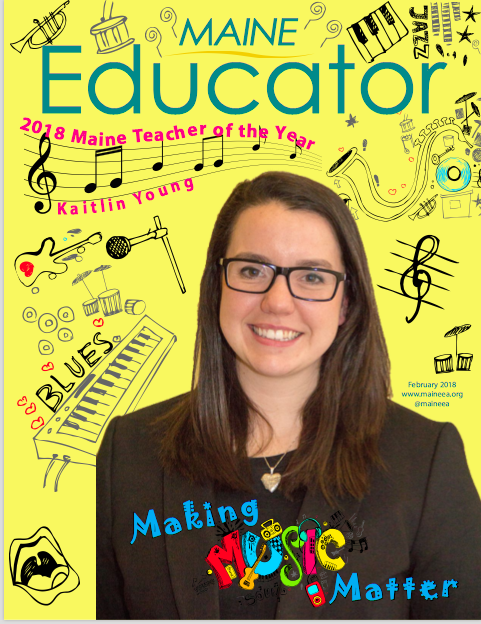
The 2018 Maine State Teacher of the Year Kaitlin Young was highlighted in an article for the Maine Educator Magazine. Kaitlin teaches music at SeDoMoCha School in Dover-Foxcroft. In addition to the article, Kaitlin is also on the cover of the February edition. Kaitlin is a Teacher Leader with the Maine Arts Leadership Initiative (MALI) and her full MALI story will appear later on this blog later on this spring.

Quotes from the article which you can access HERE.

“Arts education is essential for all students. The arts help you to participate in a larger community and we are fortunate to be able to provide these culturally enriching activities within our school.”

“We are in Dover- Foxcroft—Being Teacher of the Year isn’t about me, but perhaps my ability to be an ambassador for others. I feel honored to be part of this community and to tell others about it gives me great pride,” said Young.”

“It’s totally normal for me to one be silly and to crawl on the oor,” said Kaitlin Young with a smile. Young is the 2018 Maine Teacher of the Year and teaches music at SeDeMoCha Elementary and Middle School.”


h1

MALI Teaching Artist Leader Story: Nicole Cardano

April 24, 2018

Teaching Artist – Theatre

This is one of several blog posts in 2018 that include stories of the Maine Arts Leadership Initiative (MALI) Phase 7 Teacher Leaders and Teaching Artist Leaders. This series includes a set of questions so you can learn a little bit about each leader. CLICK HERE  for more information on MALI. CLICK HERE  for more information on the 93 Teacher Leaders and 8 Teaching Artist Leaders.  CLICK HERE  for Arts education resources. CLICK HERE  for the MALI Resource Bank. Search in the “search archives” box on the bottom right side of this post for past teacher leader stories.  Thank you Nicole for sharing your story!

Nicole Cardano has been teaching Drama and Improvisational Theater in the schools for eight years.  She teaches students in grades K-12 and adults. The majority of Nicole’s work has been with 5-8th graders. She has seen the most growth with this age group. Through Nicole’s studies and practice of improvisational theater she have connected to the foundational philosophies of Listening, Support, Eye Contact and Respect. The games that she teaches and her directorial mindset work from these foundations. Nicole believes in the process being more valuable than the product. Learning and developing these skills fosters a stronger community, a place of open listening and supportive fun.

What do you like best about being a teaching artist?

The thing I like best about being a teaching artist is expanding the awareness and experiences of connection through the practice of theater. As a teaching artist you are visiting many different environments and working with a large variety of people. My learning experience is constantly expanding. I have the opportunity of teaching theater as a tool for people to enhance social communication as well as deepen content connection.

What do you believe are three keys to ANY successful visual and performing arts education?

Providing a variety of opportunities for the students to connect. Recognizing that our strengths and challenges are different for each person. Being patient with yourself and the process. Every experience is new.

Have you found assessment to be helpful in your classes, workshops and residencies, and if so, how?

At this stage I find assessment to be most helpful in further communicating the validity of the practice. Articulating the progress that you saw within a class or with a particular student heightens the understanding of the importance of your work. I welcome recommendations on learning more formats of assessments that others have had success with.

What have been the benefits in becoming involved in the Maine Arts Leadership initiative?

Joining this supportive, creative and inspiring community has been an honor. The knowledge that we share with each other is endless due to so many different areas of expertise and experiences. I enjoy each and every conversation, and always wish I had more time with each person. I want to take everyone’s class!

What are you most proud of as an artist and/or a teaching artist?

I enjoy observing unexpected moments of pride. Such as experiencing success and true engagement from students that the teachers may not have thought would gravitate towards this work. Theater is a tool to learn with. That concept has been difficult to translate. I find that there can be a misconception that I am trying to work with the “theater kids”.  The theater kids are wonderful but that is not what fuels me to find opportunities for bringing the practice of theater into the school day. People want to play, students want to play, and at the right time teachers want to play too. We learn a great deal from each other in the act of play. In one of my first years as a Teaching Artist I went out of my way to recruit students that were not identified as being a part of any particular extracurricular interest, students that would easily have been predicted to become ‘At Risk’. Out of this selection there was one student that I quickly recognized needed to play extravagant characters. The feedback I received from a professional who had known that student for nine years was that they did not know that they could do this. Demonstrating longevity with supporting these students is something that I aspire to.

What gets in the way of doing a better job as a teaching artist?

Nicole at the Maine Arts Leadership Summer Institute

Having a set program where I am able to work with the students over their schooling years would be ideal. My work is designed to give the students Freedom through the practice and environment of Respect. This philosophy goes a long way for students that may often struggle in school, or struggle with believing in their own education.

School did not come easy to me. Teachers liked my personality, but many times did not know where to place me as a student. I had test anxiety, was a slow reader and easily lost my interest in a standard classroom setting. I could connect with people. Theater has been a life skill. This has been a way for me to study people and culture. Improvisation has allowed me to directly connect. I often think and process information with the tools of theater and improv. Relaxing a student, and providing play with the foundational rules of improv allows for a safe place to learn and interact.

What have you accomplished through hard work and determination that might otherwise appear at first glance to be due to “luck” or circumstances?

Expanding the work. Reaching new schools, classrooms and age groups. The majority of my work is truly for all ages. I have learned to zone in on the philosophies and foundations of practice that speak to all, while also finding exercises that more directly fit certain ages and environments.

What advice would you give to someone who is thinking about becoming a teaching artist or is just starting out?

Start with one project and observe/assess that. What did you most enjoy? What was challenging? What would you do differently? Where would you like to see this work continue? Then find a home for a second project based on this information, and repeat.

Be aware of what your needs are. I recognized that as an individual artist that I needed more recognition for my work and a business format. I have since launched a non-profit entitled “Theater Today”. I continue to work at this. The mission for my non-profit is:  “Theater Today facilitates, educates, and leads the mindset of drama, improvisational theater and play as a developmental tool.  We are social education and emotional growth through the medium of play, practiced in any format and with any organization.”

If you were given a $500,000.00 to do with whatever you please, what would it be?

MALI Summer Institute – Teaching Artist actor, theater maker Dana Legawiec, Nicole, Wiscasset High School Theater teacher Jean Phillips

The truth is I would distinctly support my non-profit. Creating programming that was not as limited by funding, time constraints of finding funding, and provided more consistent support. I would be intentional on what would create longevity for Theater Today, and the goals that we aspire to reach. Allowing plans to be big, while continuing to be clearly thought out. Creating the opportunity for the practice of theater to become a normal part of learning. Give talks on the importance of play. How human connection through play can promote a more positive human existence for all.

Imagine you are 94 years old. You’re looking back. Do you have any regrets?

Wow, how fast time has gone by. I am now 94. I am proud of the differences I have been able to make.  That theater is recognized, appreciated and utilized as a tool for learning and improving communication. I am filled with joy that I have been able to travel the world and meet so many amazing people. I laugh at the moments of confusion I had as a younger person. Embrace today and now. Life is outstanding! Enjoy it, and consciously share your love of it!

h1

Arts Education Policies

April 20, 2018

Arts Ed Partnership resource

Twenty-nine states in our country define the arts as a core or academic subject. You can learn what Maine and other states have in place for policies that impact arts education on the Arts Ed Partnership site at ArtScan.

h1

MALI Mega Oxford Hills

April 13, 2018

Fabulous learning opportunity

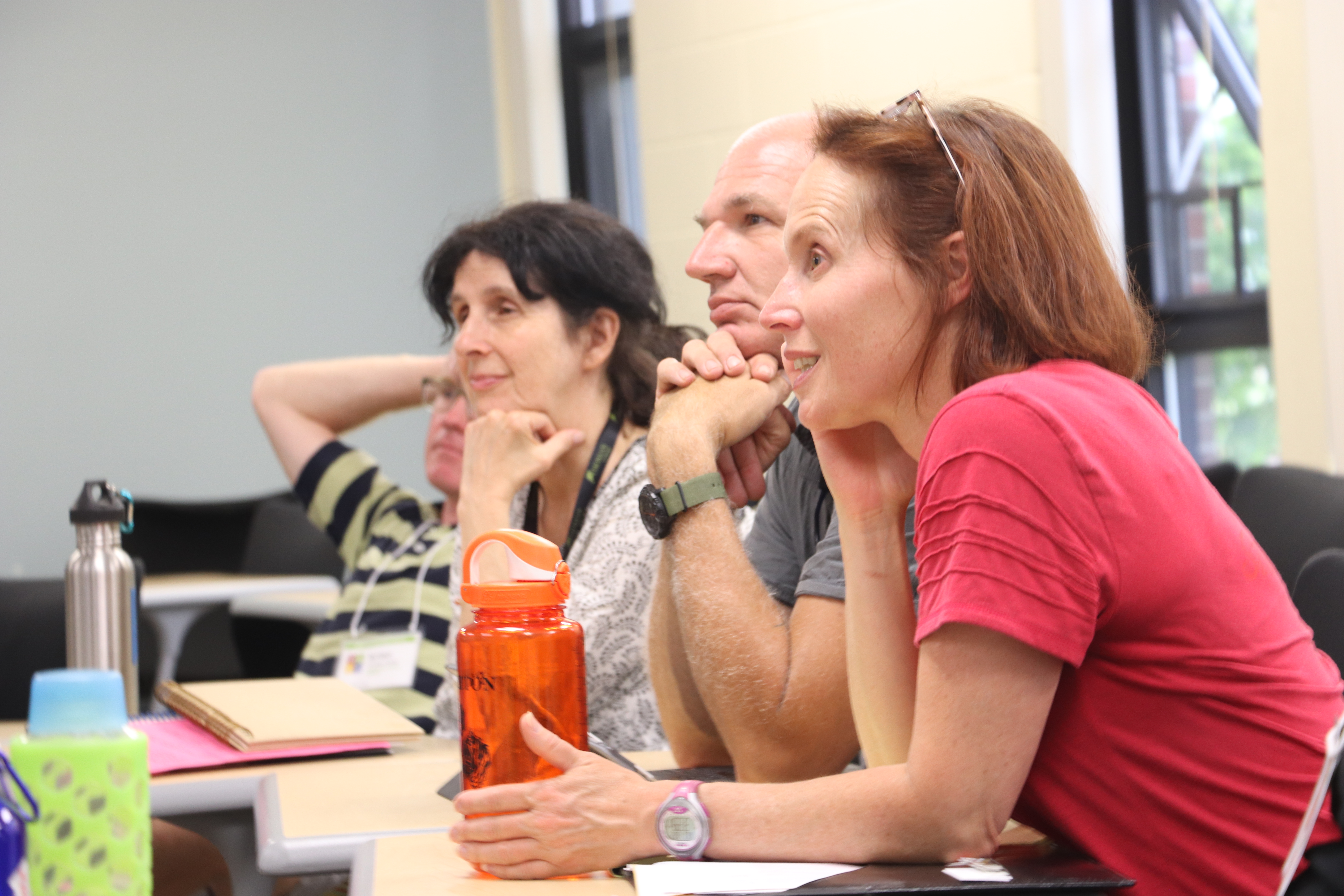
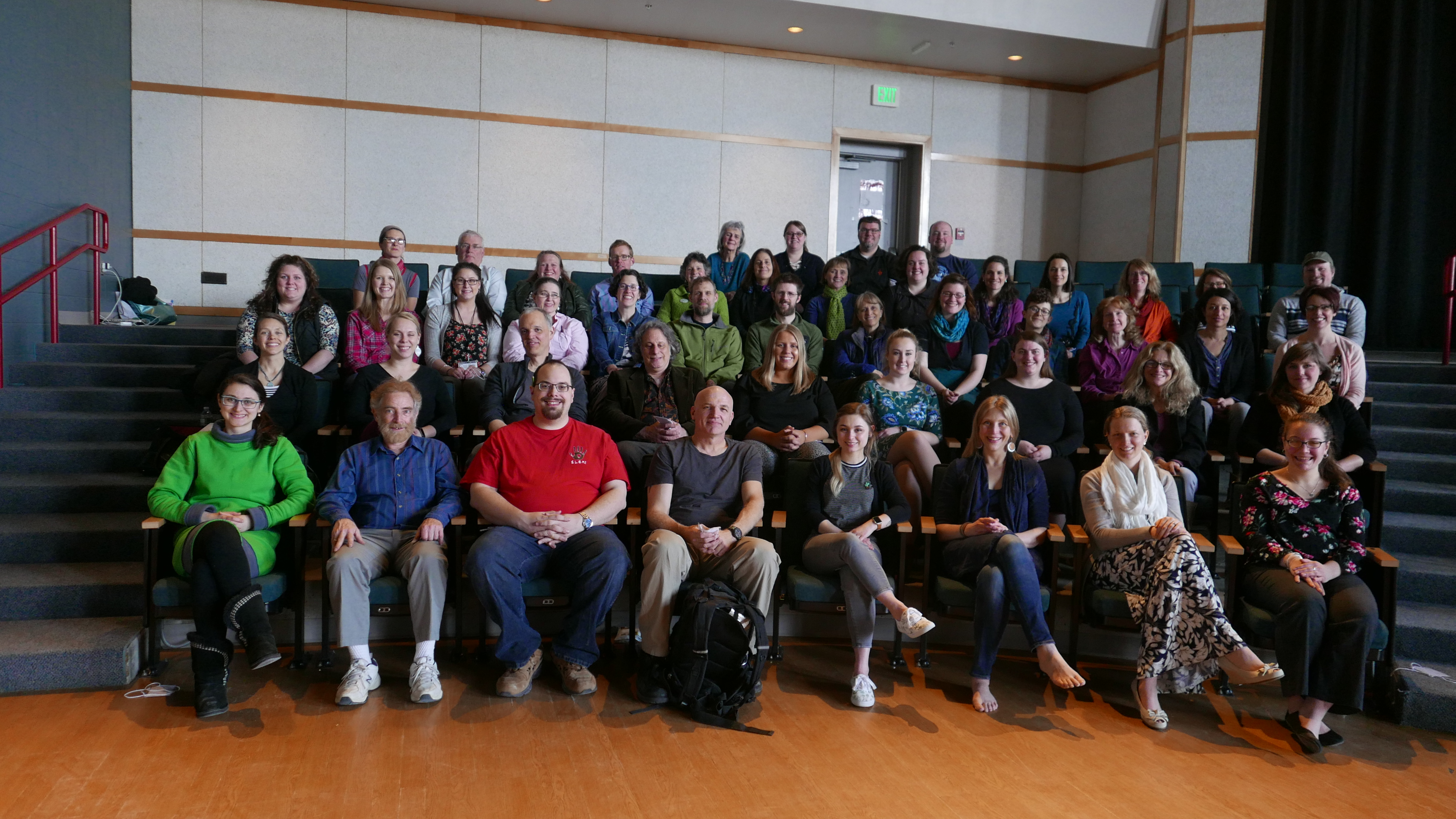
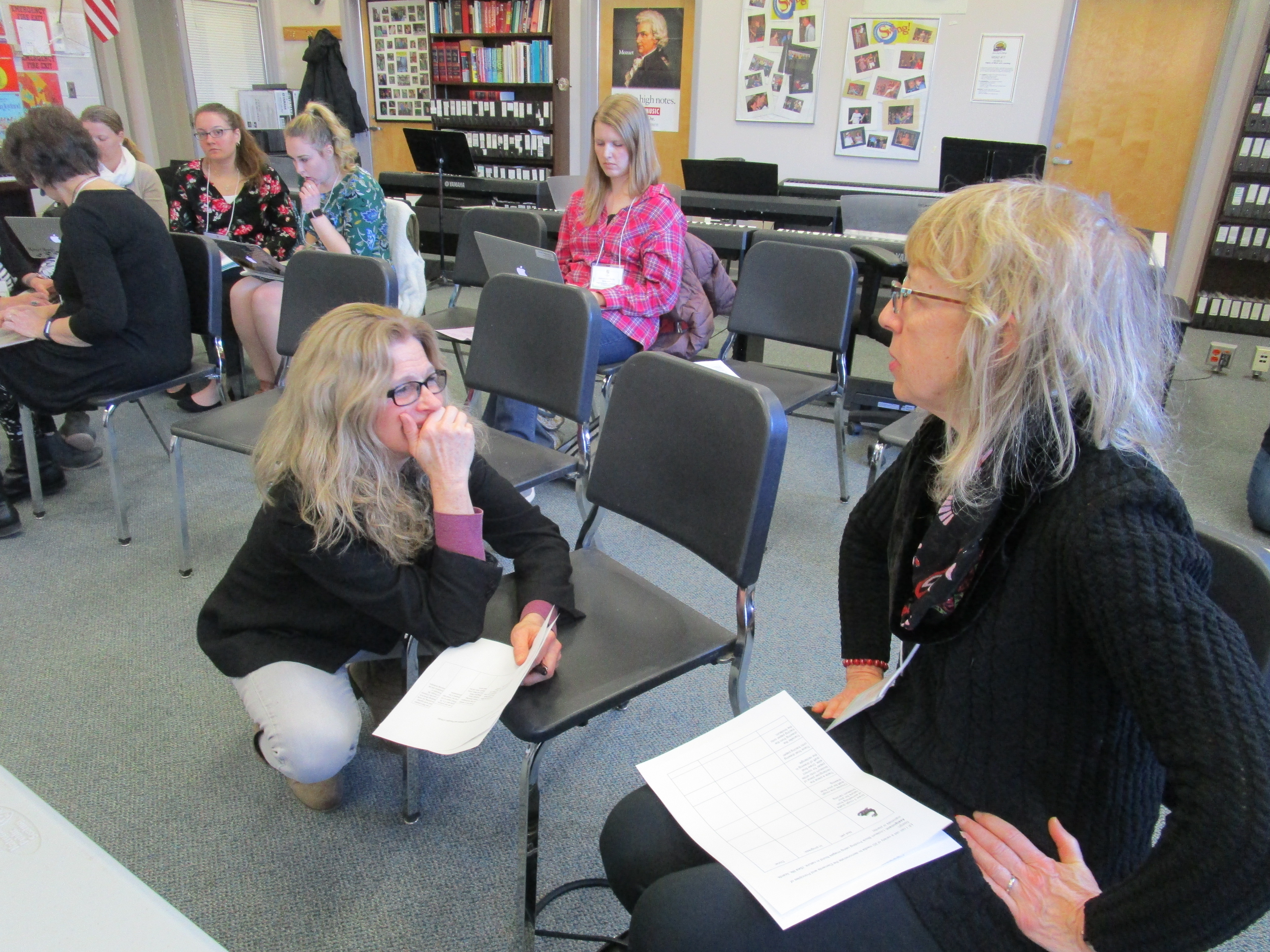
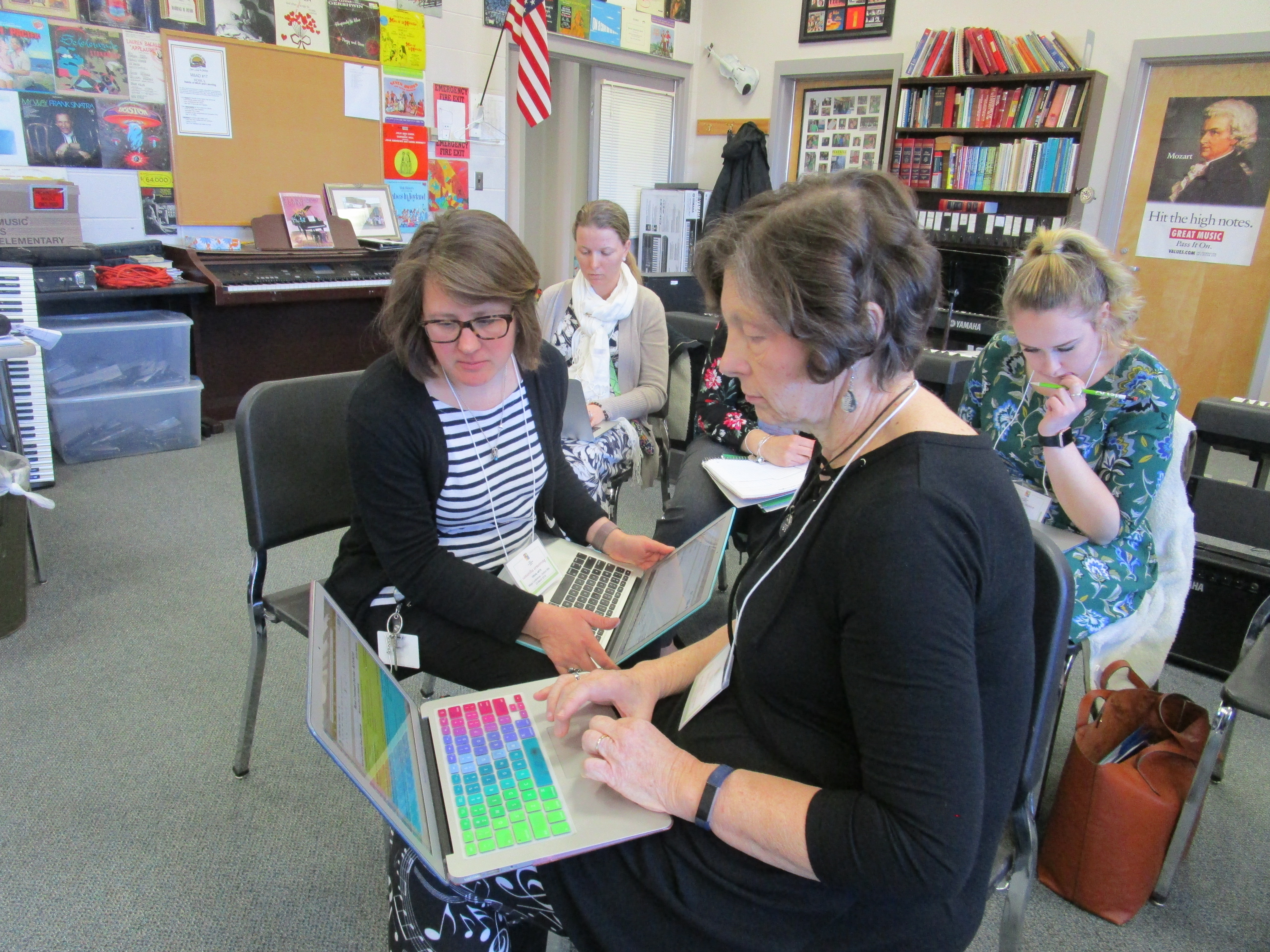
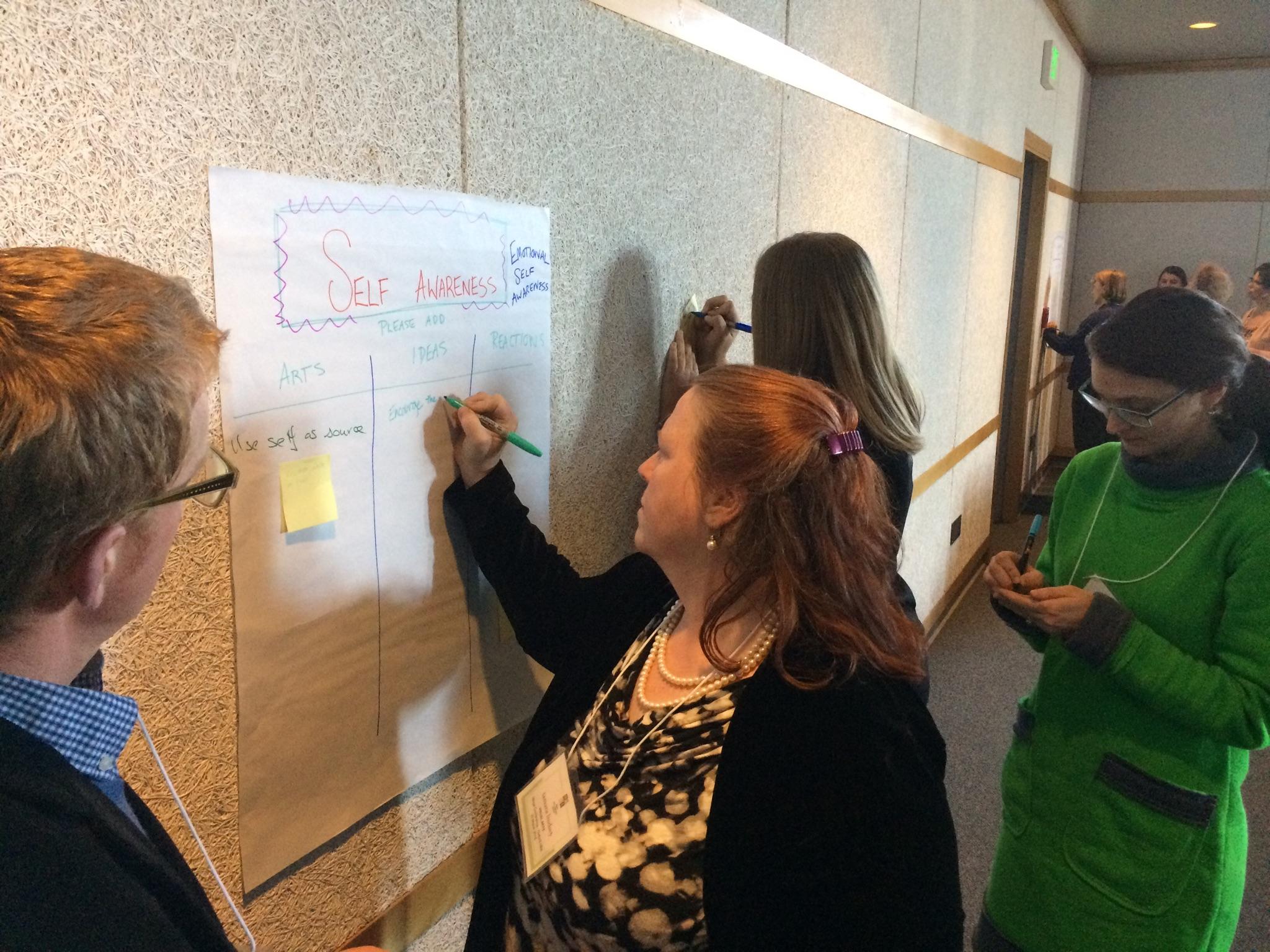
Over 70 PK-12 arts educators and Teaching Artists traveled to Oxford Hills High School in late March to attend the Maine Arts Leadership Initiative conference. The workshops varied greatly and participants had the opportunity to attend three during the day.

Thank you to the Oxford Hills visual and performing arts staff and administrators for providing the space for the conference. One week before the conference we learned that their workshop day turned into a teaching and learning day due to the many snow days. We are grateful that they were still able to make it happen.

Kris Bisson, Kate Smith, Brian Evans-Jones

A huge THANK YOU to visual arts teachers Cindi Kugell and Samantha Armstrong for all of their attention to detail.

Thank you to the following who offered workshops:

  • Cindi Kugell – Bookmaking 101: summative assessment never looked so good!
  • Lindsay Pinchbeck – The Arts and Emotional Intelligence
  • Dorie Tripp – Flexible Grouping Strategies for the General Music Classroom
  • Catherine Anderson – Tableaus of Courage: How to Help Students Engage with Complex Content through Theater
  • Samantha Armstrong – Stars and Stairs
  • Phil Hammett – Creativity
  • Tom Luther – Improvisation Crusader: Improvisation as an Essential Musical Skill
  • Nancy Harris Frohlich – Inspiring Environmental Stewardship Through Visual Arts
  • Lori Spruce and Tim Christensen – Integrating Curriculum: Making it Happen at the High School Level
  • Mandi Mitchell – Looking in the Mirror: The Importance of Student Self-Reflection
  • Brian Evans-Jones and Kris Bisson – Bridging Adolescence: A River Runs Through Us – Composing our Story
  • Jenni Null and Linda McVety – All Aboard for Arts Travel, Full STEAM Ahead!
  • Bronwyn Sale – Teaching Aesthetics and Criticism: Approaches to Standard D
  • Andrew Harris – Creativity and Taking Back the Classroom

Amanda Huotari

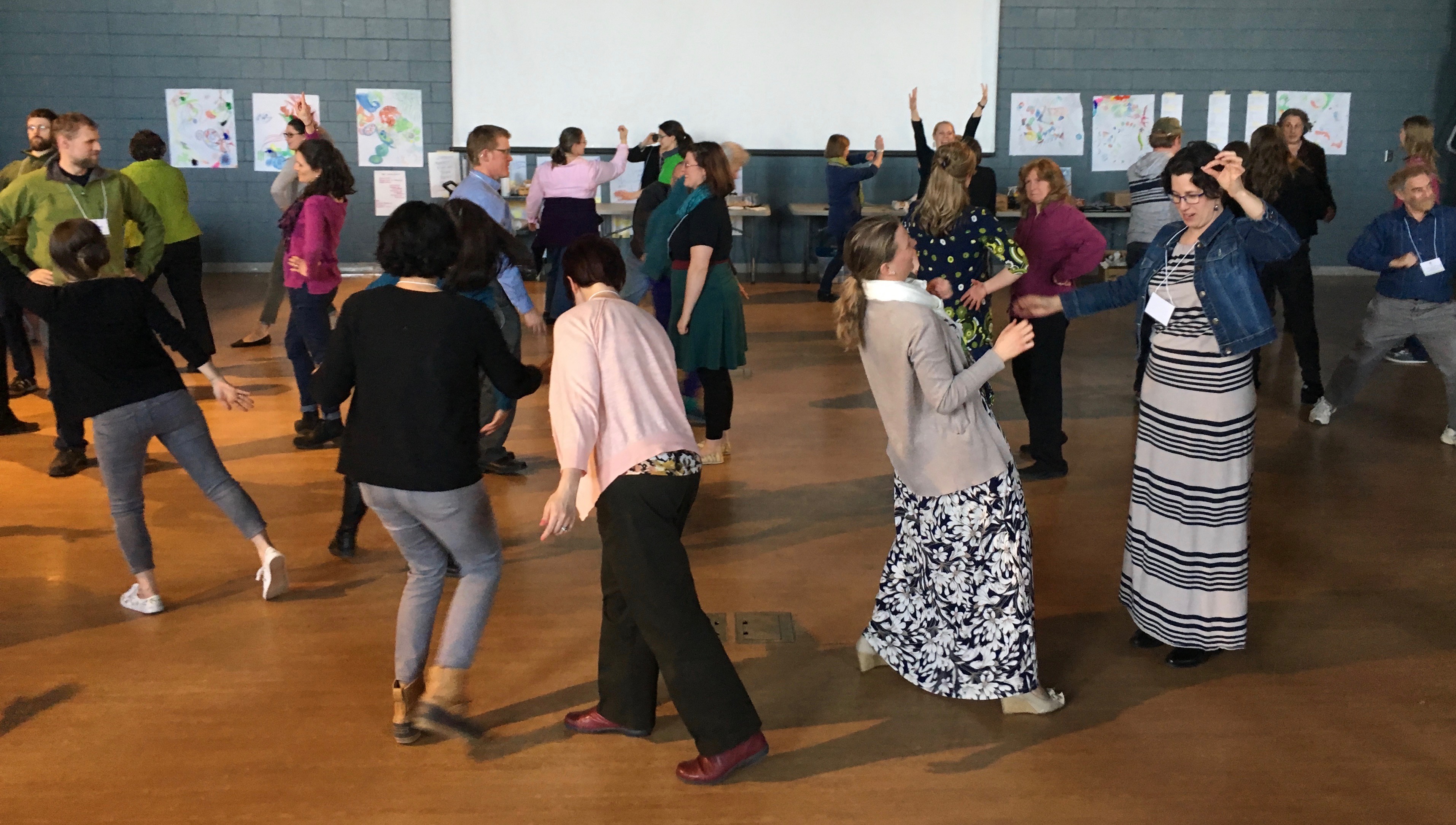
In the middle of the day we had the fabulous opportunity to work with and learn from Teaching Artist Amanda Houteri from Celebration Barn Theater.

Participants during Amanda’s session

In June there will be an opportunity for teaching artists. PK-12 arts teachers and teaching artists will have an opportunity to apply to be a leader. Watch the blog and weekly email to learn more.

Dr. Katie Rybakova and Thomas College pre-service teachers

Jan Gill and Jenni Null

Kris Bisson and Brian Evans-Jones presenting

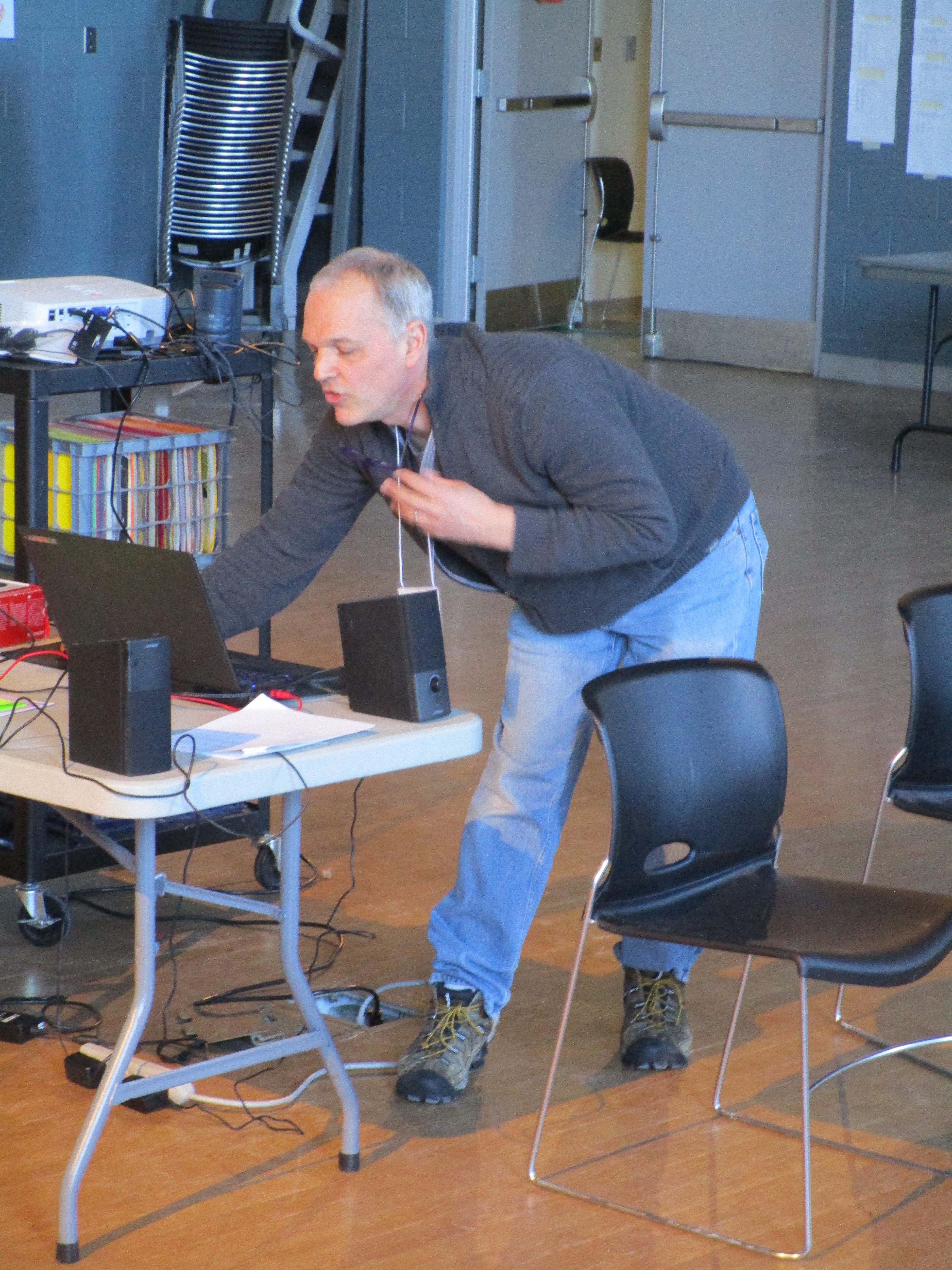
Tom Luther presenting

Mandi Mitchell

Samantha Armstrong and Linda McVety

Teaching artists Tim Christensen, Tom Luther, and Brian Evans-Jones