Posts Tagged ‘Maine arts education’

h1

Steel Pans

November 24, 2020

Such a sound they make!!

This blog post is an interview with John Kollman, music teacher in the Hermon School District. John’s passion for steel pans is alive and enthusiastic! His students in Hermon are fortunate to have him as a teacher!

John grew up in Bar Harbor and played drums and sang all through school.  He got my music performance degree from U Maine and music education credits from USM. He went into music because I really have never been interested in anything else. John has have taught at all three schools in Hermon at various times for the past 14 years including General Music k-5, Choral Music 5-12, and Guitar and Steel Pans 9-12. He currently teaches guitar, choir, and five sections of steel pans at Hermon High School. John lives in Bangor with his wife and four children.

How did you get started with steel pans and providing a program at the schools in Hermon?

It all started when my wife and I were attending the Robinson Ballet’s spring show in Bangor in 2005.  The high school-aged steel pan band from Blue Hill “Planet Pan” was providing accompaniment for a few of the dance numbers plus playing a few on their own.  When I heard the band playing this music I felt a musical joy that I had not yet experienced in my life.  I couldn’t believe what I was hearing.  The music was so exciting and new to me.  I was floored.  I instantly knew that I had to be a part of it.  A few weeks later we attended a street-dance featuring “Flash in the Pans”, the community steel band also based in Blue Hill.  We danced all night and had an amazing time.  Later that summer, I contacted the director of “Flash in the Pans”, Carl Chase, and he pointed me toward an adult beginner class happening at George Stevens Academy.  Playing the music was even more fun!  I purchased my own set of pans and joined “Flash in the Pans” the following spring. Playing in a big steel pan band with hundreds of people dancing in front of you is like no other musical experience that I have ever had. And 15 years later I can say, it never gets old!  The power and raw sound of a steel band is unmatched. Needless to say, I really wanted to start a steel pan program where I taught music in Hermon so that these musical feelings could be spread far and wide. So I pitched the idea to our newly formed arts boosters organization and we quickly got working on it and put together a proposal. I’ll give some strategies on how to do this a little later.

Tell the blog readers about the steel pan program you’ve established.

We were lucky enough to start our program in 2009 with 14 sets of pans.  It started as an after-school program for four levels, 3rd and 4th grade, middle school, high school, and adult.  The following year we were able to offer it as a regular high school class for a fine arts credit.  Since then we have been able to add instruments (all from after-school lesson fees and gig donations) and we can accommodate 25 players.  The first high school class started with one class of eight players and has since grown to five sections with around 125 students involved each year.  The after-school programs continue to thrive as well (temporarily on-hold for obvious reasons).  Our community band, PanStorm, plays parades, festivals and dances throughout the greater Bangor area.

What are the benefits of providing the program?

       Steel pan music is the only form of music that I have ever seen small children, teenagers (always a hard group to please), and adults of every age dancing together and having a wonderful time. The music seems to speak to everyone from all kinds of different backgrounds. Another key element is the accessible nature of the instruments. You can take a group of people that have never played an instrument or sang in a choir before and have them playing something that sounds pretty good in about an hour. People have a good time and gain confidence quickly. Especially at the high school level, I have seen lots of students who never got involved in the traditional ensembles (which I also love, don’t get me wrong) having a lot of success in a pan ensemble. On the flip side of that, I have been able to get students into my chamber choir from the pan program who normally would have never thought of it before.  Steel pans reach some of the students who were not reached by the traditional paths which equals more kids involved in music.

John Kollman on the left in this photo next to his son

Describe a moment or opportunity when the value of the program was made clear.

Early on in the program, our elementary groups performed at the regular elementary school concert.  Afterwards, I was approached by an audience member who said he was amazed that students that young could actually play music at such a high level.  He was bracing himself beforehand and then couldn’t believe how good they sounded. The value of the program is clear when you look on the faces of the players and the audience members and see pure joy.

Are there connections to be made beyond the school for students?

       A lot of students that started playing in school are now in the community band playing at festivals and parades. Pans also have a rich history coming from the island of Trinidad deep in the Caribbean that can be explored. Steel pan bands are emerging all over the world. It is a fast-growing art form.

What are your suggestions for others who are considering starting a program?

First I would say, you definitely should!  What we did in Hermon was:             

  1. Have a steel band perform for the school, a concert and a workshop (nowadays, a video presentation might be the only option).             
  2. Circulate a petition and have students who might be interested in playing sign it (with no firm commitment, you get a lot of signatures).             
  3. Put together a proposal using video and signatures.  I pitched it as financially self-supporting due to after school lesson fees and gig donations after the initial cost (and this has turned out to be very true).

What are the costs to start a program?

The initial cost can be a little daunting because all pans are hand-made by a highly skilled craftsperson and the cost reflects that.  You can find pans for $800 to $1500 depending on the kind and quality.  You can start with just a few sets and get it rolling that way.  People love to play them and love the sound.  They sell themselves if you can set it up right.  If anyone is interested in starting a program and needs help or ideas, please feel free to email John Kollman at john.kollman@schools.hermon.net.  Below is a video of the PanStorm community steel band performing in the July 4th parade, 2019.    

h1

Arts are Important

November 9, 2020

Whether education systems and individuals believe that arts education is essential, referred to as enrichment, are extra-curricular or an elective no one will disagree that the arts provide something that other content do not.

Last week the Bangor Metro published an article supporting the value of arts education. The article called Here’s Why the Arts are Important in Education. It cites research from the University of British Columbia published in the Journal of Educational Psychology and from Dr. Frank Wilson who is the assistant clinical professor neurology at the University School of Medicine in San Francisco, and from “Critical Evidence: How the Arts Benefit Student Achievement,” a publication by the National Assembly of State Arts Agencies and the Arts Education Partnership. Highlights point to higher test scores in math, science, English, and reasoning and creative thinking when engaged in the arts. Also, the positive impact on coordination, concentration, memory and improvement of hearing and eyesight.

In addition to research, Maine educators from Thornton Academy and Lewiston provided their own observations and experiences supporting the value of arts education programming. The next two paragraphs are taken directly from the article.

Kelsey Boucher, a K-6 Visual Arts Educator at Connors Elementary School in Lewiston, agrees, saying children are like sponges and will absorb everything in. “The earlier they are exposed to the arts and languages, the more confident they are in these areas as they grow older,” Boucher said.

Sarah Helgesen, a Special Education Teacher at Thornton Academy in Saco has witnessed nonverbal students “enunciate sounds to music and play instruments to the beat while having the best time,” and said that’s when she feels enrichment programs have proven to be the most successful, adding value to every student.

You can read the entire article at THIS LINK!

h1

Congressional Art Awards

November 5, 2020

Opportunity for high school students

The Congressional Art Awards has taken place each spring since 1982. This is a nationwide high school visual art competition to recognize and encourage artistic talent across the country and in each congressional district. Since its inception more than 700,000 high school students have participated.

2020 District One Winner
Gus by Alek Gideon
Grade 10, Freeport High School
Art Teacher: Kimberly Medsker-Mehalic

This opportunity is open to all high school students. The overall winner of each participating congressional district will have the opportunity to have their work displayed in the Cannon Tunnel of the U.S. Capitol for the entire year, beginning in June. In addition, students will be flown to Washington, D.C. for the official opening of the show in June.

The Maine Arts Commission partners with the Maine College of Art (MECA) and the National Scholastic Art and Writing Awards to select the artwork. Artwork that MECA has invited to exhibit for the annual Maine Regional Scholastic Art Awards are automatically submitted to be juried for the Congressional Art Competition.

2020 District Two Winner
Noor Aden by Carolyn Adams
Grade 12, Lewiston High School 
Art Teacher: Sarah Stocker

For more information please visit the Maine Arts Commission’s website or the Federal Congressional Art Competition website or email Pamela Moulton at pmoulton@meca.edu.


h1

Freeport High School Theatre

November 3, 2020

Antigone Now

At the end of October Freeport High School theatre program created something pretty special! Everyone felt the success and benefits from students and staff to administration and the community.

I met Natalie Safely about 3 years ago when she and dancer Nancy Salmon worked together after receiving a dance grant from the Maine Arts Commission. Natalie is the theatre teacher at Freeport High School. I had a chance to chat with Nancy last week and she mentioned the work that Natalie did this fall. I was impressed!

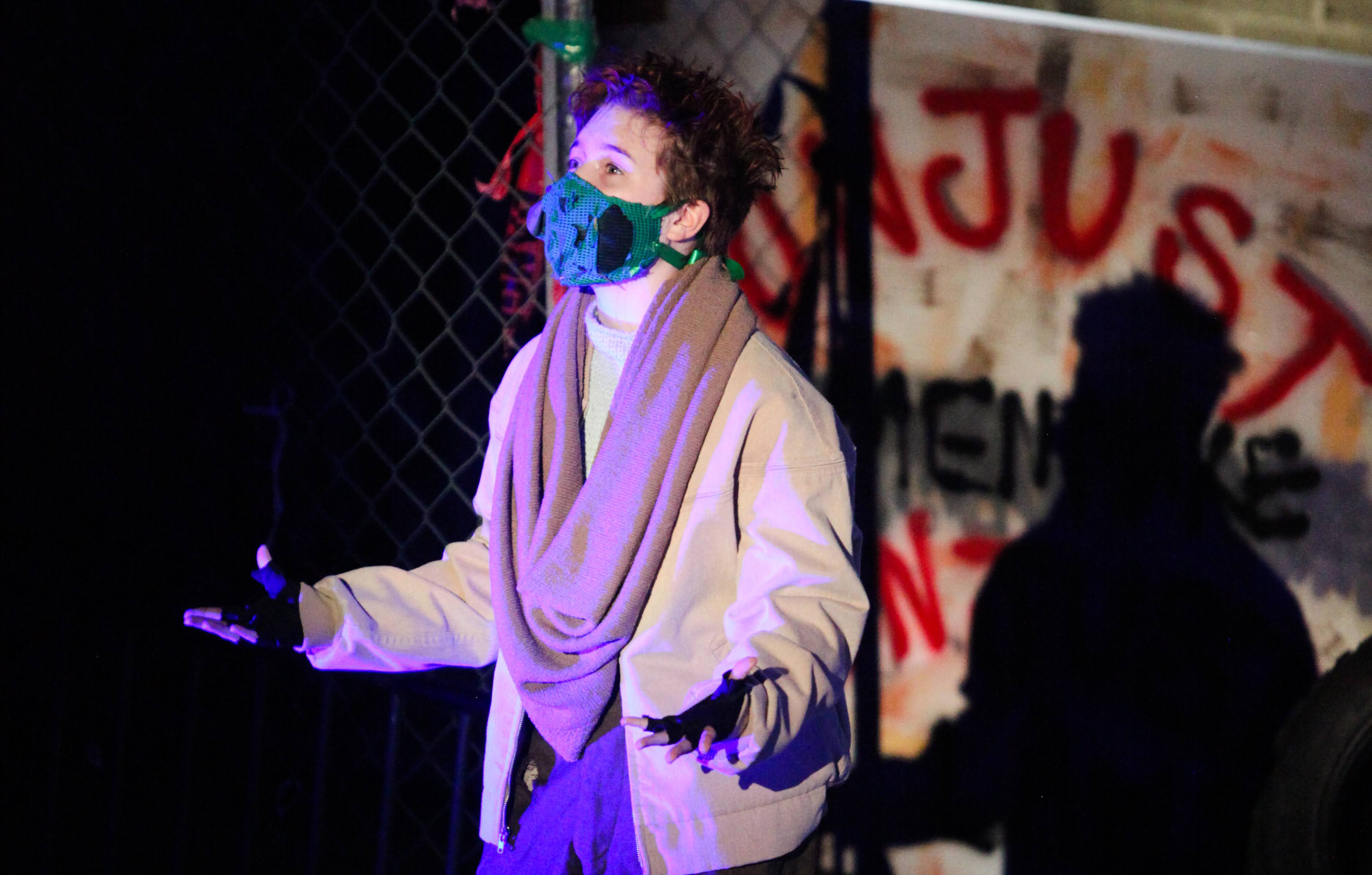
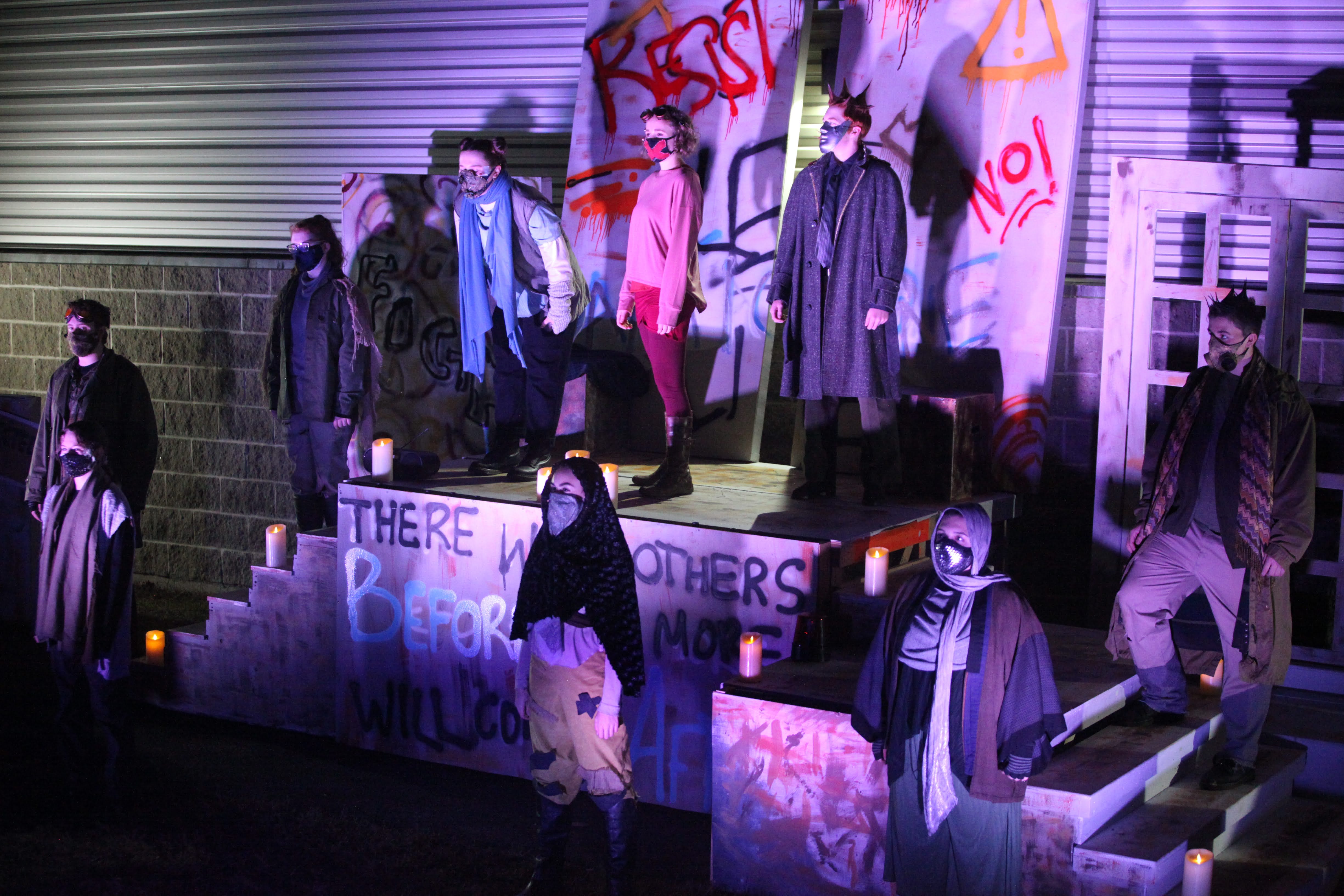
At our first meeting in the spring of 2019 I visited Freeport High School to learn more about the dance residency and the teaching and learning underway. I immediately noticed Natalie was an outstanding collaborator! This fall Natalie worked with Nate Menifield, Zoe Konstantino, and Ben Potvin and Freeport students and in five weeks they put together and performed the play Antigone Now. It is a GREAT example of the amazing work that takes place when we collaborate and focus on the pathway and possibilities! Looking at the file of photos taken by parent Ingrid van Duivenbode illustrates the magic of the performance. It was performed outside practicing appropriate pandemic safety abiding by the CDC guidelines.

 Photo by Freeport High School parent Ingrid van Duivenbode

Antigone Now, by Melissa Cooper was performed by Freeport High School’s Theatre Arts program on October 23, 24, 25. Nancy Salmon was fortunate to attend and she said: “My husband and I saw the 2nd night of Antigone Now at Freeport High School, tucked into a U-shaped alcove outdoors. We were SO impressed by and proud of the students (on “stage” and tech), the directing staff and the administration who made this COVID-safe, live performance of quality, resonating theater a welcome relief from Zoom.

They had to keep the cast and crew under 50 in order to be able to rehearse indoors.

 Photo by Freeport High School parent Ingrid van Duivenbode

I am grateful to Natalie that she took a few minutes out of her busy schedule to answer a few questions.

How did you come up with the idea to perform outside?

When schools closed last March, we were working on two different productions. As the days became weeks, and the weeks became months, we soon realized that our stage, like thousands of others, would remain dark. We didn’t know when we would be able to perform again. During a socially distanced walk with a friend, I was explaining how we couldn’t do a musical, how we can’t dance, and on and on. She said, “Natalie, why don’t you do a play with masks?” I was too close to the situation. I was focused on all of the things we couldn’t do instead of focusing on the things we could do! Sometimes, we get in our own way. When we are able to look outside ourselves: other perspectives, other options, other interpretations, the impossible becomes possible. With perseverance and flexibility we were able to create a live piece of theatre that six months ago seemed impossible.

 Photo by Freeport High School parent Ingrid van Duivenbode

What did it involve taking the performance out of doors?

In two words: Ben Potvin…It was a lot more difficult than I had anticipated. The first challenge was agreeing where on campus we could put up a set that had access to power, where cars would not drive by and where we would not be competing with sporting events and practices. When we finally agreed on a location, then came the logistics of building a moveable set. Once we got into tech week the lighting and sound had to be set up and taken down each night. We set up the soundboard in a classroom that acted like a booth where the stage manager called the cues, sound board op and spot operator ran their cues from there, however we had to set the light board up in a different location because we couldn’t keep social distancing with four students in the area we were using as a booth.  The sound was our biggest challenge. There were so many outdoor factors that came into play: airplanes flying over, sound from the traffic on I-95, masks and mic placement, sound signals cutting in and out for a variety of reasons. When I approached my principal, I said, “No problem, we can do it outside!” It took a knowledgeable tech director (Ben Potvin) to work through a lot of logistical challenges.

 Photo by Freeport High School parent Ingrid van Duivenbode

How did you keep the students safe while practicing, creating set, and performing?

Everyone had to use hand sanitizer before entering the space and throughout rehearsal. Longer rehearsals everyone was reminded to take a moment to wash their hands. Masks were worn by all inside and out.To keep the actors safe during rehearsal we put tape marks on the floor indicating 6 feet distancing, no actors shared props–we did have one prop that needed to be brought on by one actor and then used by another–as a cast we figured out that he could wear rubber gloves to bring it on stage. The actors did not wear makeup, they executed their own hair design, put on their own microphones and did not have any costume changes. During tech calls, all tools were sanitized before and after each use. Techs wore masks when working inside and outside as well as maintaining social distancing.

 Photo by Freeport High School parent Ingrid van Duivenbode

Tell a bit about the support and from who to make it happen

Our principal, Jen Gulko, is incredibly supportive of our program. After explaining to her how we would adhere to all guidelines she approved our pursuit of producing a fall play. 

We have an amazing artistic team: Ben Potvin (Technical Director), Nate Menifield (Music Director) and Zoe Konstantio ( Choreographer) and myself as Director and Producer.  These positions were in place for the fall musical, however we quickly transitioned our roles to put on a play in 5 weeks.  It took each member of the team to make this happen! Nate focused on the text analysis and vocal performance, Zoe and I focused on staging and movement, and Ben focused on the tech. With each one of us able to focus on one area, the students were more focused and remained on task.

I hope that this blog post provides you with inspiration to figure out how you also can perform with your students. I’ve included the Press Release below so you can get the full impact and hopefully take away some ideas that you can adapt for your own work this year.

Antigone Now, FALL PLAY, PRESS RELEASE

A battle for honor takes place in Freeport High School’s upcoming production of Antigone Now, a modern adaptation of Sophocles’ Antigone, written by Melissa Cooper.

Contact: Natalie Safley, 207-865-4706 ext. 801, safleyn@rsu5.org

October 12, 2019

Freeport, ME– “Theatre artists have been wearing masks since 400BC, so why can’t we?”  said Natalie Safley, Theatre Arts Director at Freeport High School, when discussing their upcoming fall play performance. When schools shut down last March due to the Covid-19 pandemic, hundreds of theaters also went dark, cancelling shows across the country. Once Safley learned that RSU 5 was going to return to school this fall under a hybrid plan (where students attend in person part of the time), she immediately reached out to FHS Principal, Jen Gulko, to discuss doing a fall production.  Maine CDC guidelines prevent musical performances at this time, and currently limit outdoor gatherings to 100. Safley and Gulko determined that a small-cast fall play – produced outside and in accordance with all current safety guidelines – could take place. Safley rushed to choose a script, gather her artistic team, and conduct auditions.  Of the experience, she notes, “Putting together a show in 5 weeks instead of 10 is an unbelievable undertaking, but FHS accepted the challenge!”  

Playscripts, Inc. describes this adaptation as a “…contemporary response to the myth of Antigone…” Antigone (played by FHS junior, Ella Vertenten) strives to bury her brother, Polyneices, with honor, defying a decree from the king (who also happens to be her uncle) that, “No one may bury him, no one may touch him. It’s against the law.” Drama ensues as the characters fight to preserve the laws of the city while keeping the family intact.  

All performances will be held outdoors, Friday-Sunday, October 23-25, at 7PM, adjacent to the entrance to the Joan Benoit Samuelson Stadium (30 Holbrook St., Freeport, Maine). Tickets must be purchased in advance; no tickets will be sold at the door. All patrons must wear a mask, practice social distancing, and should bring a blanket or chair to sit on. 

Purchase tickets to live performances here:http://bit.ly/FHSAntigone

Direction: Natalie Safley, Nate Menifield, Zoe Konstantino

Technical Direction: Ben Potvin

* Patrons must bring their own chair or blanket to sit on

*Masks and Social Distancing in place 

Contact Natalie Safley, safleyn@rsu5.org

h1

Virtual Theatre Game Night

October 21, 2020

Maine high school students are invited to participate in a virtual theater game night. The Maine Thespians officers will lead participants in an interactive workshop at no cost. Mark your calendars and join teens from across the state – Sunday, October 25, 5:00 – 6:30 p.m. This event is provided by the Maine Educational Theater Association.

For more information CLICK HERE! To register CLICK HERE!

h1

Grammy Music Educator Award

October 20, 2020

25 Semifinalists announced – Maine proud!

In the beginning of June 2020 the Music Educator Award presented by Recording Academy and Grammy Museum announced their quarterfinalists for 2021. I was proud to announce on the blog that three Maine music educators were named to the list of nearly 2,000 nominees!

  • CAROL CLARK – Gray-New Gloucester High School
  • PATRICK VOLKER – Scarborough High School
  • TRACY WILLIAMSON – Gorham Middle School 

As a follow up Tracy shared her Covid story posted on this blog that provided details on her teaching journey through the school year.

Tracy Williamson

Recently Tracy learned that she is one of 25 music teachers from 24 cities across 16 states to be named a semifinalist for the award given by the Recording Academy and GRAMMY Museum.

CONGRATULATIONS TRACY!

The finalists will be announced in December and Maine Arts Educators will be waiting to hear the outcome!

The Music Educator Award recognizes current educators who have made a significant and lasting contribution to the field of music education and who demonstrate a commitment to the broader cause of maintaining music education in the schools. The recipient will be recognized during GRAMMY Week 2021.

The award is open to current U.S. music teachers, and anyone can nominate a teacher — students, parents, friends, colleagues, community members, school deans, and administrators. Teachers are also able to nominate themselves, and nominated teachers are notified and invited to fill out an application.

Each year, one recipient is selected from 10 finalists and recognized for their remarkable impact on students’ lives. They will receive a $10,000 honorarium and matching grant for their school’s music program. The nine additional finalists will receive a $1,000 honorarium and matching grants. The remaining fifteen semifinalists will receive a $500 honorarium with matching school grants.

The matching grants provided to the schools are made possible by the generosity and support of the GRAMMY Museum’s Education Champion Ford Motor Company Fund. In addition, the American Choral Directors Association, National Association for Music Education, NAMM Foundation, and National Education Association support this program through outreach to their constituencies.

The finalists will be announced in December, and nominations for the 2022 Music Educator Award are now open. To nominate a music educator, or to find more information, please visit www.grammymusicteacher.com.

h1

Teaching in the Pandemic

September 22, 2020

Charlie’s story

One of the Maine Arts Leadership Initiative (MALI) Teacher Leaders from the first phase is Charlie Johnson. Charlie teaches Digital Design, 3D Design and Photography at Mount Desert Island High School. For many years he has been a proponent of student centered learning and using technology as a tool for effective teaching. He wrote the essay below “Teaching in the Pandemic” for the Union of Maine Visual Artists Journal.

Charlie has worked tirelessly as an art educator since 1973 and over the years I’ve been happy to watch him be recognized for his commitment to Arts Education. Charlie received the Carol Trimble Award for Exemplary Service to Education Award in 2015, was a finalist for the 2008 Maine Teacher of the Year, and is the 2006-07 Maine Art Teacher of the Year from the Maine Art Education Association.

Matilda A., Spring, Mixed Media, 12” x 12”, May, 2020 “I’m grateful for spring coming and all the flowers starting to come up.”

My initial concern as a high school art instructor with the closure of school buildings within our district was that I had no time to prepare my students for the transition. Fortunately students in my classes used the Google Suite of applications on a regular basis, primarily for presenting their work on Google Drive to obtain formative feedback and ultimately to organize their summative portfolios. Their previous work with the structures and protocols of digital submission of work did provide them a basic foundation.

Working with a Digital Media class in a computer lab equipped with the Adobe CC Suite did not translate to student laptops or home computers. Adaptations to software available on student laptops had to be constructed, causing a shift in curriculum structure and constricting student choice for exploration purposes within a less robust software .

The class that caused me the most regret for my students was Black & White Photography, as the creation of individual darkrooms labs in student homes was impractical. Even with these changes, the photography class has been particularly resilient, with the requirement to switch to digital imaging and to shoot in grayscale causing several students to improve the content and quality of their work significantly.

Alex S., What Makes Me Happy, Mixed Media/Photograph, 12” x 12”, May 2020 “I am grateful for the ability to create, both physical and emotional, to keep my inner colors bright and vivid, even when I’m the only one who sees them.”

While there remains a visual and performing arts requirement for graduation at our school, all of these classes are elective by students, and in some cases are chosen out of necessity rather than interest. Being present physically in these classes allows the instructor to personalize instruction and teaching as students become more familiar with both the content and the teacher.  Because this had already taken place during the school year for semester long classes, there was a certain basic foundation to work from during the transition period.

The group of students that I am in contact with in the most meaningful ways during this pandemic is the National Art Honor Society art students. Now, this is not an art class, but a group of the most interested and dedicated visual artists in our school, and from the very first “virtual” meeting we all shared not only time, but ideas and concepts for artworks, emotional states in reaction to the closure of classroom doors, and an artistic fellowship that was purely exuberant! During the second weekly meeting of this group, students decided to create “squares” of their feelings of gratitude that would eventually become a “GRATITUDE QUILT”, expressing the variety of things to be thankful for during the difficult time of the pandemic. 

Charlotte P., Technology, Digital, 12” x 12”, May 2020 “I’m grateful that technology is able to keep us connected even if it can become a little too overwhelming sometimes.”


MDI NAHS, Gratitude Quilt, Digital Assemblage, 4’ x 4’, May 2020
“A collaborative piece by members of the MDI HS Chapter of the National Art Honor Society”

IMAGE LIST/CAPTION:

  1. MDI NAHS, Gratitude Quilt, Digital Assemblage, 4’ x 4’, May 2020

“A collaborative piece by members of the MDI HS Chapter of the National Art Honor Society”


  1. Charlotte P., Technology, Digital, 12” x 12”, May 2020

I’m grateful that technology is able to keep us connected even if it can become a little too overwhelming sometimes.”


  1. Matilda A., Spring, Mixed Media, 12” x 12”, May, 2020

            “I’m grateful for spring coming and all the flowers starting to come up.”


  1. Alex S., What Makes Me Happy, Mixed Media/Photograph, 12” x 12”, May 2020

I am grateful for the ability to create, both physical and emotional, to keep my inner colors bright and vivid, even when Im the only one who sees them.”


h1

Young Artist’s in Quarantine

June 30, 2020

Student’s share their stories

This is part of a series highlighting the stories of young artists in quarantine. The period of free time that many people are experiencing has led to a sense of freedom in creating– when not held back by the standards expected by society and in much of art education (or needing to prove talent/fill resumes) it’s incredible what can be done. Alone in your room with just a paintbrush or guitar has led many students to find a new independence in art when they have the ability to create just for themselves. We’re hoping that by telling these stories, a change will occur in the way we approach arts education, to focus on the growth of the individual, even after quarantine comes to an end. Thank you Robyn Walker-Spencer, 2020 graduate, Camden Hills Regional High School, for launching this series of young artists in quarantine.

Kate Kemper just graduated from Camden Hills Regional High School. Below is her pandemic story.

I have always been an artist, I think. I have a grandparent on each side of my family who were extremely gifted in the arts, and my parents always say the “artist gene” skipped a generation. Over my life, I’ve expanded my mediums. I work in many forms of fine art; I am a painter, singer, poet, ceramist, and beginning mural artist.

What really sparked my love of art and helped me develop good foundations was my education at Ashwood Waldorf School. As a part of the core curriculum, I painted wet-on-wet in painting class and made a crayon drawing for every academic lesson over eight years.

In my senior year of high school, I took an advanced art portfolio class which pushed my artistic abilities even further. I learned about putting meaning into art and the different ways to make a statement about the world through the lens of creation. I now feel empowered to express my voice through a piece and do art much more frequently.

Separate, 2020, 14” x 17,” Mixed Media

There are a few common ways to make a statement about the world. Protesting, voting, speaking out, and art. You cannot have a successful social movement without art to move people. It can unite by interpreting a message into a visual format that makes it easier to understand. The repetition of an idea through many artworks grows a movement and can make real change in the mind of the audience.

But ultimately, art is what you want it to be. For me, among many others, it is a reaction.

I paint absent-minded abstractions when I need to relax, I express my frustrations when I’m angry, and I admire beauty when I’m joyful. I use it as a tool, a way to process emotion. This has come in especially handy during recent months. Amidst a global pandemic, one can expect many emotions. I went through a whirlwind of life events simultaneously, good and bad, so it is no surprise that I made a lot of art. The most defining piece of this era was one called “separate.” It was a paper cut representation of the idea of social distancing. It will join the large body of work that I am sure will arise worldwide in reaction to this pandemic.

Fruit Salad part 1, 2020, 24”x 24,” acrylic on canvas

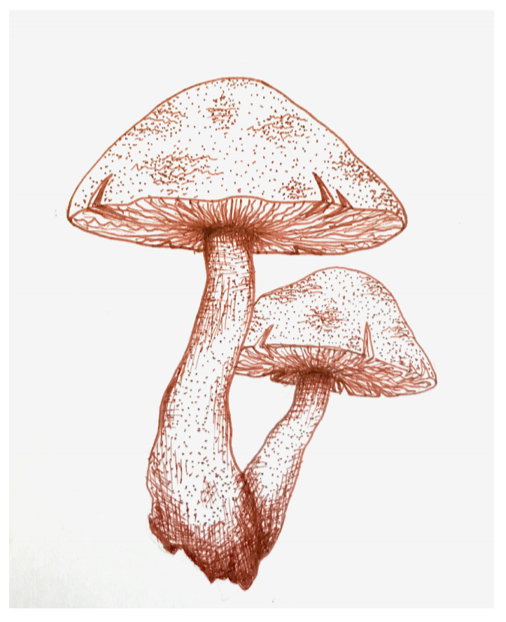
Two Shrooms, 2020, 8” x 5,” ink pen on paper

Flank Study, 2019, India ink on paper

Blind, 2019, 6”x 12,” pen and paper

Sea Tea, 2019, 6” x 6” x 4,” ceramic and ceramic glaze

Skull and Books, 2019, 18” x 24,” conté on paper

h1

Amazing Educators

June 20, 2020

YOU did it!

CONGRATULATIONS EDUCATORS

…for taking on most likely the biggest challenge in your teaching career and for getting the JOB DONE! As you close the door on another school year I wish you a relaxing summer. As you take time for yourself and reflect on the last months please know I am grateful for the commitment you make to your learners and to ARTS education!

h1

More Virtual Shows and Performances

June 18, 2020

Art, Music, K-Higher Education

CARRIE RICKER SCHOOL

Thanks to Art teacher Jen Williams for sharing her schools Virtual Art Show from Carrie Ricker School (RSU4) in Litchfield. It’s an 11 minute video on youtube showcasing the grades 3-5 student artwork – that is amazing. Two of the music tracks were created in music class with teacher Wade Johnston. View below.

AUBURN SCHOOLS VIRTUAL ART EXHIBITS

A great big thanks to Art teacher and Maine Arts Leadership Initiative (MALI) Teacher Leader Lynda Leonas for providing links to two wonderful Virtual Student Shows from where she teaches in Auburn!

RAYMOND ELEMENTARY SCHOOL

Music teacher Patricia Gordan shared her COVID story on the blog recently. The Raymond Elementary School chorus has been working since January on five songs for the spring concert. Since being away from school she has been working on one of the songs virtually: “Send Down the Rain” by Joyce Eilers. The song has been put together beautifully! SEND DOWN THE RAIN

Davia Hersey

HAMPDEN ACADEMY VIRTUAL ART GALLERY

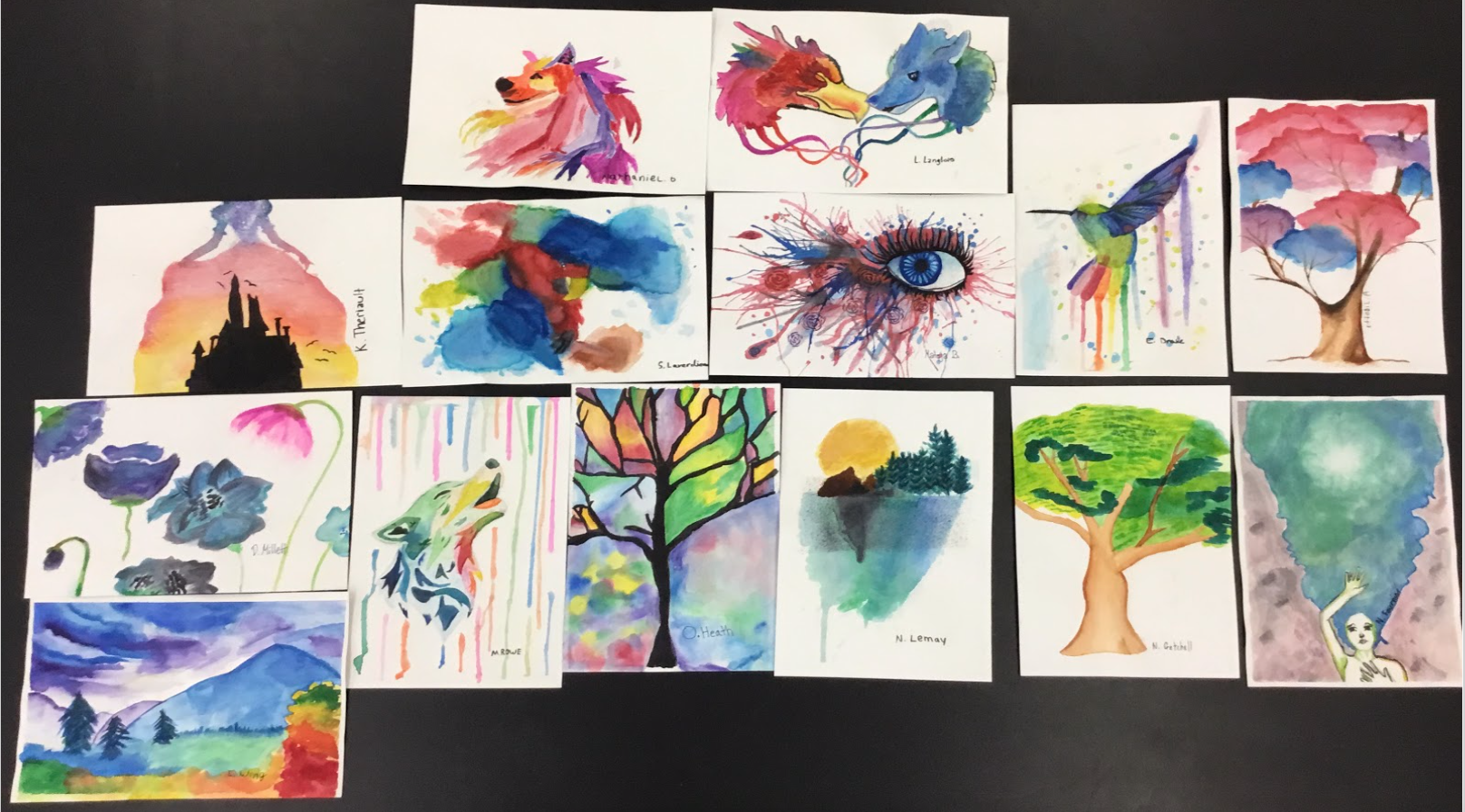
A section of the gallery features Paper Bag Portraits with this information: Let’s face it this quarantine has presented us with an opportunity to be creative. While looking for regular household items to use for art making, I found that a brown paper bag is a great size/ shape for a portrait study. It also has the effect of working on a piece of toned brown paper which is a nice place to start for a portrait. An exhibit with a plethora of ideas with thanks to Art teacher and Maine Arts Leadership Initiative (MALI) Teacher Leader Melanie Crowe!


CAMDEN HILLS REGIONAL HIGH SCHOOL

Guiding Light” – Text and Music by Matt LaBerge. Camden Hills Regional High School Chamber Singers and Alumni Virtual Choir. Director Music teacher Kim Murphy.

OAK HILL MIDDLE SCHOOL ART GALLERY

7th and 8th grade student artwork from Oak Hill Middle School is part of a virtual art show located at THIS LINK. Thank you to art teacher Gail Rodrigue-duBois for providing this opportunity.

USM JURIED STUDENT EXHIBIT

This special on-line exhibition was open to all USM students submitting work in any media. The juried show introduces students to a professional exhibition where they learn to prepare art for a professional setting, obtain feedback from art professionals, and have their work exposed to a wide range of viewers. Due to Coronavirus, the focus this year was on students learning how to photograph their art at home as well as uploading files – good skills to acquire for many future art opportunIties. GORHAM AND PORTLAND EXHIBIT

UNIVERSITY OF SOUTHERN MAINE

Thesis exhibits by Senior Seminar students Delaney Fone, Marissa Joly, Regan H. Mars, and Demel Ruff are now showcased online until August 15, 2020. The engagement of the public through the art, and the public presentation of students’ work are core components to the successful completion of the Art 401 Senior Seminar course, a senior capstone requirement course for the Bachelor of Fine Arts in Studio Art students, and a professional practice elective option for those obtaining their Bachelor of Arts studio degrees. SHOWCASE.