Posts Tagged ‘Maine Department of Education’

h1

LD 1422 Webinar

May 12, 2014

MAAI webinar, May 7

The third of a series of four webinars for the Maine Arts Assessment Initiative was held on Wednesday, May 7, entitled “LD 1422: digging deeper into the new Proficiency expectations for Maine’s schools and Arts classrooms”. In coming up with this particular webinar, facilitators Catherine Ring and Rob Westerberg were reacting to what they both believed has been a lot of misunderstanding and a great lack of clarity around the new law which states that all High Schools will be issuing diplomas, “based on student demonstration of proficiency”. The hour with nearly 20 attendees, including the Maine Department of Education new Visual and Performing Arts Specialist, Mr. Kevin Facer, allowed the opportunity to de-mystify it, and to discuss its ramifications as it pertains to Visual and Performing Arts.

The first part gave an overview of LD 1422, with links to valuable resources at the Maine Department of Education. Catherine and Rob went through the important details pertaining to how it relates to VPA, the Maine Guiding Principles which all students will be required to meet, and a few thoughts around the concept of “multiple pathways” to demonstrate proficiency. An extended conversation was had around proficiency in the arts and what that actually can mean in practice. Information very specific about what that looks like in the classroom, and articulation of the next steps for everyone to get there, regardless of where you are presently.

Finally, there was a give and take conversation around relevant questions and observations from the MAAI Teacher leaders last Summer. Some of these included, “Once established, this will inform curricular and instructional decisions?”, “How do we establish proficiencies while leaving room for creativity?”, “You cannot define proficiency until the “vagueness” is taken out of the standards… is this a road we want to go down?” and “How do we find time to do everything and teach at the same time?” Along the way, webinar attendees asked some very pointed questions as well and shared some great insights.

In debunking myths or misinterpretations, and showing how the Arts can proactively move toward proficiency, the hope is that attendees and those utilizing the archive and meeting plans can get a leg up, perhaps even on the other content areas in our own buildings, and truly be leaders as we move toward this next chapter in Maine education. In this vein, it is strongly encouraged that arts teachers spend some time viewing the archive: the live links alone will make this worth your while, while the conversations will add clarity for what is expected of arts teachers in the months and years to come.

On Wednesday, June 4, we will be holding a related webinar, featuring the ongoing work MAAI has undertaken creating a rich Resource Bank for the Visual and Performing Arts. Please plan on joining Catherine and Rob from 3:30 to 4:30 on that first Wednesday of June. In the meantime, you can access the archive of the May 7 webinar at http://stateofmaine.adobeconnect.com/maaimay2014/. You can access the professional development meeting plans that accompany the webinar at http://mainearts.maine.gov/Pages/Education/MAAI-Webinars (available tomorrow). You may utilize with this with your building and district VPA colleagues.

h1

Developing a Proficiency-Based System

April 23, 2014

What’s it all about?

In February the Maine Department of Education posted the following in their news room. I know that this would be helpful to some arts educators as you move forward with your work getting ready for the Proficiency Based High School diploma starting with the graduating class of 2018 (that is next years 9th graders). Go directly to the post by clicking here.

Join arts educators on Wednesday, May 7 for a discussion on the Proficiency-Based High School diploma on the next Maine Arts Assessment webinar, 3:30-4:30. To join the webinar (at 3:20) please go to http://stateofmaine.adobeconnect.com/maaimay2014. One contact hour is available.

The goal of proficiency-based education is to ensure that students acquire the knowledge and skills needed for success in college and careers and the centerpiece of achieving proficiency is a clear focus on learning and instruction.

In proficiency-based education, students who have not met standards receive additional academic support to help them achieve proficiency. When a student demonstrates proficiency in the expected standards, they move on in their education. The standards include content area knowledge and skills as well as those of the Maine Learning Results Guiding Principles, which include critical thinking and problem-solving.

Implementing the requirement that high schools award proficiency-based diplomas starting in 2018 places student demonstration of skills and knowledge at the center of instruction, assessments and reporting. School administrative units (SAUs) can work together or with other SAUs to develop their system for awarding of proficiency-based diplomas. Additionally, SAUs may add to the expectations for proficiency described in the content area standards and Guiding Principles

There is extensive guidance for developing educational systems that support student proficiency. The literature that describes proficiency-based education systems includes the work of Dr. John Hattie, professor and director of the Melbourne Education Research Institute at the University of Melbourne, Australia and Dr. Michael Fullan, Canadian educational researcher and former dean of the Ontario Institute for Studies in Education. Hattie’s synthesis of over 800 meta-studies is the result of 15 years of research. His recent publication Visible Learning for Teachers points to the top 10 influences on student learning. Fullan reminds school leaders to build a system of support for all learners. Fullan asserts that raising the bar (for all students) and closing the gap (for lower performing groups) is dependent on choosing four drivers that have been demonstrated to be effective at achieving measurable improvements in results for students.

As educators build proficiency-based systems, they must continuously evaluate how well their educational programs and pathways provide each student with the opportunity to learn and make progress toward demonstrating proficiency of Maine’s learning standards. The guidance offered by Hattie and Fullan can provide educators and community members with criteria against which they can evaluate and enhance proficiency-based education.

h1

What is Proficiency-Based Education?

March 13, 2014

Maine Department of Education resources on Proficiency-Based education and Standards

Screen shot 2014-03-09 at 9.53.10 PMThe information below can be found by clicking on this link or on the title of this section.

http://maine.gov/doe/proficiency/about/proficiency-based.html

What is Proficiency-Based Education?

Proficiency-based education refers to any system of academic instruction, assessment, grading and reporting that is based on students demonstrating mastery of the knowledge and skills they are expected to learn before they progress to the next lesson, get promoted to the next grade level or receive a diploma. In Maine, academic expectations and “proficiency” definitions for public-school courses, learning experiences, content areas and grade levels are outlined in the Maine Learning Results which includes the Guiding Principles, expectations for cross-disciplinary skills and life-long learning, and eight sets of content-area standards, including the Common Core State Standards in English language arts and mathematics.

The general goal of proficiency-based education is to ensure that students acquire the knowledge and skills that are deemed to be essential to success in school, higher education, careers and adult life. If students struggle to meet minimum expected standards, they receive additional instruction, practice time and academic support to help them achieve proficiency, but they do not progress in their education until expected standards are met.

The information below can be found by clicking on the link or on the word Standard.

http://www.maine.gov/doe/proficiency/standards/index.html?utm_source=Maine+Department+of+Education&utm_campaign=aa95a68366-RSS_EMAIL_CAMPAIGN&utm_medium=email&utm_term=0_21283d239d-aa95a68366-216954057

Standards

A critical component of any proficiency-based education system is a clearly articulated set of learning standards that define what students are expected to know and be able to do. The following set of resources provides support for schools to identify and align standards in a proficiency-based system.

  • Standards in a Proficiency-Based EducationA description of the role standards play in a proficiency-based diploma.
  • Maine’s Guiding Principles. A link to the Guiding Principles and the five standards for the Guiding Principles. In 2018 students are required to demonstrate proficiency of the five standards of the Guiding Principles.
  • Eight Content Areas of the Maine Learning Results. A link to the eight content areas. These content standards include career and education development, English language arts, health education and physical education, mathematics, science and technology, social studies, visual and performing arts, and world languages. Schools are required to provide a program of instruction aligned to  the eight content areas. In 2018 students are required to demonstrate proficiency in the standards of the eight content areas.
  • The Proficiency-Based Learning Simplified (PBLS) Model. A model showing the relationship among the Guiding Principles, the content standards, performance indicators and unit-based learning objectives.
  • Sample Content Area  Reporting Standards. A set of example content-area reporting standards and performance indicators. These examples show one way that schools can organize content area standards to report proficiency of the standards for the purposes of awarding a proficiency-based diploma.
  • Standards Resources. A set of design criteria, protocols and other resources for creating content area reporting standards.
h1

MDOE VPA Position

October 15, 2013

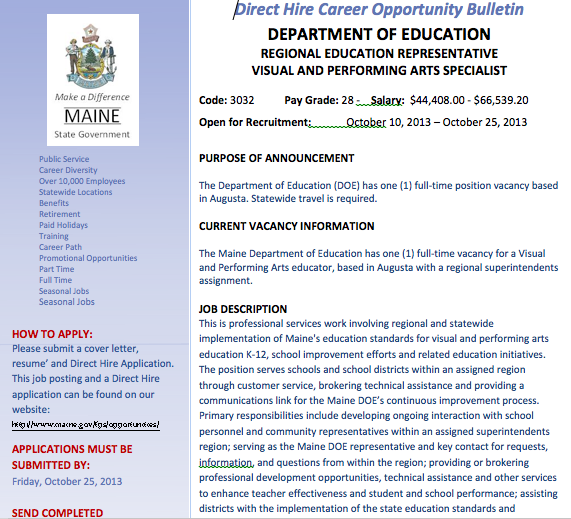
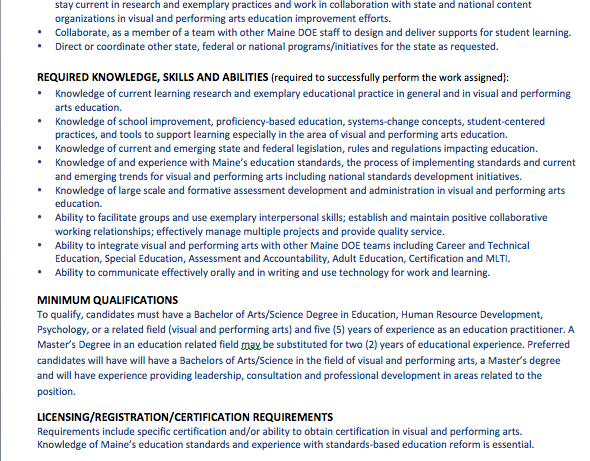
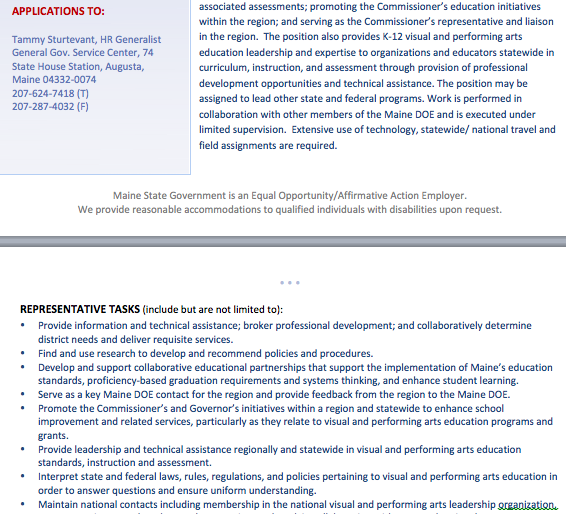
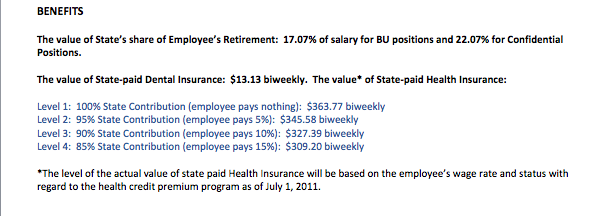
Visual and Performing Arts Specialist position, Maine Department of Education

The information below is the posting for the job at the Department that was mine until I left in September to go to the Maine Arts Commission. Since below is small, here is the information if you are interested in applying:

Submit a cover letter, resume and Direct Hire Application. This job posting and a Direct Hire application can be found at http://www.maine.gov/fps/opportunities/. PLEASE NOTE: The DEADLINE is OCTOBER 25, 2013.


Screen shot 2013-10-12 at 11.29.05 AM Screen shot 2013-10-12 at 11.29.53 AM Screen shot 2013-10-12 at 11.29.28 AM Screen shot 2013-10-12 at 11.30.13 AM

h1

MAAI Professional Development

April 29, 2013

Teacher Leaders and Leadership Team meet

MAII4-18

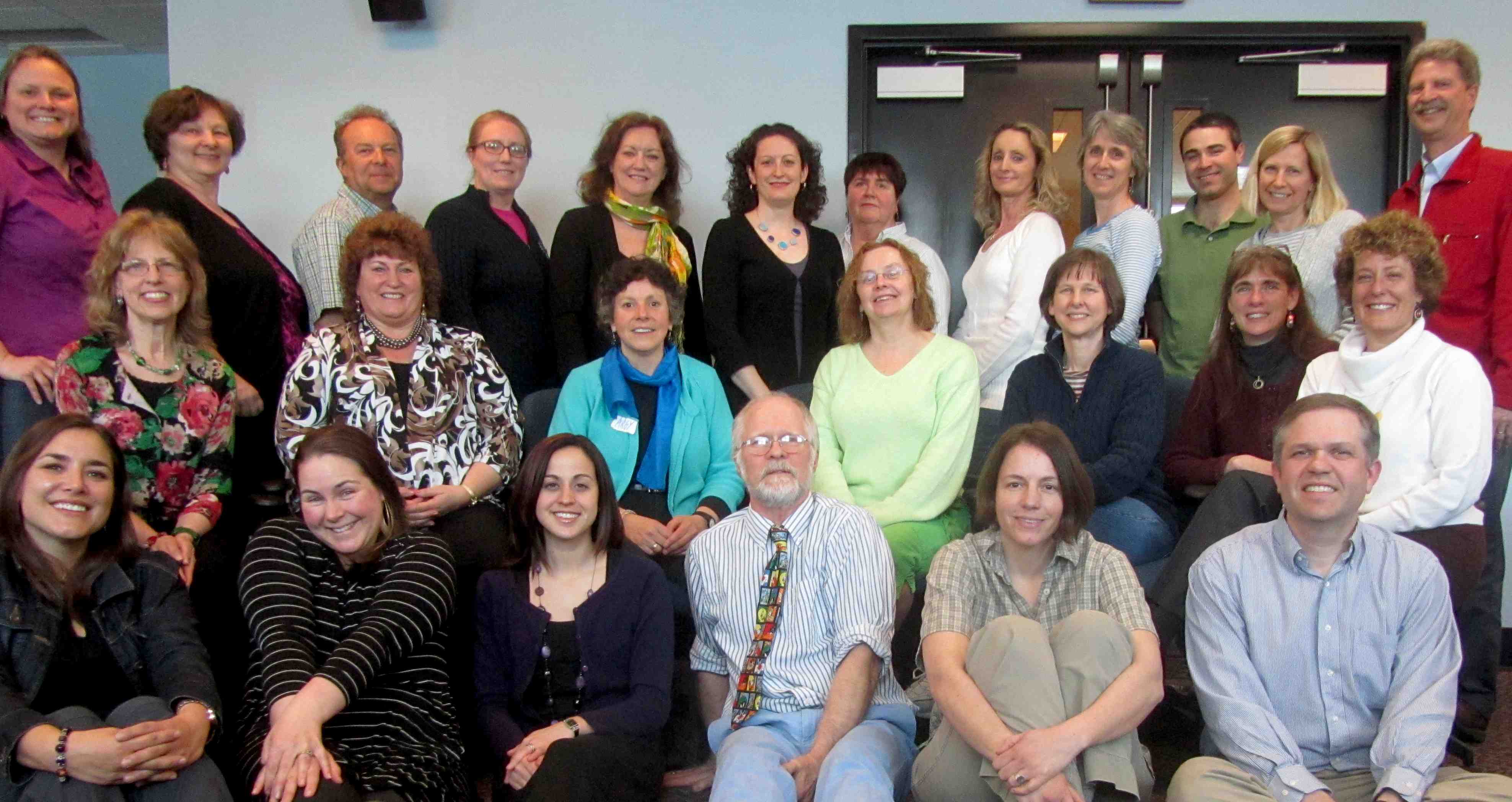
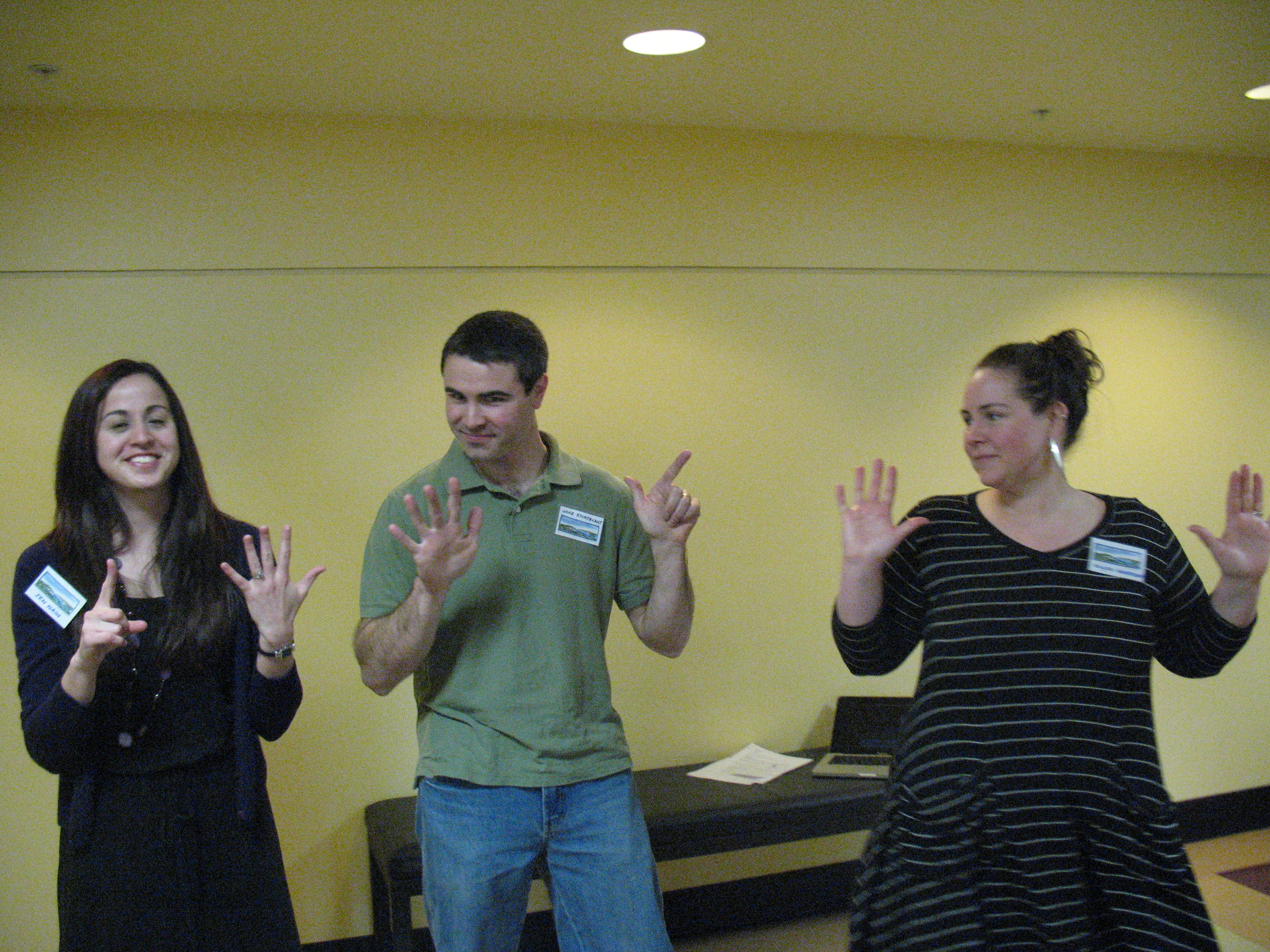
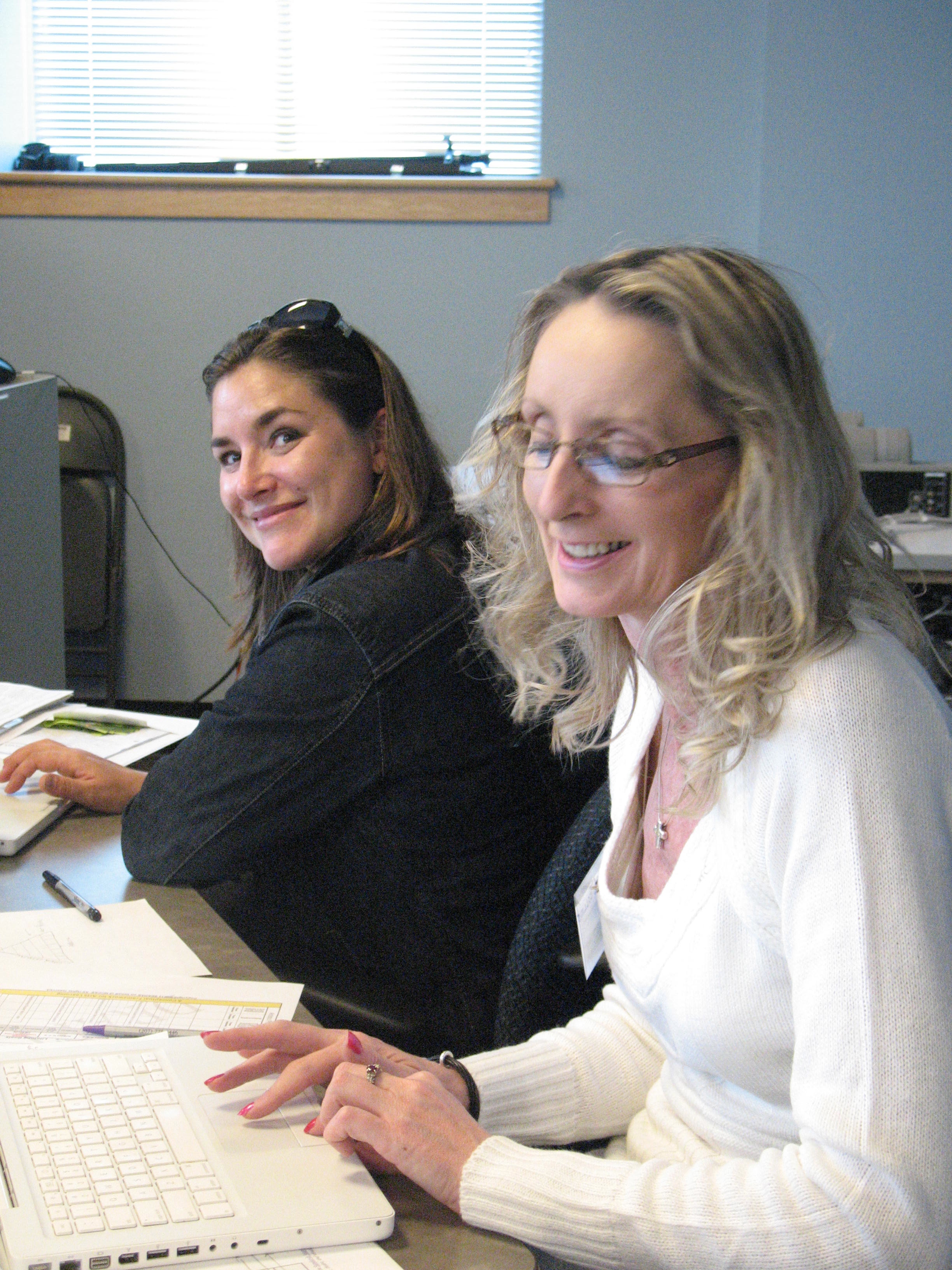
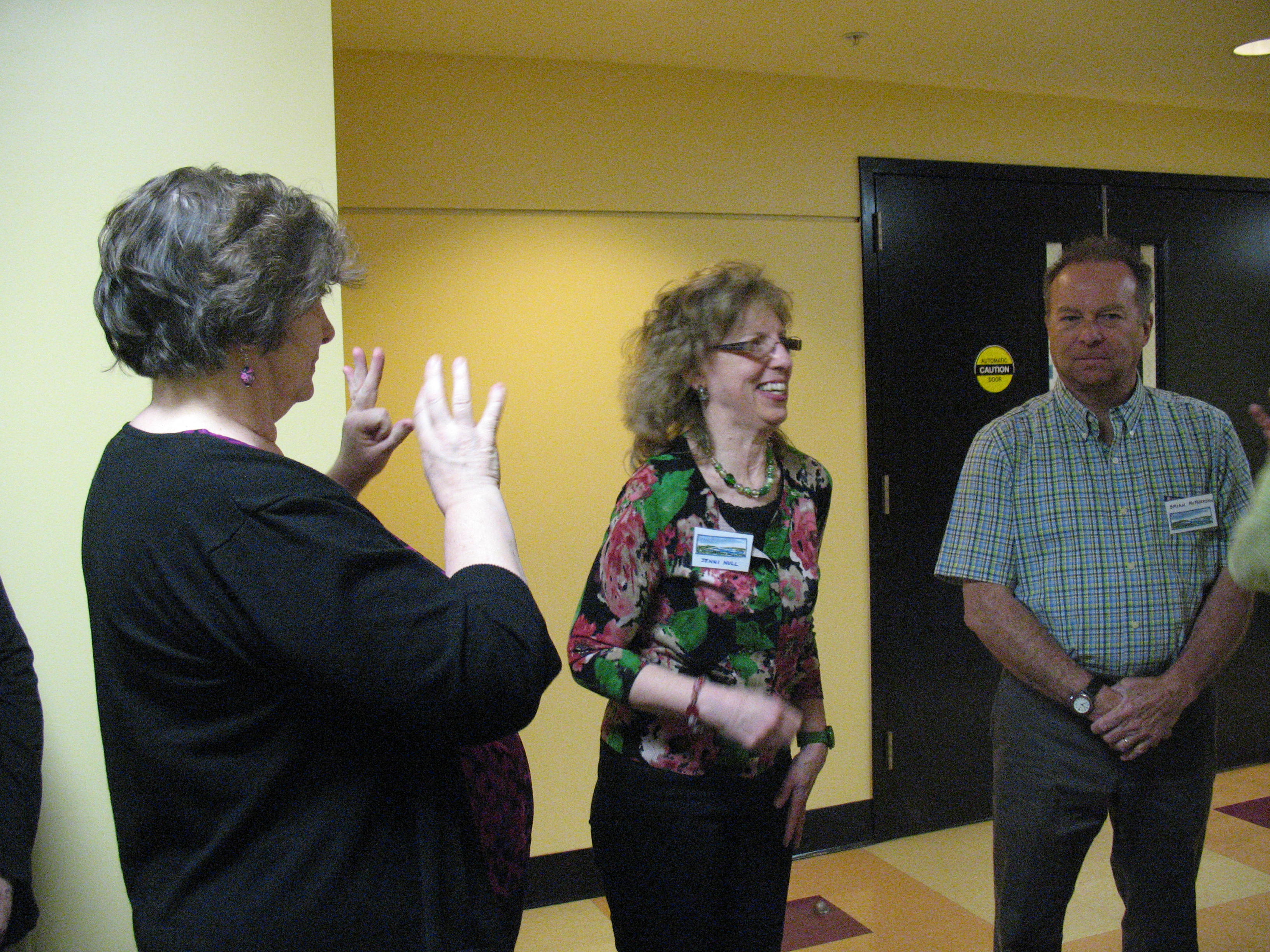
On the last week of Spring vacation 25 arts educators met at the Maine Department of Education (MDOE) to participate in a day-long professional development opportunity entitled: Understanding and Implementing Quality Arts Assessment. Earlier this school year 4 of the Maine Arts Assessment Initiative (MAAI) teacher leaders did some work around the idea of collecting examples of work that all visual and performing arts teachers could access and utilize in their classrooms. They reflected on the items that all of the teacher leaders from phase 1 had contributed to a Depository. After meeting in Google Hangout and building on ideas in a Google doc they determined that professional development was needed on what was meant by “quality”. Hence, on April 19 the day was devoted to the topic.

IMG_3205

Facilitator Wendy Cohen who had worked with the MDOE in 1997 as the national consultant on the Maine Learning Results, returned to help guide the work. The work centered around the following questions:

  • What do we already know, understand, and do related to high quality arts assessment?
  • What more can we learn?
  • What do we agree are high quality criteria for arts lessons and assessments? What criteria will MAAI commit to using together?
  • How do we provide feedback that supports reflection and growth in our collaborative work?

IMG_3236

Throughout the day there was plenty of discussion around all of the questions and the pre-reading assignments of articles, chapters in books, and review of websites helped guide segments of the day as well.

Below are some of the items that participants found useful from the day for their own teaching practices:

  • I’m excited by having a framework to work from in developing meta-rubrics for depository and future work for MAAI
  • Continue the development of assessment partnership between teacher and student
  • Creating a deeper understanding on the part of the student for the importance of assessment
  • I am going to take away the idea to make sure i put my own rubrics and assessments through some of the best practice filters
  • Discussions are invaluable with colleagues
  • Knowledge of creating rubrics of high quality and curiosity for Cornerstone rubrics
  • Being part of a larger whole was the most important part of today. I found it useful to talk/debate/discuss differing viewpoints, opinions, and understandings. I am taking with me a sense that there are colleagues out there who I can network with and that we share and informed opinion about arts assessment.  And of course there is more material on assessment out there to read than I can imagine.

IMG_3210

A great deal was accomplished and at the end of the day it was clear what needs to happen next to continue to collaborate and build on the work during phase 3 of the MAAI.

If you’d like to see a short video of the professional development opportunity please click here. If you are interested in participating in phase 3 please send me an email at argy.nestor@maine.gov.

IMG_3218

h1

Happy New Year!

January 1, 2013

Reflecting

I have taken some time today to reflect on 2012 and realize how fortunate I am to work with incredible arts educators in Maine and throughout the United States. Educators who are dedicated, passionate, and fully committed to providing an outstanding arts education for every student!

The year has been filled with many successes, some challenges, and sad losses! I wish I had time to go back through all the blog posts that I wrote in 2012 to help me remember all of the successes, challenges, and losses but instead I will provide the highlights.

Successes

The biggest success is the Maine Arts Assessment Initiative (MAAI). The second phase of MAAI officially kicked off in the spring with the identification of 20 teacher leaders. These arts educators joined the 18 teacher leaders from phase one. They participated in a 4-day institute in August at the Maine College of Art (MECA) in Portland where they expanded their knowledge in the areas of assessment, leadership, technology, and creativity. They have created workshops that are being delivered throughout this school year at the regional and mega-regional level. (Registration for the mega-regional workshops is now open – FREE and contact hours are available.) The topics of the sessions are as varied as the individual teacher leaders. I am so grateful for their commitment to the work that is making a difference for arts teachers and in arts classrooms across Maine each day. The impact on students learning is amazing!

And, uniquely the Mega-regional workshops are being co-sponsored with the Maine Learning Technology Initiative (MLTI). At these workshops their will be at least one session that is integrated with an MLTI integrator to provide a first time opportunity for educators!

The MAAI would not be possible without the commitment of the leadership team who have consistently shepherded the work. A GREAT BIG THANK YOU to Catherine Ring, Rob Westerberg, Jeff Beaudry, Bronwyn Sale, Pam Kinsey, and Matt Doiron. Their willingness to lead has made a difference! Close to 1000 arts educators have taken advantage of the professional development opportunities during the last year and a half.

The MAAI is aligned with the Maine Department of Education’s Strategic Plan: Education Evolving: Maine’s Plan for Putting Learners First.

In July Catherine and I flew to Denver for a national conference on arts assessment held at the Rocky Mountain College of Art + Design. I was proud to let others know of the grassroots efforts that Maine arts educators are involved with.

Art educator Chris Milliken, on sabbatical from Wells schools, has been following and doing research on the MAAI during this past year. He will join art teacher Lisa Marin and present a session on their findings at the Mega-regional workshop at Ellsworth High School on March 29, 2013.

Literacy is a statewide focus with the Literacy for ME being launched this fall and arts education has stepped up to become an integral part of the cross content literacy connections. Arts educators Jen Nash, Suzanne Goulet, and Lisa Gilman have been facilitating literacy webinars. Suzanne is also co-facilitating face to face sessions.

We have had 4 wonderful art exhibits at the Maine Department of Education during this past year from Maranacook Community Schools, Bangor Elementary and Middle Schools, Lake Region High School, and Messalonskee High School. Along with the exhibits we had receptions at the Blaine House with music and dance performances from each school/district. Participating and collaborating are First Lady Ann LePage, the Maine State Board of Education, and the Commissioner of Education, Steve Bowen.

First Lady Ann LePage partnered with the Barbara Bush Foundation to create a new baby journal to present to parents at hospitals across Maine when their babies are born. We did a call for K-8 artwork and 867 young artists submitted work. Thirty two pieces were selected to be published in the book which will be completed in June 2014.

The Maine arts education list-serv has grown to 1200 and the meartsed blog is growing as a source of information, not only for arts educators but for all educators. If you are not on the list-serv but would like to be, please email me at argy.nestor@maine.gov. On December 5, 2013 the blog set a record high day of 976 visitors. And a record high week happened during that same time of 2508 visitors. Thank you for taking the time to visit and informing others about what is available on the Maine arts education blog.

Challenges

  • Common Core standards for ELA and Math were released this year and teachers are being asked to incorporate them into their curricula.
  • We are waiting patiently for the next iteration of the national arts standards to be released in March March 2013.
  • Arts education in Maine is underserved. As the economy continues to be a challenge so is providing adequate arts education programs and teachers.
  • Determining how to provide quality arts education to be ready for the “proficiency based graduation requirement” slated for the graduating class of 2018.
  • What will determine “teacher effectiveness” for arts educators (the non-tested content)?

Sadness

In March music teacher Beth Polletto died in a car accident driving to school. Beth taught at Gray New Gloucester and Georgetown Central School. In May art teacher Jackie McTigue died in a car accident on her way to school. Jackie taught at Glenburn Elementary School. Both teachers were amazing arts educators and have left a huge hole. My friend and colleague 2nd grade teacher and Maine’s 2010 Teacher of the Year Kevin Grover died on Thanksgiving day after returning from a run. He is greatly missed by family, friends, and colleagues.

Looking forward

photoBeing forever optimistic, I know that 2013 will be filled with many more successes and that the challenges will be small mountains for us to climb. I invite you to collaborate with your colleagues to face the challenges and enjoy the successes. I hope you will continue to use the meartsed blog for resources and to access information. Many of you have heard me say “none of us is as smart as all of us”. Please continue to share information that I can pass on to others through the blog. I appreciate it!

I am confident that 2013 will be filled with opportunities for arts education to move forward. For example part of phase 2 of the MAAI is videotaping arts classrooms to respond to your request “what does a standards based arts education classroom look like?” So, Debi Lynne Baker (newly retired art teacher) will be visiting arts classrooms in the next few months and creating 4 short videos with examples. This is just one example of resources being developed for arts teachers.

I enjoy the challenges that my work at the Maine Department of Education provides for me. I especially love the opportunity to interact with you, the readers of the meartsed blog. So please take a moment when possible and drop me an email at argy.nestor@maine.gov or make a comment at the bottom of a blog post. You can subscribe to the blog by clicking on “Sign me up!” located on the right side of the front page of the blog.

I hope your year is filled with love and laughter and that you continue to provide outstanding opportunities for your students in arts education! Best Wishes for a wonderful 2013 and THANKS so much for all the good that you do in education!

Only one photo and one quote included in today’s post. Hopefully the photo will put a smile on your face and the quote will provide you with some “food for thought” as we dive into 2013!

The purpose of arts education is not to produce more artists, though that is a byproduct. The real purpose of arts education is to create complete human beings capable of leading successful and productive lives in a free society. – Dana Gioia, Chairman of the National Endowment for the Arts


h1

MAAI Regional Workshops

October 30, 2012

Underway throughout Maine

We are fortunate to have nineteen phase 2 arts education teacher leaders from the Maine Arts Assessment Initiative (MAAI) who have created workshops and started delivering them throughout Maine. The topics vary greatly and I am sure there is something for everyone!

You can find the schedule posted on the arts assessment page at the Maine Department of Education (MDOE) and below. You will notice that some of the details are missing below but as they become determined will be added to the MDOE page. The locations are spread out through the state to make it possible for you to attend a session in your region.

Along with the regional workshop, Mega-regional workshops are being planned as well. They will be posted in the near future. These workshops will be all day opportunities and we have teamed up with MLTI for Mega-regional workshops. If you have questions please be sure and email me at argy.nestor@maine.gov.

WORKSHOP TITLE AND DESCRIPTION DATE & LOCATION PRESENTE
MAAI: Impossible – What exactly is the Maine Arts Assessment Initiative and what direction are we headed in Maine Arts Education? November 2, 2012, 11:00am, Dexter Ridgeview School, District V Middle School Honors Festival Andria Chase, Instrumental, general music, grades 4,5, Corinth, RSU #64 and Sarah Williams, band/chorus grade, general music, grades 2-4, Glenburn Elementary School, RSU 26
Unpack it! Unwrap it! – Breaking down the Standards to Inform Instruction and Learning Information and techniques in breaking down the standards with students to provide a successful learning experience. November 2, 2012, 2:00pm to 3:00pm, Hancock Grammar Schoo Janie Snider, visual arts, grades K-8, Hancock Grammar & Laomoine Consolidated Schools
Getting Started: Incorporating Meaningful Assessment Within the Large Ensemble – A look at incorporating standards based learning and assessment within the large ensemble without the use of technology. District III High School Honors Festival & District III Junior High Honors Festival Drew Albert, Music director, Maranacook Community High School, RSU 38 and Ashley Smith, Choral Director, Brunswick High School, Brunswick School Department
There is no I in ART; Working Together to Promote Quality Art Education for all Learners – Presentation addressed to parents. The Maine Learning Results and assessment terminology will be explained in user-friendly terms. A hands-on component is also included, as the parents create a piece of art. The presentation can be tailored to suit the needs of arts educators, classroom teachers, and/or administrators. November 5, 2012, MSAD#32 Superintendent and Board of Directors
meeting, November 6, 2012 Ashland PTO meeting
Susan Beaulier, Visual Art, K-12 MSAD #32, Ashland
Assessment: This is NOT a Drive By (Assessment is MEANT for ME-student perspective) – Take a close look at a student performance in terms of formative and summative assessment. Through a hands-on exercise participants will determine what needs to be assessed and generate a rubric with the groups’ ideas. Information about the Maine Arts Assessment Initiative and resources will be shared. January 19, 2013, All Aroostook Fesitval Mari-Jo Hedman, Director of Music K-12, Fort Fairfield, MSAD #20
A Skeptic’s Exploration of Rubrics – The presentation follows my research into rubrics in order to improve both the clarity of the assessment instrument for myself and my students and to find ways to genuinely involve my students in the process. January 16, 2013, Messalonskee High School, RSU 18, 4:00 to 6:15 Leone Donovan, Visual Arts, Messalonskee High School, RSU 18
Formative and Summative Assessment Two Big  Words with Practical Applications in an Art Class – Participants will create a clay sculpture and get a hands-on understanding of both formative and summative assessment as part of the creative problem-solving process January 16, 2013, Messalonskee High School, RSU 18, 4:00 to 6:15 Gloria Hewett, visual arts, grades 6-8, Mount View Middle School, RSU 3
Literacy – A Gateway to Creativity – This workshop shows how literacy strategies can be utilized to improve students’ ability to analyze artwork. Stronger art analysis abilities can change and improve students’ understanding of their own creative problem-solving process.  Assessments are discussed as a vital part of this process. January 16, 2013, Messalonskee High School, RSU 18, 4:00 to 6:15 Pamela Ouellette, visual arts, Lisbon High School
Theatre Games: Learning By Doing – Using a Theatre-based rubric allows any teacher to assess students using the MLRs, thus “hitting” standards that may not have been accessible before.  Theatre techniques will be taught to show how to enhance curriculum/learning in any subject area. January 25, 26, 2013, Mt. Ararat High School Susan Jones, chorus, theatre, social studies, Medomak Valley High School, RSU 40
A journey into the 21st Century – Changing the Way I Teach!  – Come along on my journey as I talk about the changes I am making in my Keyboarding Class to fit the learning styles of all my students! January 26, 2013, District I Music Festival, Noble High School, North Berwick Jane Kirton, chorus, keyboarding, music for the soul, Sanford High School
Assessment, A Self Help Program for the Art Teacher – My journey to understanding the power of authentic assessment and using technology to manage student product and track student growth. TBA Danette Kerrigan, Visual Art, Sacopee Valley Middle School, MSAD 55
Sighting in Rubrics: How to Hit Educational Targets – This workshop revolves around the concept of General Rubrics and how they can be used to assess a variety of different products and processes. A good portion of the workshop involves assessment of student examples and discussion of how to interpret criteria using the rubric currently used in my classes. TBA Samantha Orchard, visual arts, Woodland Jr/Sr High School, Baileyville
Conditions for a Creative Classroom Using formative assessments to promote creative thinking and student voice in the classroom. TBA Suzanne Southworth, visual arts, Camden Hills Regional High School
The Sweet Spot: Where Learning Meets Engagement              This presentation discusses the importance of engaging students in their learning and tools that can support them. TBA Barbie Weed, visual art, grades 5-8, Gray-New Gloucester Middle School, MSAD 15
How can we meaningfully assess a large and diverse student population in music classrooms?      A brief overview of: why to assess, formative verses summative, when to use which type, examples of different assessments, and Q & A TBA Andrea Wollstadt, music, grades k-5, Biddleford Intermediate School, John F. Kennedy Memorial School, Biddeford
Assessment: To Educate and Advocate!There are many benefits to bringing authentic assessment into the music classroom. This workshop will discuss fundamental core benefits by identifying connections to the student, the community at large and the classroom teacher. In doing so, the case is made for utilizing assessment as a core component of the educational landscape for all Arts educators. TBA Jarika Olberg, choral/general music, grades 2-12, Waynflete School, Portland
h1

Maine Arts Assessment Initiative Summer Institute

July 30, 2012

First day

The last week has been crazy, busy getting ready for the summer institute which starts this morning. The Maine Department of Education’s second summer institute of the Maine Arts Assessment Institute gets underway today at Maine College of Art Thirty five teacher leaders started arriving in Portland yesterday to be ready for the early start at Maine College of Art. The leadership team met to go over the details of the daily schedule and participants continued to communicate electronically.

Over the past six weeks the 20 phase 2 teacher leaders have been communicating on the initiative wiki by responding to questions and having conversations on assessment, leadership, and technology. The standards based, student centered institute will continue to ask questions and provide the time for participants to discuss ideas, share practice, and explore options. Two essential ideas identified by Stiggins in Classroom Assessment for Student Learning:

  1. Teachers must be masters of the five standards of assessment quality in order to communicate accurate, dependable assessment information to any audience or assessment user.
  2. Students are the key users of assessment information and one of the best practices for teachers to improve student use of assessment information is to involve them directly in classroom assessment in appropriate ways as much as possible. 

    Throughout the week I will blog on the institute and keep you posted on the progress. I am excited about the possibilities and opportunities this provides, not only directly for the institute’s participants but for all Maine arts teachers and arts classes this could reach. One outcome of the week is that the teacher leaders will put together a workshop to present at the regional level. This allows the initiative to come to your region of the state! This work aligns with the Department’s strategic plan Education Evolving.


h1

Bangor Elementary and Middle Schools Artwork

June 3, 2012

Artwork at Maine Department of Education

During April, May, and June there are 39 pieces of artwork are on display from elementary and middle school students from Bangor. Congratulations to the students for a JOB WELL DONE! The student artwork can be seen online by clicking here or it can be found on the right side of the front page of this blog.

The artwork may be viewed in person during office hours at the Maine Department of Education, 5th floor of the Cross Building, in Augusta. On Wednesday, June 6th, the Celebration of Arts Education is scheduled at the Blaine House and the Department where students will be recognized for their artwork. Students will be recognized by Maine’s First Lady Ann LePage, Chair of the State Board of Education James Banks, and the Commissioner of Education Steve Bowen.

During the ceremony three kindergarten students from the Fruit Street School will perform a song they have created, writing the music and lyrics with the guidance of their music teacher Anne Chamberlain-Small. A great big THANK YOU to Anne and the following art teachers for their contributions:

  • William S. Cohen School – Art Teacher Katrina Lajoie
  • Fourteenth Street School and Downeast School  – Art Teacher Julie Hayes
  • Fruit Street School – Art Teacher Wendy Libby
  • James F. Doughty School – Art Teacher Marta Robbins
  • Mary Snow School – Art Teacher Deborah Jellison
  • Vine Street School – Art Teacher Heidi Crahan

h1

Competency Based, Student Centered, Standards Based Education

April 29, 2012

Clarification

Standards have been around for a long time but during the last (about a) year the conversation has become more serious about what that means. As I’ve said before, the ground is shifting beneath us, and the transition of education to meeting the needs of all students is more focused.

The term standards-based, competency based, and student centered are terms that we are hearing more and more. The terms are not just for high school students but include elementary, middle, AND high schools. So, what is the different now from 1997 when the state originally adopted the standards document, Maine Learning Results? I see three differences:

  1. The Maine legislature has put in place LD 1422 which states that the graduating class will leave high school having successfully shown that they have achieved the standards. It will no longer be determined by completing each year, K-12, of schooling. Not based on seat time, but showing proficiency of meeting the standards.
  2. The Maine Department of Education recently released the strategic plan called Education Evolving: Maine’s Plan for Putting Learners First which “sets out objectives and action steps for building an education system in Maine that meets the needs of all learners, from early childhood into adulthood, and prepares them for college, careers, and civic life.”
  3. Educators who have been around a long time participating in many conversations are more than ready to take action. The Maine Coalition for Customized Learning which started as a handful of school districts working with the Reinventing Schools Coalition work is now up to 20 Maine school districts. They are working collaboratively to share and create resources to continue to move in the standards based direction. The first cohort started in July 2009.

Not to long ago I read in the news two articles that provide information on what is happening across the country with education in this standards based/proficiency based/ competency based environment. I hope you will have the time to read about our neighboring state, New Hampshire, to learn about their work in an article called N.H. Schools Embrace Competency-Based Learning written by Catherine Gewertz and published online February 7, 2012 (Education Week). And, the second article called ‘Competency’ Approach Challenges Colo. District written by Christine A. Samuels and published online March 26, 2012 (Education Week) provides a look at Adams 50 who has been working on a standards based system for several years.