Posts Tagged ‘Maine DOE’

h1

Teach Maine Center

October 24, 2023

Educator workforce in Maine

The Maine Department of Education (DOE) and Educate Maine have partnered to develop the Teach Maine Center to support and advance a vibrant educator workforce in Maine that enables all students to thrive.

The Teach Maine Center will engage, empower, and unite educators across the state to incubate and develop strategies, supports, and professional learning connected to the Teach Maine Plan.

It is encouraging to learn that the Maine DOE and Educate Maine are taking action to face the teacher shortage problem in Maine. This is a critical time since educators and schools are faced with increased student and community needs.   

“Maine is a place that values and respects our educators and we are turbocharging that with the Teach Maine Center. The vision is to create a hub by teachers and for teachers that allows them to collaborate, innovate, and lead our profession and public education forward in Maine,” said Maine Education Commissioner Pender Makin.  

“We are excited to announce this groundbreaking partnership with the Maine Department of Education to create the Teach Maine Center.  This partnership represents our shared commitment to strengthen, grow and diversify Maine’s educator workforce.  We look forward to this important work and the positive impact it will have on students, teachers, the teaching profession, and the future of education in Maine,” said Educate Maine Executive Director Jason Judd. 

Through December 2024, partners will identify and meet with stakeholders around teacher workforce issues, conduct 16 in-person and virtual county-level forums with educators to get input on teacher recruitment and retention, complete a landscape analysis of the educator workforce, solicit statewide educator input on ongoing professional development needs, and launch a marketing campaign focused on encouraging people to join Maine’s educator workforce. In collaboration with key education organizations and the Maine DOE, Educate Maine will assemble an advisory committee to provide input throughout the initial phases of the Center.

This information is taken from a more comprehensive pieces found on the ‘news page’ on the Educate Maine website at THIS LINK.

h1

Student Opportunity

October 20, 2023

Applications open

The Maine Department of Education (DOE) is opening applications for the 2023/2024 Student Cabinet, a group of students that meet regularly with the Maine DOE and each other to discuss educational opportunities, improvements, and policy.

Facilitated by student representatives from the Maine State Board of Education, the purpose of the Student Cabinet is to provide a forum for Maine students’ voices to be heard. This is the fourth year the Maine DOE has appointed students to a Student Cabinet with the goal of integrating student voices into decision-making on education issues that impact their journey through Maine’s education system.

In past years students have helped in identifying mental health needs at school, raised issues of racial equity, and helped brainstorm ways to individualize learning. Last year, the Student Cabinet presented their mental health concerns and ideas to Maine’s Legislative Committee on Education and Cultural Affairs.

The Maine DOE is especially interested in having perspectives from students with diverse experiences, interests, cultures, and backgrounds represented on the Student Cabinet. It is important that the student cabinet include members from all geographical locations across Maine, and who are able to represent and advocate for underrepresented groups of students throughout Maine.

There are 12-24 seats that are open for students in grades 4 – 12 and the first year of college. The newly appointed members will serve for a term of two years starting this November. All 16 counties in Maine will be represented on the Student Cabinet.

Selected cabinet members will be expected to attend scheduled meetings, prepare for each meeting as needed, work in a collaborative manner with one another and with Department staff as needed, and express views and opinions openly, constructively, and respectfully.

Scheduled meetings:
There will be two in-person, all-day meetings scheduled in Augusta in December 2023 and Spring 2024, accompanied by monthly virtual meetings held on the fourth Thursday of the month from December 2023 through the spring of 2024 from 3:00 – 4:00 pm via Zoom. For in-person meetings, travel reimbursement will be provided and travel arrangements can also be made for students if needed.

Instructions for applying:
Students interested in serving on the Maine DOE Student Cabinet will need to submit the electronic application by November 15, 2023. Applications can be submitted electronically here.

For more information contact Rachel Paling, Communications & Outreach Manager, Maine Department of Education at rachel.paling@maine.gov.

h1

Arts Ed Advocacy Day

March 22, 2021

Documentation of the day – February 17

If you were able to attend the virtual plenary sessions on February 17 in recognition of Arts Education Advocacy Day you are aware of the outstanding opportunity the 2 hour session provided. If you were not there, you’re in luck. All of the sessions were recorded and embedded below. The day was organized by the Maine Alliance for Arts Education (MAAE) in collaboration with the leaders of the ABC – Arts Are Basic Coalition.

The first one below actually took place during the last part of Arts Education Advocacy Day, the ABC Student Advocacy Initiatives. We know at the heart of providing quality arts education programs and access to it are students! I salute all the Maine students who care deeply for the arts and are afforded an excellent curriculum. And, to all the arts educators striving to provide access to these programs, thank you!

ABC Student Advocacy Initiative

Governor Janet T. Mills Arts Ed Advocacy Message

Remarks from Maine Arts Commission Arts Education Director Martha Piscuskas

Conversation with Maine Art Education Association President Lynda Leonas and Argy Nestor

Visual Art Advocacy Video Maine Minds

Conversation with Maine Educational Theatre Association leader Kailey Smith and Beth Lambert

Maine Department of Education – Kellie Bailey, Social/Emotional Learning and Trauma-Informed Practices Specialist, Commissioner Pender Makin, and Jason Anderson, Visual and Performing Arts Specialist

Conversation with Maine Dance Educator representative Thornton Academy Dance Educator Emma Campbell and MaryEllen Schaper

Conversation with Maine Music Educators Association President Sandra Barry and Kaitlin Young

Music Advocacy Video

Thank you to Susan Potters, Executive Director of MAAE and Melissa Birkhold MAAE Advocacy Coordinator for the plenary session for Maine Arts Ed Advocacy Day and making these individual videos available. The videos are also available on the MAAE website at THIS LINK.

h1

Arts Education Advocacy Day

February 16, 2021

Don’t miss it!

REGISTER HERE TO PARTICIPATE

h1

School Emergency Relief Fund

February 6, 2021

Applications being accepted by schools

This blog post provides information on obtaining federal funding that has come Maine’s way. These funds are earmarked as “relief funds” to help support educational programs because of the pandemic. The Maine Arts Commission encourages you to make a list of materials, supplies, instruments, tools, software and whatever else you have needed or still need during the pandemic. We all know that your programs have been impacted greatly. Please make a list and an appointment to see your administrator so your needs can go into the school/district application.

From the Maine Department of Education

We are pleased to share an exciting update with our partners in education regarding the Elementary and Secondary School Emergency Relief (ESSER II) funds. Maine has received $183,138,601 for the Elementary and Secondary School Emergency Relief Fund (ESSER II) through the Coronavirus Response and Relief Supplemental Appropriations (CRRSA) Act. The ESSER II application is now available in Maine’s Consolidated Federal Grant portal. Completed applications will be reviewed on a rolling basis beginning Tuesday, February 2, 2021.  

The current ESSER FAQs from the U.S. Department of Education are available here and here. As a reminder, CRRSA also provides support for non-public schools through the Governor’s Emergency Education Relief (GEER II) funds.

Earlier this week the U.S. Department of released the Emergency Assistance for Non-Public Schools (EANS) webpage available here. Maine has been allocated $12,751,099 for eligible non-public schools based on the State’s relative number of children aged 5 through 17 at or below 185 percent of poverty who are enrolled in non-public schools. More information regarding the EANS application is forthcoming. 

Please contact Karen Kusiak at Karen.Kusiak@maine.gov with any questions.  

h1

In Today’s News

June 24, 2020

Maine DOE begins work of creating ME Learning Platform

Created by Maine educators for Maine educators and students, the Department of Education is proud to announce that the work of creating the Maine Learning Platform has begun.  To provide anytime, anywhere learning options and resources for educators, students and their families, the Maine Department of Education, in collaboration with curriculum coordinators, Maine educational community organizations, museums, learning centers, and Maine educators, is creating a library of asynchronous learning modules that are aligned to Maine’s Learning Results.

Developed by the over 400 Maine educators who have answered the call to create innovative lessons, these modules will be integrated to ensure that learning is synthesized across subject areas, and are project-based to encourage learning that is active and engaging.

The Department is developing a custom web-based platform to house these modules. The platform will provide educators and families with a bank of resources, with which they can provide students robust learning opportunities.  These modules could be utilized for enhancing lessons, remediation, enrichment, credit recovery, or for use during remote learning – whenever a student cannot access classroom instruction.

Each module will be designed around the essential question, “How do I Interact with and Impact My World?” The format will organize modules by grade level in grades pk-5, and by grade span for grades 6-8 and 9-12.

The essential elements of each of the modules include:

  • A project-based format
  • Best practices in asynchronous lesson design
  • Embedded formative assessments and opportunities for students to check for understanding
  • Standards in two or more content areas, three preferred
  • Opportunities to demonstrate growth in one or more of the Guiding Principles
  • Content that is inclusive of the experiences and multi-cultural backgrounds of  students.
  • Considerations in accommodations for special education and English Learners
  • Embedded elements of social/emotional/behavioral learning and trauma-informed practices

During the first planning meeting that was held on June 15, 2020 the elements, format, and timeline were reviewed with the dynamic group of teachers, and the brainstorming and collaboration began for creating modules for a quarter of a school year.

The platform will be launched at the beginning of September, and feedback on the modules will inform the continued development process throughout the 2020-2021 school year. We are excited by the professional collaboration and creativity that the platform will ignite with Maine educators, and by the development of organic, Maine-based learning resources and opportunities.

h1

Maine DOE

April 8, 2020

Guidance from Commissioner of Education for remainder of school year

Dear Champions of Education,

As you may know, US CDC guidance recommends an 8 to 20 week timeframe for avoiding large group/in-person instruction once there is evidence of community transmission of COVID-19.  Therefore, I am recommending, with the support of the Governor, that you begin to plan to replace classroom/group instruction with remote/distance learning for the remainder of the 2019-2020 school year.

It is difficult to make such a recommendation, recognizing the profound challenge of reinventing public education and the many culminating events and rites of passage that educators and students anticipate all year long. I also realize that this recommendation will be difficult for families to hear, given the challenges of childcare and managing school expectations on top of the other significant impacts of this state and national emergency.

That said, I believe it is extremely important for school leaders to have as much information as possible in order to best prepare educators, students, and communities for a longer period of remote learning and to promote opportunities for redesigned celebrations and alternative ways to provide both continuity and closure.

Please know that you’re not in this alone. The DOE team is available Monday through Friday – with daily “office hours” for discussing and sharing challenges and solutions; free professional development offerings; an enormous list of online and “unplugged” resources for every possible subject/content area, topic, and grade level; and as many resources as we can make available to you and your schools.  The schedule can be found here.

Here are some additional updates, requirements, and recommendations:

SAT and student grades:  

As you know, the SAT was used as part of our ESSA accountability assessment system, and we have received a waiver exempting us from the ESSA assessments.  We will not be requiring, nor offering, the SAT to this year’s 3rd year high school students, and we intend to invite educators and school/school administrative unit (SAU) leaders to assist us as we redesign a state assessment system that will authentically measure school success and student achievement in a more useful and meaningful way.

We have confirmed that the SAT is not required for admission, nor will it be required as a screener for any program, at any Maine college or university.  In addition, we are hearing that colleges and university across the country are following suit. NPR reported about this last week.

We also learned that UMS will be using a pass/fail system this year, including prerequisites for competitive and advanced courses, and that they recognize that students from the current cohort of applicants may also be receiving pass/fail grades. They are developing innovative and flexible admissions criteria and processes.

We have heard from many SAUs and schools who are using a variety of grading practices during this emergency education situation: some schools are maintaining grading practices, while others are implementing Pass/Fail. Some schools are only providing feedback instead of grades, and some are only including grades that improve a student’s overall GPA or academic standing. Ultimately this is a local determination, however we would encourage SAUs and regions to discuss and determine a system that holds harmless students for whom conditions are outside of their control.

Enrolling new students:

There are many students whose families are experiencing housing disruption or changes during this COVID emergency, and we’ve had several calls regarding whether schools are expected to register new students if they move into a SAU. The answer is, “Yes.”  It is important to ensure there are directions that are publicly available on how new students can enroll during this pandemic.

Commissioner’s Conference for superintendents:

We apologize for this inconvenience, but we will be postponing the Commissioner’s Conference that had been scheduled to take place in June.  We are looking for another date and will share this as soon as possible.

Providing meals during April Break:

We have applied for and received approval for a waiver that will allow for SAUs to continue approved Unanticipated School Closure meal service operations during April Break. You can claim reimbursement for meals served at approved sites over the break on the days of the week you have been approved to serve.

Continuity of Education Plans:

SAUs do not need to send us your plans – only the minutes from the board meeting at which your continuity of education plan was approved by your board – in order to receive the waiver on the minimum required school days. If you need assistance or resources for ensuring learning opportunities for your students, please reach out to the Department.  A copy of the minutes should be submitted here.

Take care of yourselves and your people:

Unlike the well-defined grief of a definite and specific loss, the nebulous impacts from COVID-19 are disorienting and hard to describe; we’re experiencing the loss of our basic and reliable systems and structures.  While the economy, health care, and education systems are disrupted, and when the fabric of our social habits and traditions disintegrates into forced isolation, people understandably lose the comfort of predictability and control.  I mention this here because it can be helpful to acknowledge grief for what it is and to remember that the process actually helps us to adapt to new conditions and to become resilient.

Collectively, Maine schools have provided a much-needed sense of security for students, families, and communities during this extraordinarily challenging time, and all of us at DOE continue to be in awe of your leadership and your commitment to providing the best educational services possible for your students.

As always, thank you for everything you do on behalf of your students and our education system!

–  Pender Makin

Pronouns: she, her, hers

Commissioner, Maine Department of Education

Posted April 7, 2020

h1

Argy’s Journey Continues

June 4, 2019

Walking down memory lane

What a joy it has been during the last few weeks to reflect at the 43 years of my educational pathway. I am fortunate to have selected a career that has provided learning experiences that have expanded my thinking and understanding of how individual learners learn and how we are part of a world of learning connections. I have met and worked (and played) with amazing educators from Maine and around the world.

NEXT STEPS

So, where am I headed next? I have many ideas of what I want to do but I’m going to start by building on the natural next steps.

  • I am working towards creating a fund for Maine arts educators and teaching artists to travel and learn. I’ve had amazing opportunities to travel and every one of them has influenced my creative thinking and doing. I want to support educators who have dreams to travel and learn. I know that when a person returns from traveling that it impacts the learning environment which has the potential to plant seeds and open doors for students. I’m working on the idea with big thinkers and funders. Once I work out the details I will ask you to contribute to the fund. If everyone gives a little we can build the fund more quickly.
  • I will be serving as the director of the middle school at Sweetland School, an arts integrated school in Hope. Lindsay Pinchbeck started the Reggio Emilia inspired school five years ago at the Sweet Tree Arts Center. I have served as an advisor to the school and am excited about the possibilities for the students entering middle school. I will support the teaching team and do some arts integrated teaching as well.
  • In 2016 Lindsay and I traveled to Mpamila Village in Malawi to provide teacher workshops on arts integration. Of course, I gained more than I offered and for the last 3 years continued to support the teachers with 8 other educators providing workshops. My work will go on with Go! Malawi, an organization in Maine that was started by a former student. In July 2020 we will guide the Mpamila teachers to create their own workshops to facilitate at a country wide conference.
  • Malawi led to the innovative work of HundrED and I will continue to share innovative work of the organization. I plan to return to Helsinki this fall for the summit and am especially excited about their Youth Ambassador program.

I will continue to blog through the summer on this blog and communicate with the Maine arts education list-serv about the progress of my work. Please communicate with me at meartsed@gmail.com or through the Maine Arts Education blog below.

WHERE I’VE BEEN 

Like anyone in education we know the paychecks aren’t huge but my life has been rich with opportunities. From the ‘ah-ha’ moments of an individual student’s accomplishment to the excitement of a teacher connecting with other educators and everything in between. When I was teaching every day one thing became clear – hanging out in a middle school art classroom was a continuous learning opportunity and I loved it. My students and colleagues taught me and helped grow my skills and passions as a human being. I received so much than I gave. Being part of an interdisciplinary teaching team where visual art was valued by others as much as I valued it was amazing! When I was recognized in 1995 as the Maine Teacher of the Year I realized how fortunate I was to be honored for such humbling work.

When I left my art room after 30 years it wasn’t easy, teaching was what I knew and loved. But the challenge helped me see more clearly that my mission as an educator was taking a turn. My own son said to me: “Mom, your classroom is just going to get a little larger.” And he was ‘spot on’ (as Rob Westerberg says) about that. Once I fully committed to the work at the state I realized that my “teacher lens” was to guide me. I knew what I needed and wanted as a teacher so I honored that and moved forward collaborating with others to make that happen. Visiting hundreds of arts classrooms in schools across the state was an incredible learning opportunity. The visits led to the 1200 member list-serv and daily communication on this blog.

I AM GRATEFUL

Along the way others continued to collaborate and provide support. I am soooo grateful for the many connections, some of which I mention below.

Carol Trimble

Carol Trimble who was the executive director of Maine Alliance for Arts Education (MAAE) was supportive from day one when I arrived at DOE. Together we brought back the state wide arts education conference and I helped with the first state wide arts education census and other MAAE projects. Carol was and continues to be an incredible mentor with a clear mind who can articulate ideas like no one I know.

Many of you remember David Patterson who sadly passed away from cancer in July 2014 at the age of 50. His wisdom and encouragement taught me to believe in the power of communication to form the community. He pushed, questioned, taught and encouraged me every step of the way. This blog wouldn’t be if it wasn’t for him.

Anne Kofler was the elementary art teacher who taught ‘downstairs’ while I taught middle school ‘upstairs’. She inspired me to go the extra mile and made me a better person in so many ways. She continued to support me, after I left the classroom, to take on the ‘big challenges’ and ‘lean in’. All the while herself, taking on cancer, which eventually took her away in May 2016. Her love for using her travels to inspire her students continues to impact me.
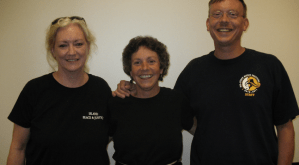
Catherine, myself, Rob

Catherine Ring and Rob Westerberg took a chance when I invited them to travel to NH in the summer of 2010 for the New England Institute on Assessment. I am so grateful that they did – I continue to learn from both of them! Together we created the Maine Arts Assessment Initiative (MAAI) by listening to the needs of the field, reviewing the research, brainstorming and planning. The first MAAI leadership team represented PreK-higher education and helped launch the idea without funding in place. There were tears in my eyes when I heard Jeff Beaudry say “we can sleep on the floor and eat peanut butter and jelly sandwiches if we have to, there’s no turning back now.” And, launch we did with 18 amazing teacher leaders at Maine College of Art for the 4-day summer institute. At the end of the institute the teacher leaders made it clear that we weren’t moving into Phase 2 without a place for them.
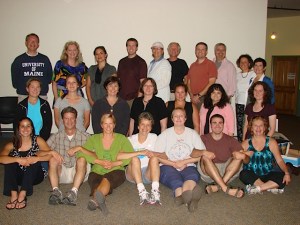
Phase I Teacher Leaders

Since that first summer, the initiative has grown into a strong leadership program, influencing and inspiring, and the shift in assessment practices around the state took hold. When we traveled to Washington, D.C. for the Teach to Lead summit in August 2015 MAAI shifted to the Maine Arts Leadership Initiative (MALI). Teachers with high expectations for themselves and a passion for learning – teaching other teachers has been the foundation of the success. Educators willing to share their ideas, use research, build on their knowledge, and support the network has worked well for Maine. Title II funds helped to support the summer institutes, critical friend days, mega conferences, winter retreats, stipends for participants, and statewide conferences over the next several years. The partnerships and associations with the Maine visual and performing arts organizations and institutions has been an enormous part – too many to name all of them. Thank you all!
In 2013 i moved to the Maine Arts Commission and the work (and play) of MALI expanded to include teaching artists and community arts organizations. They have provided a broader view of arts education. We’ve all been enriched by their participation in MALI. Linking arms with the greater community of arts and arts education is another way to support learners of all ages in their educational paths. I am especially grateful to the 108 teacher leaders and teaching artist leaders who continue to do amazing work in arts education and as artists!

There are so many more individuals and organizations to thank but this blog post could go on for pages. The people I mentioned are ‘giants’ and every day I stand on their shoulders and fortunately continue to learn from them!

BEYOND MAINE

Throughout the 13 years at the state I’ve had many opportunities to connect with and learn from others outside of Maine. Presentations and workshops at regional and national conferences about MALI, serving in leadership roles with the State Education Agency Directors of Arts Education and the State Arts Agency Arts Education Directors, and serving on the educational council of the Americans for the Arts have provided me ongoing chances to learn from others.

Mpamila teachers in Malawi

My work in Malawi has been amazing. I originally emailed a former student about her work with Go! Malawi and asked if she could use my skill set. From there the idea developed into creating arts integration workshops. I am forever grateful to Lindsay Pinchbeck who agreed to travel to Malawi in 2016. The collaboration that we’ve formed has influenced all parts of my life. She has definitely made me a better teacher, artist, and person. Spending 10 days providing arts integration workshops for the teachers in Mpamila Village opened my eyes to so much about the world. For the last 3 years we continue to support the teacher workshops and have had 8 educators use their expertise in Malawi. In addition we’ve sewn hundreds of dresses and pants for the children in Mpamila School. This work has taken place with friends, family, and colleagues from all over Maine and in other states across the country. I am so grateful to the many who continue to contribute by sewing and contributing to purchase the materials needed.

Malawi led to HundrED when our Malawi project was selected and Lindsay and I were named Ambassadors for the program. We traveled to Helsinki, Finland last November for the HundrED summit and met people from all over the world doing AMAZING work. The network is expanding and I encourage all of you to check out their site and consider applying to be an Innovator, deadline June 30.

CONTINUE – STAY IN TOUCH

I hope that our paths will continue to cross since my work in arts education will continue. Please feel free to reach out using my gmail address at meartsed@gmail.com. I will be blogging throughout the summer and perhaps beyond. Your work in arts education is critical to continue to make the world a better place. Thank you!

h1

In Today’s News

May 10, 2018

Little kids rock

Bangor Daily News article on Maine DOE music program.

h1

Maine DOE

April 5, 2018

Department’s proposed diploma bill (LD 1898) released for review

The Maine Department of Education’s proposal for the high school diploma, as referenced in this recent priority notice, was released from the Maine State Legislature Office of the Revisor of Statutes on Wednesday, April 4 as LD 1898, An Act To Amend Maine’s High School Diploma Standards and Ensure Maine Students Meet State Standards upon Graduation.

The Commissioner requested that the Department’s proposal be submitted as a “Governor’s” bill to allow for the greatest possible opportunity for discussion between the Department and the public. The Department considers this discussion to be an open dialog and we look forward to further conversations.

A public hearing is expected to be scheduled for early next week. Once it is scheduled, it will be posted on the Joint Standing Education and Cultural Affairs Committee calendar.

In anticipation of the public hearing, the Department is providing an updated summary of what the bill does and does not do.

LD 1898

  1. Removes the mandate that districts base a diploma on an undefined concept (“proficiency”) by repealing 4722-A and replacing it with 4722-B.
  2. Points to a reasonable and appropriate level of achievement in two foundational content areas (English and math) required for the diploma
  3. Bases achievement criteria on knowledge, skills, and progressions that are already present and defined in Maine’s Learning Results
  4. Provides students with disabilities equitable access to education and a diploma
  5. Requires that students have high quality instruction and learning in all content areas
  6. Makes room for students to access their education through both traditional, (classroom-based) avenues and non-traditional (experience-based) avenues in separate, integrated, and independent contexts
  7. Allows districts to implement diploma requirements beyond the minimum set by the state

LD 1898 does not

  1. Eliminate what has come to be called “proficiency-based education,” “proficiency-based teaching,” or “proficiency-based learning.” Instruction and learning based on learning outcomes, as described by some in recent articles, is standards-based education by a different name.  Maine schools have been striving for and succeeding in implementing teaching and learning based on standards since the state adopted the Maine Learning Results in 1997. Under the Department’s proposal, school districts may continue to teach, grade, and structure learning as they determine best meets the needs of students, parents, and the school community