Posts Tagged ‘MALI’

h1

MAMLE

October 22, 2019

Arts teachers shine

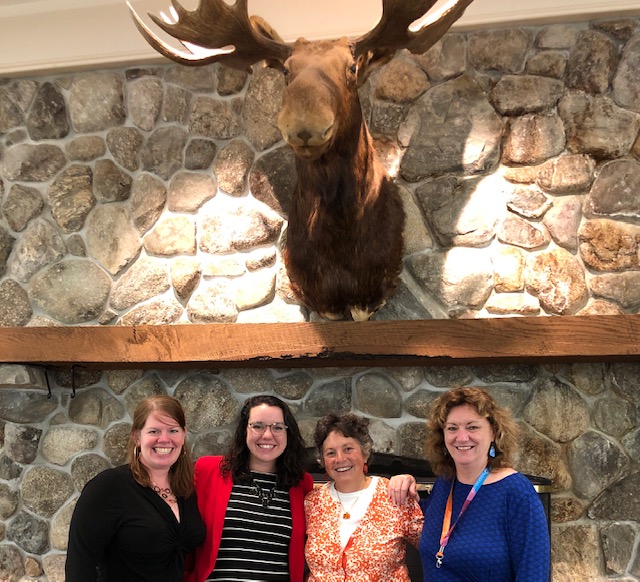
Kris Bisson,Kaitlin Young, Argy Nestor,Catherine Ring

Last Thursday and Friday I attended the Maine Association for Middle Level (MAMLE) Conference at Point Lookout. I have fond memories of returning to the site in Northport – so many amazing learning opportunities for arts educators have taken place there for many years. The MAMLE conference has always been a place where middle level arts educators are welcomed and the conference goers are appreciative of what is offered. This years theme was Filling Our Cups: Teaching in Challenging Times.

Kris Bisson

Kris Bisson, Music Educator at Marshwood Middle School in Berwick and Maine Arts Leadership Initiative (MALI) Teacher Leader presented a session called Integrating your community in the classroom: service learning project models. Kris is the perfect person to present on the topic since she’s had her students engaged in multiple projects in her students community. Her well known Bridging Adolescence: A River Flows Through Us project that she collaborated with teaching artist Brian Evans-Jones on, made a huge impact on her students and community members. I was thrilled when her students shared this project at the State House December 2018 at an arts education celebration.

Kaitlin Young

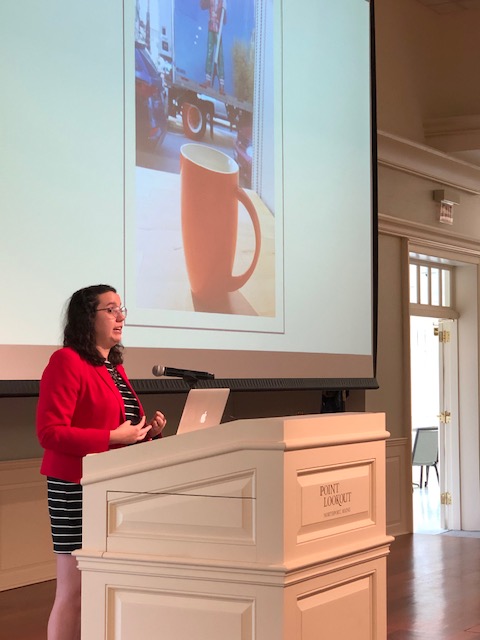
Kaitlin Young, 2017 Maine Teacher of the Year, Music Educator at Sedomocha Elementary and Middle Schools, and Maine Arts Leadership Initiative (MALI) Teacher Leader provided a key note that had participants engaged. The title was What We Can Do When We Are Brave Together. Kaitlin’s presentation was inspirational and very realistic. It provided thought provoking ideas which participants could take with them and put immediately in place. Thank you Kaitlin for filling up all of our cups!

If you’re a middle level educator consider participating in the conference next year which will be held in Portland. Check the MAMLE site for information.

h1

RAMS Art Project

July 9, 2019

Great work Anthony Lufkin – 2018 Knox County Teacher of the Year

Art Educator and Maine Arts Leadership Initiative Teacher Leader Anthony Lufkin teaches grades K-6 in MSAD #40 and with students at the Rivers Alternative Middle School. This spring the middle school students took on an amazing project. They focused on social and health issues that impact individuals and communities. Students quickly got into a deep level of learning and the connection with these topics and issues on the brain. The topics were challenging ones and each students selected a topic to research and create a response artistically. Two other teachers worked with the students along with the Farnsworth Art Museum. This is a great example of students engaged in and taking the lead in their learning. Take a look at this video and gain an understanding of an amazing project for middle schoolers.

h1

Express-a-Book

July 2, 2019

Not your traditional book club

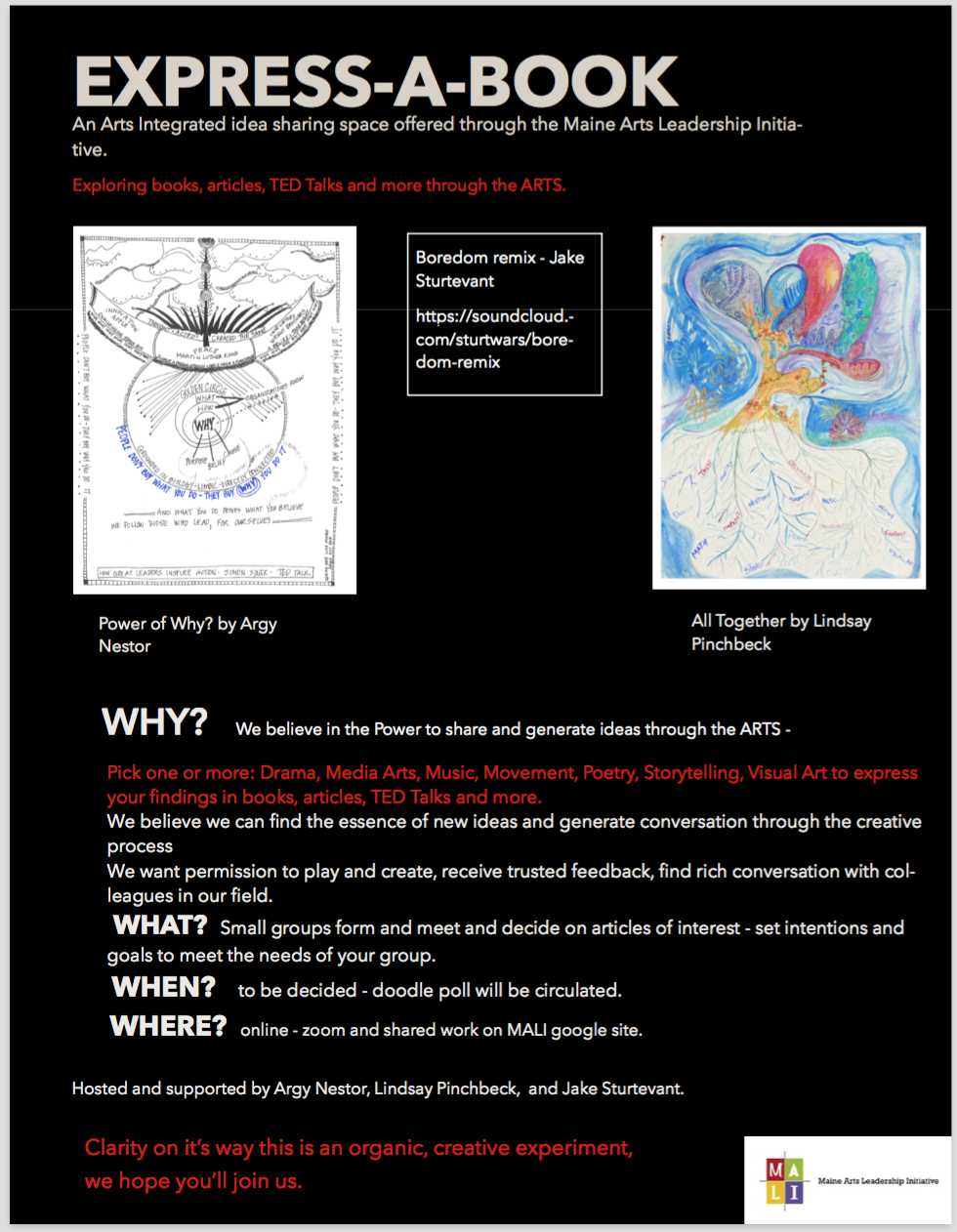
Express-a-Book uses the Arts, to create a learner centered, collaborative environment to share ideas. Participants experience the Arts and the format highlights the accessibility and power of the creative process. When we bring people together in a collaborative and creative environment we see learners, of all ages, engage at a high level. The Express-a-Book process supports this notion.

In 2017 Maine Arts Leadership Initiative (MALI) Design Team members Falmouth High School music teacher Jake Sturtevant and Sweetland School founder and director Lindsay Pinchbeck and Argy Nestor who was the Director of Arts Education at the time created Express-a-Book – an innovative and creative approach to a traditional book club.

They presented the idea, after creating a protocol and experiencing it themselves, to members of MALI. Other teacher leaders stepped up, formed groups and experienced the process themselves. The results were amazing!

“It was wonderful to have the opportunity and excuse to jump in the sandbox and find ways to play with, highlight, reflect, and communicate my learning in a unique way.”

~Jake Sturtevant

HISTORY
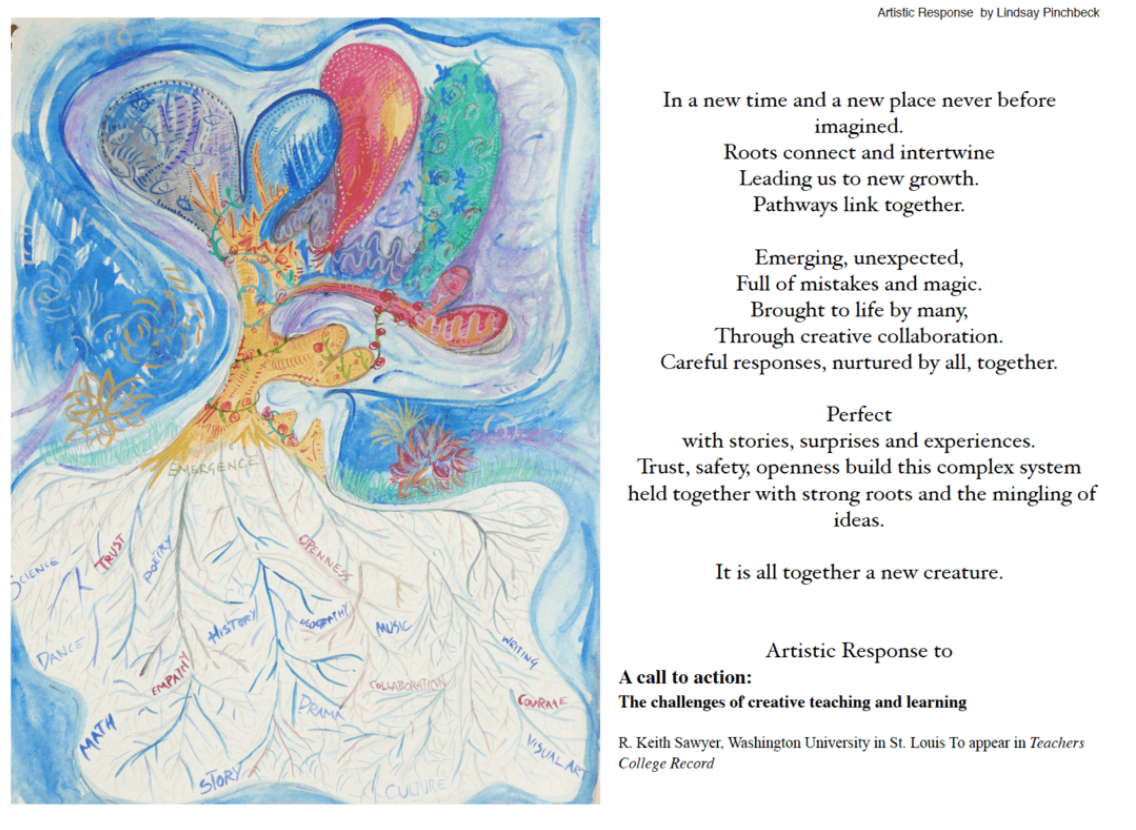
Lindsay, Jake, and Argy planned and tried the process and presented it to the MALI participants. Lindsay wanted to read about creativity in teaching and learning so she read the article A call to action: The challenges of creative teaching and learning by R. Keith Sawyer.
Jake was curious about the power of boredom. He listened to In defense of boredom on WNYC, Radio, Manoush Zomorodi’s Podcast Note to Self, and read the book Bored and Brilliant. Argy wanted to focus on leadership so she listened to Simon Sinek’s TED Talk called How Great Leaders Inspire Action.

Once they completed their review they responded by creating artworks. Lindsay made a painting and wrote a poem, Jake created a remix mp3, and Argy made a black and white illustration. They shared and responded to each image/sounds by giving feedback and asking questions. This provided the opportunity to learn about each of their topics in a collaborative environment.

What has been learned by using Express-a-Book?

  • Share ideas and resources through an active process
  • Use the arts to make information accessible and engaging for learners
  • Learn together as a community
  • Allow for individuals who do not often engage in art making processes to experience the potential of the arts to enhance learning 
  • Offer a low cost, simple, scalable and refreshing approach to a ‘book club’ 
  • The process has practical applications for a variety of classrooms and settings. Express-a-Book can be applied across disciplines or in professional learning communities, it can take place face to face or electronically, within or across schools, districts, across a region/state/country/ or even the world.
  • Individuals must be willing to stretch and be vulnerable
  • Example of teachers teaching teachers

If you’re interested in seeing the protocol please email Argy at meartsed@gmail.com.

Express-a-Book has been used successfully at conferences and gatherings in Maine and beyond in a variety of ways. The format has been shared in workshops, videos, short articles and highlighted in Teaching Strategies That Create Assessment-Literate Learners by Jeffrey Beaudry and Anita Stewart McCafferty.


h1

Argy’s Journey Continues

June 4, 2019

Walking down memory lane

What a joy it has been during the last few weeks to reflect at the 43 years of my educational pathway. I am fortunate to have selected a career that has provided learning experiences that have expanded my thinking and understanding of how individual learners learn and how we are part of a world of learning connections. I have met and worked (and played) with amazing educators from Maine and around the world.

NEXT STEPS

So, where am I headed next? I have many ideas of what I want to do but I’m going to start by building on the natural next steps.

  • I am working towards creating a fund for Maine arts educators and teaching artists to travel and learn. I’ve had amazing opportunities to travel and every one of them has influenced my creative thinking and doing. I want to support educators who have dreams to travel and learn. I know that when a person returns from traveling that it impacts the learning environment which has the potential to plant seeds and open doors for students. I’m working on the idea with big thinkers and funders. Once I work out the details I will ask you to contribute to the fund. If everyone gives a little we can build the fund more quickly.
  • I will be serving as the director of the middle school at Sweetland School, an arts integrated school in Hope. Lindsay Pinchbeck started the Reggio Emilia inspired school five years ago at the Sweet Tree Arts Center. I have served as an advisor to the school and am excited about the possibilities for the students entering middle school. I will support the teaching team and do some arts integrated teaching as well.
  • In 2016 Lindsay and I traveled to Mpamila Village in Malawi to provide teacher workshops on arts integration. Of course, I gained more than I offered and for the last 3 years continued to support the teachers with 8 other educators providing workshops. My work will go on with Go! Malawi, an organization in Maine that was started by a former student. In July 2020 we will guide the Mpamila teachers to create their own workshops to facilitate at a country wide conference.
  • Malawi led to the innovative work of HundrED and I will continue to share innovative work of the organization. I plan to return to Helsinki this fall for the summit and am especially excited about their Youth Ambassador program.

I will continue to blog through the summer on this blog and communicate with the Maine arts education list-serv about the progress of my work. Please communicate with me at meartsed@gmail.com or through the Maine Arts Education blog below.

WHERE I’VE BEEN 

Like anyone in education we know the paychecks aren’t huge but my life has been rich with opportunities. From the ‘ah-ha’ moments of an individual student’s accomplishment to the excitement of a teacher connecting with other educators and everything in between. When I was teaching every day one thing became clear – hanging out in a middle school art classroom was a continuous learning opportunity and I loved it. My students and colleagues taught me and helped grow my skills and passions as a human being. I received so much than I gave. Being part of an interdisciplinary teaching team where visual art was valued by others as much as I valued it was amazing! When I was recognized in 1995 as the Maine Teacher of the Year I realized how fortunate I was to be honored for such humbling work.

When I left my art room after 30 years it wasn’t easy, teaching was what I knew and loved. But the challenge helped me see more clearly that my mission as an educator was taking a turn. My own son said to me: “Mom, your classroom is just going to get a little larger.” And he was ‘spot on’ (as Rob Westerberg says) about that. Once I fully committed to the work at the state I realized that my “teacher lens” was to guide me. I knew what I needed and wanted as a teacher so I honored that and moved forward collaborating with others to make that happen. Visiting hundreds of arts classrooms in schools across the state was an incredible learning opportunity. The visits led to the 1200 member list-serv and daily communication on this blog.

I AM GRATEFUL

Along the way others continued to collaborate and provide support. I am soooo grateful for the many connections, some of which I mention below.

Carol Trimble

Carol Trimble who was the executive director of Maine Alliance for Arts Education (MAAE) was supportive from day one when I arrived at DOE. Together we brought back the state wide arts education conference and I helped with the first state wide arts education census and other MAAE projects. Carol was and continues to be an incredible mentor with a clear mind who can articulate ideas like no one I know.

Many of you remember David Patterson who sadly passed away from cancer in July 2014 at the age of 50. His wisdom and encouragement taught me to believe in the power of communication to form the community. He pushed, questioned, taught and encouraged me every step of the way. This blog wouldn’t be if it wasn’t for him.

Anne Kofler was the elementary art teacher who taught ‘downstairs’ while I taught middle school ‘upstairs’. She inspired me to go the extra mile and made me a better person in so many ways. She continued to support me, after I left the classroom, to take on the ‘big challenges’ and ‘lean in’. All the while herself, taking on cancer, which eventually took her away in May 2016. Her love for using her travels to inspire her students continues to impact me.

Catherine, myself, Rob

Catherine Ring and Rob Westerberg took a chance when I invited them to travel to NH in the summer of 2010 for the New England Institute on Assessment. I am so grateful that they did – I continue to learn from both of them! Together we created the Maine Arts Assessment Initiative (MAAI) by listening to the needs of the field, reviewing the research, brainstorming and planning. The first MAAI leadership team represented PreK-higher education and helped launch the idea without funding in place. There were tears in my eyes when I heard Jeff Beaudry say “we can sleep on the floor and eat peanut butter and jelly sandwiches if we have to, there’s no turning back now.” And, launch we did with 18 amazing teacher leaders at Maine College of Art for the 4-day summer institute. At the end of the institute the teacher leaders made it clear that we weren’t moving into Phase 2 without a place for them.

Phase I Teacher Leaders

Since that first summer, the initiative has grown into a strong leadership program, influencing and inspiring, and the shift in assessment practices around the state took hold. When we traveled to Washington, D.C. for the Teach to Lead summit in August 2015 MAAI shifted to the Maine Arts Leadership Initiative (MALI). Teachers with high expectations for themselves and a passion for learning – teaching other teachers has been the foundation of the success. Educators willing to share their ideas, use research, build on their knowledge, and support the network has worked well for Maine. Title II funds helped to support the summer institutes, critical friend days, mega conferences, winter retreats, stipends for participants, and statewide conferences over the next several years. The partnerships and associations with the Maine visual and performing arts organizations and institutions has been an enormous part – too many to name all of them. Thank you all!

In 2013 i moved to the Maine Arts Commission and the work (and play) of MALI expanded to include teaching artists and community arts organizations. They have provided a broader view of arts education. We’ve all been enriched by their participation in MALI. Linking arms with the greater community of arts and arts education is another way to support learners of all ages in their educational paths. I am especially grateful to the 108 teacher leaders and teaching artist leaders who continue to do amazing work in arts education and as artists!

There are so many more individuals and organizations to thank but this blog post could go on for pages. The people I mentioned are ‘giants’ and every day I stand on their shoulders and fortunately continue to learn from them!

BEYOND MAINE

Throughout the 13 years at the state I’ve had many opportunities to connect with and learn from others outside of Maine. Presentations and workshops at regional and national conferences about MALI, serving in leadership roles with the State Education Agency Directors of Arts Education and the State Arts Agency Arts Education Directors, and serving on the educational council of the Americans for the Arts have provided me ongoing chances to learn from others.

Mpamila teachers in Malawi

My work in Malawi has been amazing. I originally emailed a former student about her work with Go! Malawi and asked if she could use my skill set. From there the idea developed into creating arts integration workshops. I am forever grateful to Lindsay Pinchbeck who agreed to travel to Malawi in 2016. The collaboration that we’ve formed has influenced all parts of my life. She has definitely made me a better teacher, artist, and person. Spending 10 days providing arts integration workshops for the teachers in Mpamila Village opened my eyes to so much about the world. For the last 3 years we continue to support the teacher workshops and have had 8 educators use their expertise in Malawi. In addition we’ve sewn hundreds of dresses and pants for the children in Mpamila School. This work has taken place with friends, family, and colleagues from all over Maine and in other states across the country. I am so grateful to the many who continue to contribute by sewing and contributing to purchase the materials needed.

Malawi led to HundrED when our Malawi project was selected and Lindsay and I were named Ambassadors for the program. We traveled to Helsinki, Finland last November for the HundrED summit and met people from all over the world doing AMAZING work. The network is expanding and I encourage all of you to check out their site and consider applying to be an Innovator, deadline June 30.

CONTINUE – STAY IN TOUCH

I hope that our paths will continue to cross since my work in arts education will continue. Please feel free to reach out using my gmail address at meartsed@gmail.com. I will be blogging throughout the summer and perhaps beyond. Your work in arts education is critical to continue to make the world a better place. Thank you!

h1

The Waldo

May 27, 2019

Waldoboro, Maine

Maine Arts Leadership Initiative (MALI) Teaching Artist Leader Joe Cough and his wife Lindsay will be performing at The Waldo in Waldoboro in June. Check this out…

On the second Saturday of the month from June through October, 4:00 – 7:00 p.m. galleries, studios, and creative businesses located in the heart of the historic Waldoboro village will be celebrating the Midcoast’s vibrant arts community.  As part of the series, The Waldo will offer tours of the theatre, freshly popped popcorn, and a rotation of established and up-and-coming performing artists. We’re happy to welcome back local Waldoboro musicians Joe and Lindsay Cough as the “opening act” of our 2019 series, sponsored by The Bangor Savings Bank.

The couple offers a range of eclectic and synergistic talent.  Joe is a vocalist, multi-instrumentalist, composer, conductor, and educator who specializes in French melodies and uses his “spinto tenor” vocal technique across many musical genres. Lindsay is an accomplished singer and Norwegian hardanger fiddler. She is also a member of the Professional Doll Makers Art Guild, and creates in one-of-a-kind handmade polymer clay dolls. Her work is on Facebook at Wind’s Knees Art Dolls.

The Waldo hopes to highlight the hidden talent of the Midcoast throughout the summer. If you are interested in sharing your musical, literary, or performance prowess at an ArtWalk, please email info@thewaldotheatre.org and mention “ArtWalk” in the subject line to see how you can get involved!

h1

Arts Accessibility Webinar

May 13, 2019

Shawna Barnes

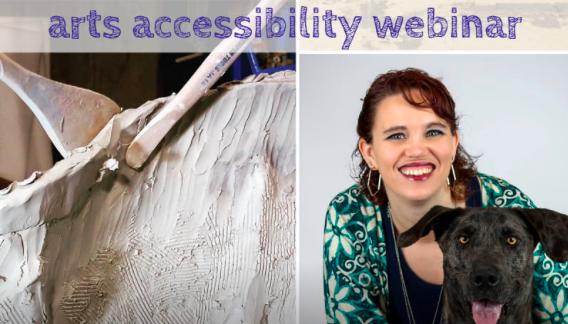
On Sunday, May 26, 7:30 – 8:30 p.m. Shawna Barnes will be hosting a webinar on Arts Accessibility. Shawna is a Teaching Artist Leader with the Maine Arts Leadership Initiative.

Shawna N.M. Barnes is a disabled artist and arts accessibility educator. One of her passions is helping educators, camp counselors, and relatives of those living with a disability, find economic solutions to arts access barriers.

In this short webinar, Shawna will introduce several inexpensive and immediate modifications to tools that can be done to help your student or loved one be able to create as independently as possible. Adaptive tools can be expensive. So a big focus for Shawna is finding those creative adaptive solutions by using products you may already have at home, in your studio, or in the classroom.

Do you have a specific tool, disability, or pain point you’d like covered? Ask your question, or describe your situation in this event, and Shawna will be picking 2-3 to use as examples during this webinar.

This introductory webinar is FREE and scheduled to last 30 minutes. If there is higher interaction and engagement, time may be extended an additional 30 minutes. Material will be presented via a live Facebook video on her sculpting page – Shawna N.M. Barnes – Beyond the Clay Art Studio.

To learn more contact Shawna at info@shawnabarnes.com.

h1

“Finding the Boxmaker”

May 7, 2019

Tom Luther’s album released

Finding the Boxmaker album cover

On May 1, 2019 composer/performer Tom Luther released his newest album, “Finding the Boxmaker”. The album has been released in digital-only format on Bandcamp, and can be found at THIS LINK.

“Finding the Boxmaker” is an instrumental work that was inspired by William Gibson’s Count Zero and the art of Mark Kelly. The music combines acoustic performance with electronic, improvised material with algorithmic/systems based material, and a layering of “found” sounds. The music explores different combinations of all three and alternates between “Tableaus” and “Assemblages”.

There are five “Assemblages” of slowly evolving soundscapes surrounded by six “Tableaus” of more traditional musical narratives. Like chapters in a novel, there are over-arching relationships between the Tableaus that “nest” the work together.

Much of the work is driven by the idea of assemblage, this being the collecting or curating of seemingly unlike (and often ordinary) found objects and arranging them in compelling ways. The work of Joseph Cornell (1903-1972) stands out as exemplary, and is a key narrative element in Gibson’s novel. Mark Kelly also works with assemblage in addition to working with some systems driven art which is the second primary driver of the work.

Despite the influence of Count Zero, “Finding the Boxmaker” is not a retelling of Gibson’s novel. “It is an exploration of systems, a merging of acoustic and electronic aesthetics, and a restructuring of how I think about music and art and my relationship to both”, says Luther.

“Finding the Boxmaker”

Tom is on the Maine Arts Commission Teaching Artist roster and a member of the Maine Arts Leadership Initiative as a Teaching Artist Leader. Tom will be facilitating on June 17 at the Teaching Artist professional development workshop. When Tom isn’t writing music he is teaching at the Midcoast Music Academy. Not to mention Tom is a great guy and musician that you should meet if you don’t already know him and his work. 

h1

Teach to Lead

April 6, 2019

Great opportunity to develop ideas with your team

Many of the Maine Arts Education blog readers remember that the Maine Arts Leadership Initiative (MALI) started as the Maine Arts Assessment Initiative (MAAI) back in 2010. In 2014 a team made up of MAAI teacher leaders and leadership team

Maine MALI team, bottom left

members were invited to attend a Teach to Lead Summit in Washington, D.C. It was an AMAZING OPPORTUNITY!! The team realized that the name of the initiative wasn’t reflecting the future work of MAAI. A focus on LEADERSHIP was clear so the members of MAAI decided to change the name to the Maine Arts Leadership Initiative. Like everything we’ve done in the 8 years that the initiative has been in place it was a careful decision. It proved to be the best thing for MALI. We know that in many school districts across Maine and across the country that arts educators are leaders. They are looked to for their many skills – collaboration, problem-solving, curriculum integration, student-center learning and so much more that takes place in arts education classrooms everyday. Why wouldn’t visual and performing arts educators be asked to contribute their expertise to help move schools and school districts forward?!!

You have a chance to lead your colleagues and community to a Teach to Lead Summit. Do you have an idea that takes some intense planning and time with your colleagues? Do you want to take action around something that is needed in your school? If so, I urge you to consider taking a trip west to the next Teach to Lead Summit taking place on September 19-21, 2019 in Salt Lake City, UT. The information is below – take a look – see if you’re a good match. If you have any questions please email me at argy.nestor@maine.gov.

Whole Child, Whole Teacher Summit

September 19-21, 2019

Salt Lake City, UT

Calling all educators! Submit an idea for our next Teacher Leadership Summit!

Teach to Lead supports teachers as valued experts in instruction and students’ needs. Teach to Lead summits provide teams with time to collaborate, skills development, and professional consultation to incubate innovative ideas that can make a positive impact for students in their schools, communities, districts and states.

This topical summit will bring teacher leaders and other stakeholders together to address the needs of the Whole Child and Whole Teacher in an effort to transition from a focus on narrowly defined academic achievement to one that promotes the long-term development and success of all children, as well as the well-being of all teachers.

Each idea should reflect a need that addresses students’ and/or teachers’ health, safety, learning, support in and out of school, and access to engaging and challenging opportunities. Examples of project topic ideas might include:

  • Healthy: homelessness, hunger, student and teacher well-being and mental health
  • Safe: school safety, bullying and harassment
  • Engaged: cultural diversity, student identity, school culture and climate, professional networking
  • Supported: supports for a diverse teacher workforce, coaching and peer mentoring, adult-student relationships, community partnerships, language services and supports
  • Challenged: access to challenging coursework or professional development, access to extracurricular opportunities, etc.

How do participants benefit from the Summit?

  • Develop a local idea for change into a complete plan
  • Obtain the support of a dedicated “critical friend” from a supporting organization to advance your work
  • Build relationships with ASCD, Teach Plus, the United States Department of Education, and national supporting organizations
  • Be provided with free registration and hotel accommodations for two nights or parking ( hotel will be provided free of charge for teams traveling more than 50 miles; parking will be provided for teams traveling 50 miles or fewer to the summit).

Who may submit an idea application?

  • Any teacher leader with an actionable idea is encouraged to apply here (or cut and paste into your browser) https://www.surveymonkey.com/r/TTLSLC19 by 11:59 pm ET on May 17, 2019 . Accepted ideas will be notified the week of June 10th.
  • Teams must have 3-5 members and must be led by one current teacher. Other key stakeholders (e.g. parent, student, community members, school and government officials) are encouraged.

All submitted ideas must: 

  • Encourage teachers to lead from the classroom.
  • Promote collaborative work among multiple stakeholders.
  • Identify an area in need of innovation or a specific problem with an eye towards actionable solutions.
  • Be viable in the local context and sustainable over time.

All submitted ideas may:

  • Be functioning at any stage of development – an emerging idea requiring input and buy-in to something that has been implemented which is ripe for improvement or expansion.
  • Focus on any level of change – school, district, or state.

Please contact info@teachtolead.org for additional information or questions.

h1

Pen Pals Pilot Program

April 4, 2019

PEER 2018:  5th Grade Painting Pen Pals Pilot Program

Lynda Leonas has been a Maine Arts Leadership Initiative (MALI) Teacher Leader since 2015, Phase 5. It was great to hear about her work at Walton School that is connecting her students with others.
5th grade students from Mrs. Breau’s class at Walton School in Auburn, Maine, began a trial practice run of the painting pen pal program on November 8 during a 30-minute art class with their art teacher, Lynda Leonas. Each student inspired personal responses and program feedback from music and art educators, teaching artists, and members of the Maine Arts Commission during the November MALI Critical Friends Day at the Viles House in Augusta. Students were thrilled with the responses they received and hope to meet their practice partners one day!
Elementary schools in Androscoggin and Cumberland Counties will participate in a larger practice run of this peer student painting exchange this coming spring. We hope to define and direct any technical adjustments necessary in creating a simple large scale painting pen pal exchange and exhibit for teachers and students within the State of Maine. Each grade 5 student will create a painting within an open choice painting studio environment. The painting will be exchanged with a student in another school district. Each participant will reflect upon key ideas and emotions expressed within the art work they receive and respond with his/her own personal interpretation to create visual conversations!
Students and teachers will expand their communities without leaving their classroom throughout the Painting Pen Pals process. Students will access and upload paintings, reflections, and literary responses in the form of poetry into a WIKI site creating an online exhibit while art and classroom teachers upload formative assessments, enrichment activities, and their own painting pen pal works! Our goal is for all peer partnerships to meet in person at a culminating exhibit of their completed works.
h1

Two Teaching Artists’ Journeys

March 19, 2019

Nicole Cardano and Brian Evans Jones

Maine Arts Leadership Initiative Teaching Artists Leaders, summer institute, 2017. Brian is in the back row, third from the left. Nicole is in the front row, first person on the left.

I’m always interested in learning about the needs of teaching artists and how to better support them. I view their role in education as vital. Oftentimes it is the teaching artist who inspires a young person. Providing opportunities for learners in grades PreK through high school that include a teaching artist can be empowering for the learner. I have hope that every young person either becomes an artist or an appreciator of the arts as they continue learning on their life journey.

Those of us who have made arts education a career are so fortunate. We are engaged in the creative process as  individuals and have the chance to help young people develop their artistic ideas as well. When arts educators collaborate with teaching artists it is truly amazing. Both teachers learn but the ones who benefit the most are our students.

Pablo Picasso said: “Every child is born an artist, the problem is how to remain one once we grow up. I think of the artist in each of us as a fragile, beautiful and precious light, a creative spark inside of every person.”

Nicole and Brian at the MALI Summer Institute, 2018

Recently I asked two teaching artists who are leaders in the Maine Arts Leadership Initiative (MALI) to ponder what has contributed to their success as teaching artists. Brian Evans-Jones and Nicole Cardano joined MALI in 2017 during the summer institute.

Brian Evans-Jones is a poetry and creative writing teacher who moved to southern Maine from the UK. He’s been writing poetry since he was 16. Brian has a B.A. in English and Creative Writing from Warwick University.

“Since 2005 I have taught creative writing, which is as important to me as my own writing. I’ve taught all kinds of people, from 4 to 94, in all kinds of venues, and this is the main way I try to spread the appreciation of poetry.”

Nicole Cardano has been teaching Drama and Improvisational Theater in PK-grade 12 schools for eight years. In addition, she teaches adults. Nicole’s studies and practice of improvisational theater connect to the foundational philosophies of Listening, Support, Eye Contact and Respect. The games that she teaches and her directorial mindset work from these foundations. Nicole believes in the process being more valuable than the product. Learning and developing these skills fosters a stronger community, a place of open listening and supportive fun. You can learn more about Nicole’s work on Facebook at Theater Today, Nicole’s non-profit organization.

“This December I worked with elementary and middle school students in preparation for their field trip to see Charles Dickens’ Christmas Carol. The students learned about workhouses and the hard labor and often dangerous jobs that children did in London during the 1840’s. We imagined this world through writing and theater exercises.”

NICOLE, HER TEACHING ARTIST JOURNEY

I started out as a Teaching Artist before I knew that this job title even existed. I was teaching drama and improvisational theater at the Summer Festival of the Arts and re-establishing the drama club program at my alma mater, Pemetic Elementary School. One program would lead to the start of another one. In the last nine years the work has grown. I have formed a non-profit, Theater Today, and have been able to spearhead a larger program in partnering with The Grand Theater, in Ellsworth.

Two years ago I learned that The Grand had a program called Performing Arts for Children showing school-aged performances during the school day, but they were not getting the audiences that they hoped for. The opportunity to partner was clear. Several professionals collaborated to create a Community Arts Curriculum out of which grew my role as the Arts Outreach Educator. This is our second year of this outreach collaboration and we are working with the full student body of four schools, three serving grades K-8, and one 9-12 high school. I have worked with 1,311 students leading theater integration workshops in their classrooms since September of 2017 in just this partnership alone (not including the additional programs I still lead). After meeting with classroom teachers, I design improvisational theater workshops that provide connections between the classroom curriculum and the live theater field trips at The Grand.

I grew up locally on Mount Desert Island in Maine. I got my first taste of theater in school. This made me aware that I wanted to be able to sing better, as I could not really carry a tune. As luck would have it there was an outstanding vocal teacher in our town. Carol Cramer Drummond was an accomplished opera singer and became my performance mother. Carol taught me confidence through song and showed me another world. I struggled to learn in school in the format I was expected. My mother too had her own history of challenges in school. I am now raising my daughter, also as a single parent, and I find myself advocating for her experiential learning needs.

Theater was the only subject I could think to study as I went on to Saint Michael’s College in Vermont. Both of my parents supported this decision. I graduated cum laude with a departmental award of honors and minored in Spanish as an extension of my year abroad in Mexico. My senior year of college one of my theater professors was intrigued with the book “Truth in Comedy; the Manual of Improvisation” from the training and performing center IO (formerly Improv Olympic) in Chicago, IL. IO teaches long form improvisation, where you perform a full show based off of one audience suggestion. Our professor formed an improv troupe and we studied this book. I graduated college in May of 2001 and went home to work a summer job and await a New England Theater festival that I had been selected to compete in. I had plans to go to New York City to follow a job lead. That September our nation experienced 9-11. My understanding of the world as I knew it had changed. The job did not pan out. Going to Chicago to study improv felt like the most sensible and sane endeavour. I competed at the festival in January and flew out to take a level one class at IO. I stayed for the full year and completed the improvisational program. Chicago became my home. Improv was the language that I spoke. I continued to study, perform and work for ten years in this city.

I moved back home to Maine for family reasons. I was raising my three year old daughter and my father had gone through stage four bladder cancer due to his exposure to Agent Orange in Vietnam. Time moved forward and my daughter entered school. She was also displaying learning challenges and was not showing the results that our schools wanted. I served for a full term as the chair member of our local school to support education and to better understand it. I really enjoyed being a part of this team. My term ended and I had to decide where I could make a greater impact. My programs were growing and it is a conflict of interest to be on a school board and working in the schools. I continued to develop the work that I saw a need for and believe in. I formed Theater Today to continue this mission. Theater is a tool that helps to communicate and explore topics of interest. This has been true on my journey through life. The practice of theater is a social, emotional and educational tool for all. I embrace process more so than product.

I design the curriculum for the theater integration workshops as the Arts Outreach Educator with The Grand. In our first outreach workshop I was working with 8th graders. The show that they were scheduled to see was “Frankenstein”. The students were studying gothic romantic writing. I taught them about the significance of Mary Shelley and how she wrote Frankenstein, the first sci-fi novel, based on the real modern science of the early 1800’s. The science teachers invited me to speak on this in their classroom, and so I did. In these workshops we highlighted that we are in the middle of history. Through the use of improvisational theater we “built” Victor Frankenstein’s laboratory and acted out scenes on what could go wrong with today’s modern science….

Next I worked with high school juniors and seniors in preparation for seeing Thornton Wilder’s “Our Town”. With the practice of theater we explored the American Dream and enhanced public speaking skills.

This December I worked with elementary and middle school students in preparation for their field trip to see Charles Dickens’ Christmas Carol. The students learned about workhouses and the hard labor and often dangerous jobs that children did in London during the 1840’s. We imagined this world through writing and theater exercises. We explored Dickens mission of the important role of education in the fight against poverty.

The curriculum areas of integrated study have spanned grades K-12.

In the growth of the outreach program with The Grand I see that there could be more partnerships with other arts organizations in an effort to expand the community of learning. For example, art exhibits could have in-classroom workshops with visual artists in connection to gallery showings. The possibilities are endless. Partnering teaching artists with directors of arts organizations has the potential to create a lot more routine work for arts integration in our schools and blurring the line between classroom and community, thus creating more experiential learning opportunities. Many students, and adults, have not been exposed to all that their town or neighboring towns have to offer. Arts outreach expands the exposure to life that any one person has.

The programs with The Grand and Theater Today are primarily supported by grants and scholarships. We do hope to expand the sponsorship opportunities for this programming.

BRIAN, HIS TEACHING ARTIST JOURNEY

Path 1:

January 2005:  I am in the last year of my undergraduate degree in Creative Writing at Warwick University, UK. Not sure what to do after graduating, I go to see my course director and ask him, “How can I teach creative writing?” He tells me I should go see the professor who runs the university’s creative writing summer school for students aged 11-16. He gives me a job. I work on the summer school for the next 4 years, starting as an assistant for a couple of days, and ending up as a full teacher, staying for two weeks.

April 2006:  I am training as an English teacher in a vocational high school in Manchester, England. I hate it. The school asks for volunteers (unpaid) to run Enrichment workshops. Starved of creative writing teaching, I run one on story writing. 8 students attend.

June 2006:  I am interviewing for a full-time job as English teacher at another high school in England. The principal offers me the post. I say I’ll take it provided I can teach an hour’s creative writing a week, pointing to my experience on the Warwick summer schools and at my previous high school. He says yes.

January 2010:  My creative writing group at the high school has had enrolments of 12 students, 4 students, 18 students, and 23 students. I have organized annual competitions in poetry and fiction, getting the principal and vice principals involved in the judging. I have published chapbooks of the students’ work. In January of 2010, the head of Creative Writing at the local college (Winchester Uni) agrees to judge a fiction competition, teach a lesson to my groups, and give them talk about taking creative writing at college.

December 2010:  I have quit my job at the high school. I contact the head of Creative Writing at Winchester Uni to ask for work, and he asks me to teach an undergraduate course. I teach at Winchester Uni until I leave England in 2014, eventually increasing my teaching to 6 courses per year.

November 2011:  One of my colleagues at Winchester Uni starts an organization called the Hampshire Writers Society. I attend the first meetings to support her initiative. She tells me about a competition to become Hampshire Poet Laureate in 2012 and encourages me to enter. I enter it.

January 2012:  I am named Hampshire Poet Laureate. Over the next year, I am paid to write 4 poems and to run workshops in prisons and homeless hostels. The Poet Laureate also promotes my work as a teaching artist to schools throughout Hampshire. I set up an online project (Writing Hampshire) that encourages people to write poems about their favorite places in the region and submit them for web publication.

2012-13:  Approximately 30 schools contact me to ask me to run poetry workshops. About half of these want me to help students write poems for the Writing Hampshire project. Writers’ groups, arts centers, and community organizations also ask me to work for them. Combining my work as a college professor and teaching artist, I am teaching creative writing full-time.

Path 2:

June 2006:  I am completing my training as a high school English teacher. One of the requirements is to join relevant professional associations. I find an organization I’ve not heard of before called the National Association of Writers in Education. I don’t have much money, but I decide to join it.

July 2008:  All NAWE members receive a letter from the Open University. The OU is expanding its creative writing courses and wants new teachers. NAWE members are encourage to apply. I do, and I am given a course to teach.

June 2010:  After two years teaching my OU course, my manager contacts me. They have a vacancy at short notice, and would like me to take it. The combined income gives me enough money to quit my unhappy high school job and go freelance, albeit with a part-time income, but with more time to write.

December 2010:  I contact my local arts center. Based on my experience teaching for the OU, they hire me to run poetry and fiction workshops. By the time I leave England in 2014, I have run 30 workshops and classes fort them, for children and adults.

April 2013:  The manager of the Jane Austen House in Hampshire, England, attends one of my poetry workshops at the arts center. She hires me to run a poetry workshop at the Jane Austen House.

August 2014: I have moved to Maine with my family. We go to a children’s art event at the Jewett House in South Berwick. I get talking to the manager, and tell her about my work at the Jane Austen House. She hires me to run a writers group at the Jewett House and also some one-off creative writing workshops.

November 2015: With some others, I give a presentation at the New England Museums Association Conference on my work at the Jane Austen House and the Jewett House. Soon after the Conference, I am hired by two other historic buildings to run workshops for them.

May 2015:  I am at the end of my first year in grad school at UNH and looking for ways to fill the summer. I offer some free mentoring to a young writer who has come to my writers’ group at the Jewett House. Her mother is grateful, and invites me to go with them to an event called Big Night run by something called the Telling Room in Portland. I go, and I am hugely impressed by the Telling Room’s work with school students. I ask to train as a Telling Room Teaching Artist.

2016-2018:  I work on multiple residencies for the Telling Room, working with 7 schools and leading several residencies.

Path 3:

April 2016:  I am at the end of time in grad school at UNH and wondering about starting a creative writing nonprofit. I hear about a funding workshop run by the Arts Council of NH. I go to it and meet the woman in charge of Arts funding. We meet again later; she tells me about the NH Teaching Artist roster. I apply to the roster and am accepted.

May 2016:  I look for other rosters to apply to, and discover Maine has one. I apply, am accepted, and am invited to a Teaching Artists Training Day.

Brian conducting Poetry Out Loud workshop at Hermon High School

August 2016: At the Training Day. I meet Argy Nestor, who talks to me about Poetry Out Loud. I have experience of the British equivalent. Argy asks if I could do some workshops for POL in Maine. I say yes! I also meet Kate Smith, music teacher at my local elementary school. She tells me about our local Education Foundation, which funds projects in our district. She encourages me to apply for a grant to work with Central School in South Berwick. The grant is funded.

November 2016 and 2017: Argy sends me hundreds of miles to the parts of Maine that are farthest away from my home in South Berwick, bringing Poetry Out Loud wokshops to rural schools and broadening my knowledge of my adopted home state at the same time.

March 2017: My 2-week poetry residency with second grade at Central School in South Berwick takes place. 80 children all write several poems, redraft one to go in a chapbook, and share their learning with their parents.

Brian and Kris presenting, MALI Mega, March 2018

August 2017: Argy invites me to apply to the Maine Arts Leadership Initiative (MALI). I attend as a Teaching Artist Leader. Kris Bisson, Chorus teacher at Marshwood Middle School, attends my poetry workshop. She asks me to be involved in a composition project with her 7th and 8th grade chorus groups, and writes a grant to the Marshwood Education Foundation.  I also meet Tim Christensen, potter and Teaching Artist extraordinaire; Nicole Cardano, improv artist; and Lindsay Pinchbeck, teacher of the integrated arts school Sweet Tree Arts.

Fall 2017:  I run my part of Kris’s chorus project. I meet the students for 6 sessions and help them write lyrics based on a local landmark bridge that is the focus of a community renewal project.
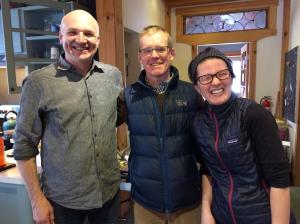
Tim Christensen, Brian, Lindsay Pinchbeck at Sweetland School

January and October 2018: Lindsay Pinchbeck invites me to Sweet Tree Arts to run collaborative residencies, first in partnership with Tim Christensen and later with Nicole Cardano.

2018:  The Arts Council of NH send me to schools throughout the Seacoast region of NH to run Poetry Out Loud workshops.

2018:  Kris Bisson and I present our collaborative project at MALI and at the MAMLE conference.

November 2018:  Argy asks me to make some Poetry Out Loud videos to be hosted on the Maine Arts Commission website. I work with student POL competitors and the MAC’s Ryan Leighton to plan and record the videos.

December 2018:  Kris’s chorus perform their composition piece at the State House in Augusta. I am privileged to attend.

This is not a complete picture of what I have done, but I hope it gives an idea of how my work as a Teaching Artist started, expanded, and changed. What I want to show is that I never planned to do this: every new thing emerged and developed from other things I did before, generally not knowing what they were going to lead to. I don’t claim that this is an ideal path: I still have not gotten back to being a full-time teacher of creative writing as I was in 2014, before I left Britain; and even then my income was barely enough to support a new family. But it has been a fun ride.

If I have advice for new teaching artists, it would be:

·      Find things to do that are the right things to do for you, however small at first.

·      Look for places to meet good people: people on the same wavelength as you.

·      Be as creative about your teaching are you are in your art.

Good luck!