Posts Tagged ‘MDOE’

h1

Integration Workshop

February 7, 2015

Maine DOE

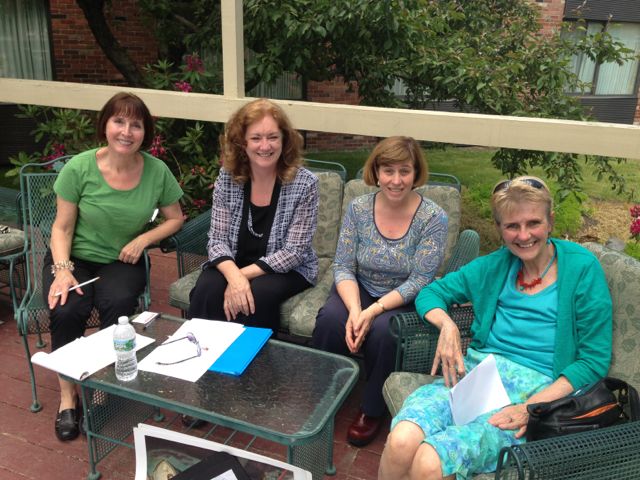
IMG_20150124_102723641Saturday January 24, the Maine Department of Education hosted an arts integration workshop at Wentworth school in Scarborough. Twenty-Five educators attended the workshop which  investigated how arts integration can support learning and  comprehension skills.

This was the first event for the Maine Arts Integration Collaborative which, will provide professional development for teachers in all subject areas to learn skills and methods on integrating the arts across the curriculum, to deepen student learning and appreciation for the arts, while raising student engagement and motivation.

IMG_20150124_134044013Drawing from Common Core standards, educators used strategies in drama, music, visual arts, storytelling and poetry that provide flexible options for students to access curriculum and diverse ways of expressing understanding through arts based learning. The presenters Dr. Louise Pascale, of Lesley University and Dr. Lisa Donovan of the Massachusetts College of Liberal Arts provided arts integration strategies for more students to access curriculum, engage with materials and demonstrate understanding. Some of the strategies included were:
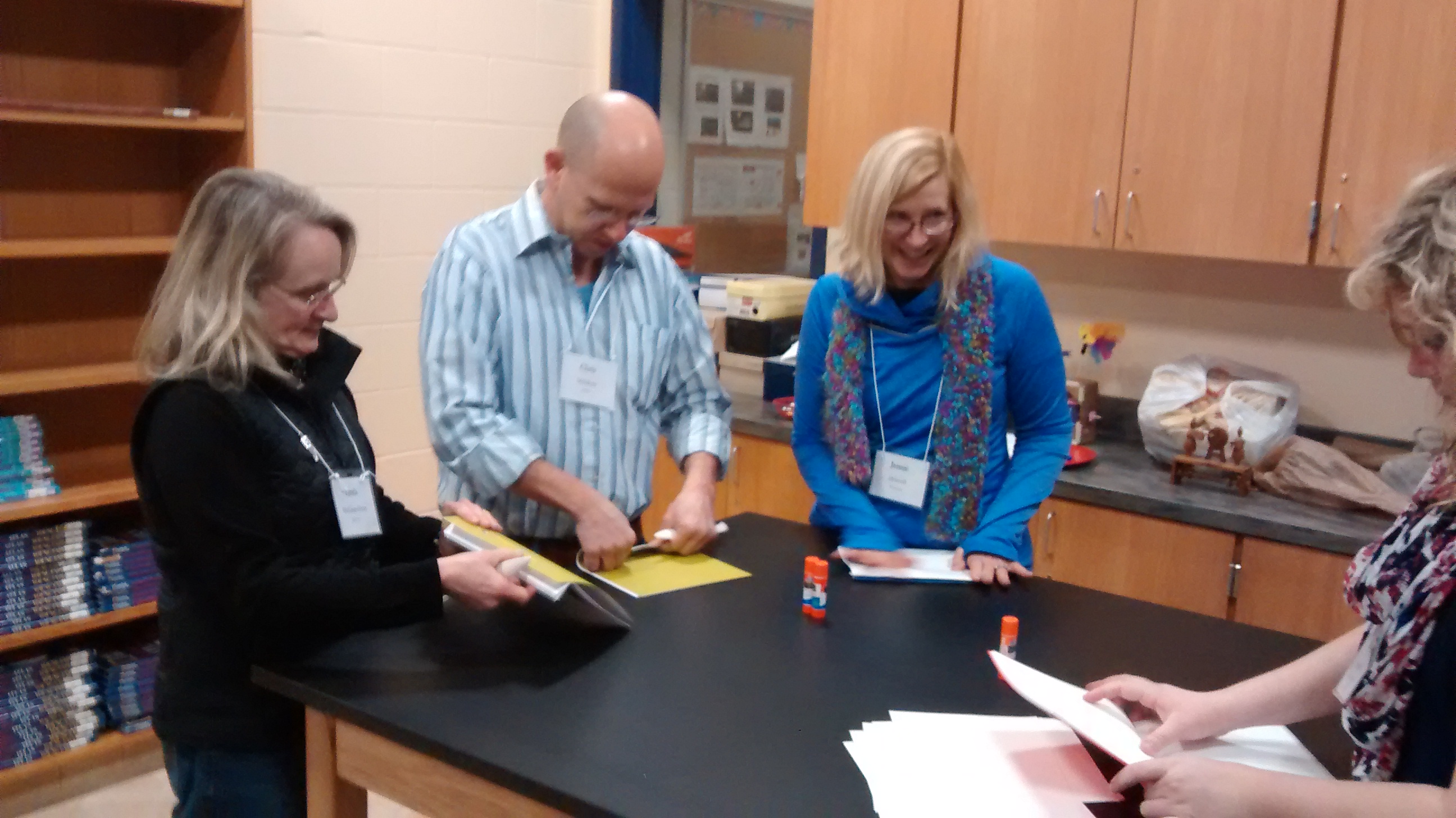

Visual Art Strategy: Bookmaking
Visual Art Strategy: Observational Drawing
Storytelling Strategy: Personal Storytelling
Drama Strategy: Tableaux
Music Strategy: Soundscape
Poetry Strategy: Observation Poems

IMG_20150124_095956173

h1

Student Art Display Opportunity

May 27, 2014

Maine Department of Ed Art Display

manikinThe exhibition schedule to display artwork at the Maine Department Education office is now available on a first come-first taken basis to visual arts teachers. The display dates will be:

October 1, 2014 – December 30, 2014
January 1, 2015 – March 31, 2015
April 1, 2015 – June 15, 2015
MLTI will display the summer months

Please read the specifications an requirements below before requesting an exhibit date.

Maine Department of Education Art Display
Specifications and Requirements

NUMBER OF DISPLAY HOLDERS:  24
(11 are landscape (horizontal); 13 are portrait (vertical)) – Total: 24 pieces of artwork
SIZE (opening) OF DISPLAY HOLDERS:  18” by 24”
ELIGIBILITY:  Pre K-12 student artwork

Guidelines:
·         Mount artwork on 18”X24” construction paper (nothing heavier) and ready to be slipped into the artwork holders. Only ONE piece per frame please!
·         2 labels for each piece – one attached to the back of the art and one paper clipped to the piece to be used for the art label (info below)
·         Please include a list of the students with their name, school, and grade in one document
·         Please include a disk with the photographed work for use online or please email the images (be sure and have them labeled with the name and grade of artist). Let me know of your school’s guidelines for posting student work.
·         Please include release forms with permission to post the work online
·          (I can provide a form if you’d like)
·         Deliver artwork to the address below a few days before scheduled exhibit. (Artwork will be returned within a week of exhibit completion).

shapes-of-wonder-emily-hayes-mt-vernon-elementary-school-grade-2-dona-seegersLabel holder size 6.5” by 1.5”
Include on label:
·         Name of artist
·         Title of work (optional)
·         Medium (optional)
·         Age or grade of artist
·         Name of school/teacher

Send work to:
Kevin Facer, Visual and Performing Arts Specialist
Maine Department of Education
23 State House Station
Augusta, ME 04333

Physical address if the artwork is hand delivered:
111 Sewall Street, Augusta (Cross building, next to the State House)

If you have any questions please call Kevin Facer @ 207-624-6826 or email kevin.facer@maine.gov.

h1

Introducing Kevin

May 18, 2014

Kevin Facer, Visual and Performing Arts Specialist, Maine Department of Education

KFacerI am happy to introduce you to Kevin Facer who joined the Department recently. He’d love to hear from you so don’t hesitate to contact him at kevin.facer@maine.gov

  1. Tell us about your professional (and if you’d like to include personal) background. How did you get where you are?

Hi Argy, thanks for the opportunity to meet arts educators through the blog. I was an arts kid in high school. The arts were, and still are important to me and most likely helped me stay in school. After high school, I served in the U.S. Marine Corps, and then started a community college program in photography. I worked as a blue collar chef and then photographer in commercial and fashion sectors in Philadelphia. I went back to graduate school and did an MA in Humanities and M.Ed. in Arts Ed., and started teaching photography after having a show at college. Currently, I’m working on a dissertation about artists and creative problem solving toward an Ed.D.

  1. What did you think of this real Maine winter?

This one seemed harsh. I hope it gets better.

  1. Why did you become an art teacher?

I didn’t set out on a career to become a teacher. I suppose it found me by accident. Having experience as a working photographer and making my own photographs to show led me to start teaching after an exhibit I had at a college. After a few years adjunct teaching, I began teaching high school photo and art. Working in a studio environment with students is a rewarding experience and I believe all arts teachers share a similar perception about what they do.

  1. What are you most passionate about in arts education?

As a teacher, for me it is all about creating memorable learning experiences. The kind of experiences students will know and remember because they grew and gained from doing it. Arts teachers understand the uniqueness of the creative learning process that ultimately lead to both self and creative discovery. Curriculum standards and learning outcomes are part of the process of teaching that frame steps in learning, but as teachers we also want to do things that spark creative thinking as a lifelong habit.

  1. What are your most important goals as VPA specialist?

Right now all of the core functions of the job seem important, with emphasis on supporting Proficiency Based Education and Educator Effectiveness. But with arts education specifically my work with MAAI, promoting arts integration with other content specialists and teachers, STEAM education as an approach to teaching, gifted education opportunities in the arts and building partnerships with arts teachers across the state, and connecting to community, state and national arts organizations are my priorities.

  1. What is your advice for arts educators?

I may not be the best choice for advice. But, I believe arts teachers need to take ownership of the arts programs in their school. Network and gain support from parents and your community. Showcase your work and the work of your students; collaborate and acts upon discussions with teachers and administrators in your school and those connected to you as these discussions can create great things. Look for unusual and customary ways to advocate for the arts in your conversations as these connections help everyone involved to become stronger and more engaged. Years ago, I taught in a high school that didn’t have a gallery space to show student work. Sure the hallways are okay, but I really wanted to do more. So, during a week there were school board and community meetings I got a 16’ truck and turned it into a mobile gallery, parked it in front of the meeting places and in town on Friday evening. Many people walked up the ramp to see the student show, which turned into strong support for the school and our arts programs.

  1. What do you believe are three keys to ANY successful visual and performing arts education?

I spent some time thinking about how success can be defined in terms of stability of the arts program, status within the school and community, experience and notoriety of the teacher. These things can have influence on a program, but it’s all about student learning and their engagement with the arts. So, with this out front, my three keys are:

  • Challenging Instruction – Think “Habits of the Mind” for the arts area you teach.
  • Engagement – How active students are in their school and community about the arts.
  • Legacy – This is from my experience as a high school art teacher, but when students wrote to me ten years after graduation about how their art experiences are used in their jobs, that they have a job (that they like) directly related to the arts, or send an invitation to an exhibit or performance, makes you think that maybe you made a positive difference.­
  1. You’ve had a chance to check out the MAAI what benefits do you see in educators becoming involved?

Arts assessments are going to change the scope of arts instruction, not necessarily in the content of what is being taught, but definitely in how the arts will be taught and the nature of evaluation. Therefore, assessment is split into two major areas of Arts Knowledge (basic skills to include tests) and Art Ability (examples of production). This implies there is a shift in thinking from grading an assignment or project, to evaluating student learning. This is why being part of MAAI and learning new approaches to teaching and assessment will be valuable to teachers.

  1. If you were given a $500,000.00 to do with whatever you please, what would it be?

It’s been far too long since my wife and I had a real vacation, but after that I would like to put the funds into the development of a center/institute for arts, craft and science where the mission is to discover connections between disciplines. Light on curriculum, heavy on creating, that would be my ideal learning environment.

Contact Information: kevin.facer@maine.gov


207-624-6826

h1

LD 1422 Webinar

May 12, 2014

MAAI webinar, May 7

The third of a series of four webinars for the Maine Arts Assessment Initiative was held on Wednesday, May 7, entitled “LD 1422: digging deeper into the new Proficiency expectations for Maine’s schools and Arts classrooms”. In coming up with this particular webinar, facilitators Catherine Ring and Rob Westerberg were reacting to what they both believed has been a lot of misunderstanding and a great lack of clarity around the new law which states that all High Schools will be issuing diplomas, “based on student demonstration of proficiency”. The hour with nearly 20 attendees, including the Maine Department of Education new Visual and Performing Arts Specialist, Mr. Kevin Facer, allowed the opportunity to de-mystify it, and to discuss its ramifications as it pertains to Visual and Performing Arts.

The first part gave an overview of LD 1422, with links to valuable resources at the Maine Department of Education. Catherine and Rob went through the important details pertaining to how it relates to VPA, the Maine Guiding Principles which all students will be required to meet, and a few thoughts around the concept of “multiple pathways” to demonstrate proficiency. An extended conversation was had around proficiency in the arts and what that actually can mean in practice. Information very specific about what that looks like in the classroom, and articulation of the next steps for everyone to get there, regardless of where you are presently.

Finally, there was a give and take conversation around relevant questions and observations from the MAAI Teacher leaders last Summer. Some of these included, “Once established, this will inform curricular and instructional decisions?”, “How do we establish proficiencies while leaving room for creativity?”, “You cannot define proficiency until the “vagueness” is taken out of the standards… is this a road we want to go down?” and “How do we find time to do everything and teach at the same time?” Along the way, webinar attendees asked some very pointed questions as well and shared some great insights.

In debunking myths or misinterpretations, and showing how the Arts can proactively move toward proficiency, the hope is that attendees and those utilizing the archive and meeting plans can get a leg up, perhaps even on the other content areas in our own buildings, and truly be leaders as we move toward this next chapter in Maine education. In this vein, it is strongly encouraged that arts teachers spend some time viewing the archive: the live links alone will make this worth your while, while the conversations will add clarity for what is expected of arts teachers in the months and years to come.

On Wednesday, June 4, we will be holding a related webinar, featuring the ongoing work MAAI has undertaken creating a rich Resource Bank for the Visual and Performing Arts. Please plan on joining Catherine and Rob from 3:30 to 4:30 on that first Wednesday of June. In the meantime, you can access the archive of the May 7 webinar at http://stateofmaine.adobeconnect.com/maaimay2014/. You can access the professional development meeting plans that accompany the webinar at http://mainearts.maine.gov/Pages/Education/MAAI-Webinars (available tomorrow). You may utilize with this with your building and district VPA colleagues.

h1

In Today’s News

April 25, 2014

Update from the Maine Department of Education

This information is part of this weeks MDOE Commissioner’s Update. You can subscribe to the weekly updates by going to the same link that is below.  In the meantime, the entire article is located at http://mainedoenews.net/2014/04/23/maine-arts-teachers-focus-on-standards-assessment/.

Maine arts teachers focus on standards, assessment
Posted on April 23, 2014 by Maine Department of Education

Arts teachers from across the state met at the University of Maine at Orono for a Maine Arts Assessment Initiative (MAAI) regional workshop earlier this month. The workshop focused on articulating proficiency in arts learning and developing proficiency models for different grade levels.

In the spring of 2011, Maine launched the MAAI statewide initiative on arts education assessment…


h1

Developing a Proficiency-Based System

April 23, 2014

What’s it all about?

In February the Maine Department of Education posted the following in their news room. I know that this would be helpful to some arts educators as you move forward with your work getting ready for the Proficiency Based High School diploma starting with the graduating class of 2018 (that is next years 9th graders). Go directly to the post by clicking here.

Join arts educators on Wednesday, May 7 for a discussion on the Proficiency-Based High School diploma on the next Maine Arts Assessment webinar, 3:30-4:30. To join the webinar (at 3:20) please go to http://stateofmaine.adobeconnect.com/maaimay2014. One contact hour is available.

The goal of proficiency-based education is to ensure that students acquire the knowledge and skills needed for success in college and careers and the centerpiece of achieving proficiency is a clear focus on learning and instruction.

In proficiency-based education, students who have not met standards receive additional academic support to help them achieve proficiency. When a student demonstrates proficiency in the expected standards, they move on in their education. The standards include content area knowledge and skills as well as those of the Maine Learning Results Guiding Principles, which include critical thinking and problem-solving.

Implementing the requirement that high schools award proficiency-based diplomas starting in 2018 places student demonstration of skills and knowledge at the center of instruction, assessments and reporting. School administrative units (SAUs) can work together or with other SAUs to develop their system for awarding of proficiency-based diplomas. Additionally, SAUs may add to the expectations for proficiency described in the content area standards and Guiding Principles

There is extensive guidance for developing educational systems that support student proficiency. The literature that describes proficiency-based education systems includes the work of Dr. John Hattie, professor and director of the Melbourne Education Research Institute at the University of Melbourne, Australia and Dr. Michael Fullan, Canadian educational researcher and former dean of the Ontario Institute for Studies in Education. Hattie’s synthesis of over 800 meta-studies is the result of 15 years of research. His recent publication Visible Learning for Teachers points to the top 10 influences on student learning. Fullan reminds school leaders to build a system of support for all learners. Fullan asserts that raising the bar (for all students) and closing the gap (for lower performing groups) is dependent on choosing four drivers that have been demonstrated to be effective at achieving measurable improvements in results for students.

As educators build proficiency-based systems, they must continuously evaluate how well their educational programs and pathways provide each student with the opportunity to learn and make progress toward demonstrating proficiency of Maine’s learning standards. The guidance offered by Hattie and Fullan can provide educators and community members with criteria against which they can evaluate and enhance proficiency-based education.

h1

MDOE VPA Position

October 15, 2013

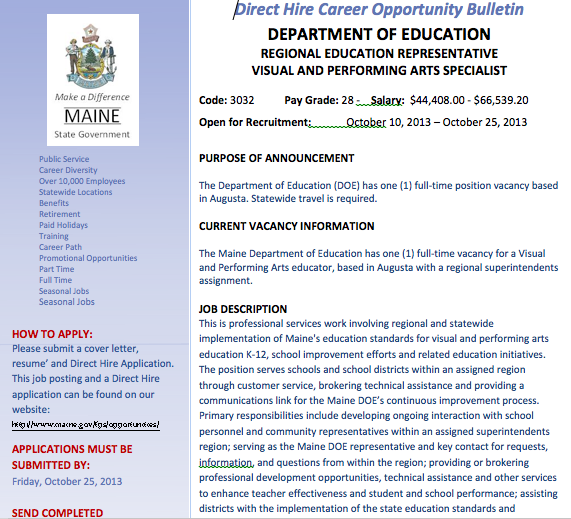
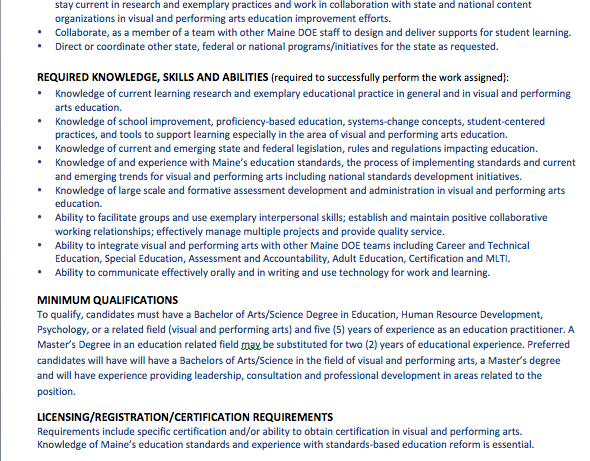
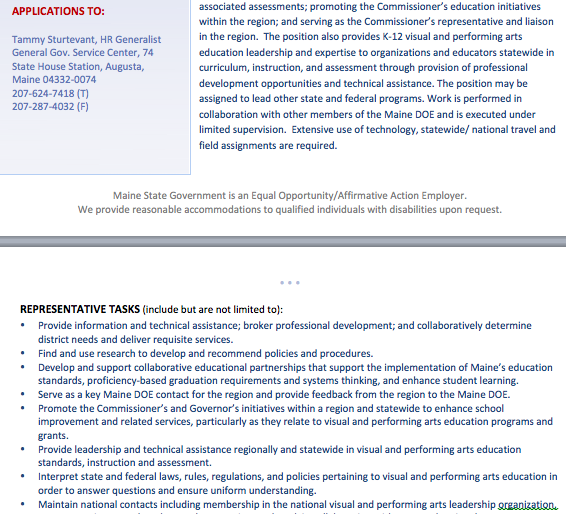
Visual and Performing Arts Specialist position, Maine Department of Education

The information below is the posting for the job at the Department that was mine until I left in September to go to the Maine Arts Commission. Since below is small, here is the information if you are interested in applying:

Submit a cover letter, resume and Direct Hire Application. This job posting and a Direct Hire application can be found at http://www.maine.gov/fps/opportunities/. PLEASE NOTE: The DEADLINE is OCTOBER 25, 2013.


Screen shot 2013-10-12 at 11.29.05 AM Screen shot 2013-10-12 at 11.29.53 AM Screen shot 2013-10-12 at 11.29.28 AM Screen shot 2013-10-12 at 11.30.13 AM

h1

Calling All Arts Teachers

September 4, 2013

Hear Ye, Hear Ye, Visual Art and Music Teachers!

Visual Art Assessment Photo

Elizabeth Arno, Catherine Ring , Liz Bouchard and Angelika Blanchard

How do we “do” assessment in the Art or Music room?  How can quality assessment practices vastly improve our students proficiency in our disciplines, help kids gain the skills and creativity they need, and be our biggest ally in advocating for our arts programs?  If you would like to earn three credits in a graduate course with a cohort of your peers, led by instructors who have been closely involved in the Maine Arts Assessment Initiative, here is your chance!

Join us this Fall in one of two graduate courses offered by the New England Institute for Teacher Education.  Click on the links below for more information or to Register!

EDPO 540-Refining Assessment Practices in the Music Classroom (K-12)
Sept. 20, 21 & Dec. 13, 14 (Just two weekends: Fri. 4-8pm, Sat. 8-4pm)
Location:  BANGOR
Instructor:  Jake Sturtevant

and

EDPO 536-Refining Assessment Practices in the Visual Art Classroom (K-12)
October 4, 5 & Dec. 6, 7  (Just two weekends: Fri.4-8pm, Sat. 8-4pm)
Location:  AUGUSTA
Instructor:  Catherine Ring

Courses are granted three graduate credits from Endicott College upon successful completion and have been approved by the Maine Department of Education for recertification.

TO REGISTER or for more information, Click on the links above.

h1

MAAI Regional Workshops

October 30, 2012

Underway throughout Maine

We are fortunate to have nineteen phase 2 arts education teacher leaders from the Maine Arts Assessment Initiative (MAAI) who have created workshops and started delivering them throughout Maine. The topics vary greatly and I am sure there is something for everyone!

You can find the schedule posted on the arts assessment page at the Maine Department of Education (MDOE) and below. You will notice that some of the details are missing below but as they become determined will be added to the MDOE page. The locations are spread out through the state to make it possible for you to attend a session in your region.

Along with the regional workshop, Mega-regional workshops are being planned as well. They will be posted in the near future. These workshops will be all day opportunities and we have teamed up with MLTI for Mega-regional workshops. If you have questions please be sure and email me at argy.nestor@maine.gov.

WORKSHOP TITLE AND DESCRIPTION DATE & LOCATION PRESENTE
MAAI: Impossible – What exactly is the Maine Arts Assessment Initiative and what direction are we headed in Maine Arts Education? November 2, 2012, 11:00am, Dexter Ridgeview School, District V Middle School Honors Festival Andria Chase, Instrumental, general music, grades 4,5, Corinth, RSU #64 and Sarah Williams, band/chorus grade, general music, grades 2-4, Glenburn Elementary School, RSU 26
Unpack it! Unwrap it! – Breaking down the Standards to Inform Instruction and Learning Information and techniques in breaking down the standards with students to provide a successful learning experience. November 2, 2012, 2:00pm to 3:00pm, Hancock Grammar Schoo Janie Snider, visual arts, grades K-8, Hancock Grammar & Laomoine Consolidated Schools
Getting Started: Incorporating Meaningful Assessment Within the Large Ensemble – A look at incorporating standards based learning and assessment within the large ensemble without the use of technology. District III High School Honors Festival & District III Junior High Honors Festival Drew Albert, Music director, Maranacook Community High School, RSU 38 and Ashley Smith, Choral Director, Brunswick High School, Brunswick School Department
There is no I in ART; Working Together to Promote Quality Art Education for all Learners – Presentation addressed to parents. The Maine Learning Results and assessment terminology will be explained in user-friendly terms. A hands-on component is also included, as the parents create a piece of art. The presentation can be tailored to suit the needs of arts educators, classroom teachers, and/or administrators. November 5, 2012, MSAD#32 Superintendent and Board of Directors
meeting, November 6, 2012 Ashland PTO meeting
Susan Beaulier, Visual Art, K-12 MSAD #32, Ashland
Assessment: This is NOT a Drive By (Assessment is MEANT for ME-student perspective) – Take a close look at a student performance in terms of formative and summative assessment. Through a hands-on exercise participants will determine what needs to be assessed and generate a rubric with the groups’ ideas. Information about the Maine Arts Assessment Initiative and resources will be shared. January 19, 2013, All Aroostook Fesitval Mari-Jo Hedman, Director of Music K-12, Fort Fairfield, MSAD #20
A Skeptic’s Exploration of Rubrics – The presentation follows my research into rubrics in order to improve both the clarity of the assessment instrument for myself and my students and to find ways to genuinely involve my students in the process. January 16, 2013, Messalonskee High School, RSU 18, 4:00 to 6:15 Leone Donovan, Visual Arts, Messalonskee High School, RSU 18
Formative and Summative Assessment Two Big  Words with Practical Applications in an Art Class – Participants will create a clay sculpture and get a hands-on understanding of both formative and summative assessment as part of the creative problem-solving process January 16, 2013, Messalonskee High School, RSU 18, 4:00 to 6:15 Gloria Hewett, visual arts, grades 6-8, Mount View Middle School, RSU 3
Literacy – A Gateway to Creativity – This workshop shows how literacy strategies can be utilized to improve students’ ability to analyze artwork. Stronger art analysis abilities can change and improve students’ understanding of their own creative problem-solving process.  Assessments are discussed as a vital part of this process. January 16, 2013, Messalonskee High School, RSU 18, 4:00 to 6:15 Pamela Ouellette, visual arts, Lisbon High School
Theatre Games: Learning By Doing – Using a Theatre-based rubric allows any teacher to assess students using the MLRs, thus “hitting” standards that may not have been accessible before.  Theatre techniques will be taught to show how to enhance curriculum/learning in any subject area. January 25, 26, 2013, Mt. Ararat High School Susan Jones, chorus, theatre, social studies, Medomak Valley High School, RSU 40
A journey into the 21st Century – Changing the Way I Teach!  – Come along on my journey as I talk about the changes I am making in my Keyboarding Class to fit the learning styles of all my students! January 26, 2013, District I Music Festival, Noble High School, North Berwick Jane Kirton, chorus, keyboarding, music for the soul, Sanford High School
Assessment, A Self Help Program for the Art Teacher – My journey to understanding the power of authentic assessment and using technology to manage student product and track student growth. TBA Danette Kerrigan, Visual Art, Sacopee Valley Middle School, MSAD 55
Sighting in Rubrics: How to Hit Educational Targets – This workshop revolves around the concept of General Rubrics and how they can be used to assess a variety of different products and processes. A good portion of the workshop involves assessment of student examples and discussion of how to interpret criteria using the rubric currently used in my classes. TBA Samantha Orchard, visual arts, Woodland Jr/Sr High School, Baileyville
Conditions for a Creative Classroom Using formative assessments to promote creative thinking and student voice in the classroom. TBA Suzanne Southworth, visual arts, Camden Hills Regional High School
The Sweet Spot: Where Learning Meets Engagement              This presentation discusses the importance of engaging students in their learning and tools that can support them. TBA Barbie Weed, visual art, grades 5-8, Gray-New Gloucester Middle School, MSAD 15
How can we meaningfully assess a large and diverse student population in music classrooms?      A brief overview of: why to assess, formative verses summative, when to use which type, examples of different assessments, and Q & A TBA Andrea Wollstadt, music, grades k-5, Biddleford Intermediate School, John F. Kennedy Memorial School, Biddeford
Assessment: To Educate and Advocate!There are many benefits to bringing authentic assessment into the music classroom. This workshop will discuss fundamental core benefits by identifying connections to the student, the community at large and the classroom teacher. In doing so, the case is made for utilizing assessment as a core component of the educational landscape for all Arts educators. TBA Jarika Olberg, choral/general music, grades 2-12, Waynflete School, Portland
h1

Literacy for ME

May 18, 2012

Maine’s Comprehensive State Literacy Plan

Lisa Gilman teaches visual arts at the Winthrop Middle School. During the last year she has served as a content specialist on the State Literacy Committee. Recently she wrote this post for the meartsed blog to provide information to arts educators of the work the committee has done.

The committee was formed during the Fall of 2010. The MDOE applied for a Striving Readers Comprehensive Literacy (SRCL) formula grant to be used to establish a Statewide Literacy Team charged with assisting the MDOE to develop a Statewide Literacy Plan. The Maine Department of Education was awarded the SRCL grant in November 2010. 

Along with many state literacy specialists and classroom specialists we began this journey by looking at other states that had completed their literacy plans. At the helm is Leeann Larsen, Literacy Specialist, MDOE, who has been a great leader for this daunting task of creating a plan for the state.   

“Literacy for ME outlines steps and identifies resources to help educators and others provide children with a strong early childhood foundation in literacy, provide students with effective literacy training throughout their years in school, and provide adults with low levels of literacy with the adult-level training they need.”

The literacy plan is organized around the following 6 components:

  • Strong leadership
  • System-wide commitment and partnerships
  • Standards and curriculum
  • Instruction and intervention
  • Assessment
  • Professional learning

These same components are familiar to Maine educators because they have the same components as other initiatives such as RTI and standards based education. This plan is not in addition to literacy efforts but a guide for ongoing work at the State and local level. Literacy for ME hopes to develop a cultural shift in how we think of literacy. Literacy for ME intends to broaden literacy for all residents of Maine. The plan is designed to initiate partnerships beyond the classroom walls.

The state of Maine defines literacy as: The ability to construct and convey meaning for a variety of purposes through an array of contextual forms and symbols, including reading, writing, speaking, listening, and viewing.  As an art educator who has taught reading along with my regular visual arts curriculum, literacy must not be designated to just Language Arts classes. Literacy is continually defined and expanded in our contemporary world.

Be looking for the formal plan to be launched in August 2012. 

Thank you Lisa for providing this information!