Posts Tagged ‘MECA’

h1

Reflecting on the Summer Institute

July 10, 2013

Thinking, thinking, thinking

IMG_3423

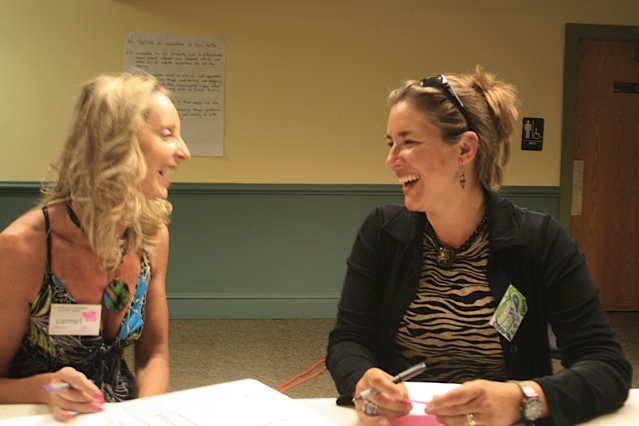
Participants discussing information at the summer institute, June, MECA

I spent some time this weekend putting together the lists of feedback on different topics that we focused on with the teacher leaders at the Maine Arts Assessment Initiative summer institute. It was a good activity since I didn’t have to move around much in the heat. One of the final exercises was to ask the teacher leaders to take a moment and reflect on the work during the three days.


They wrote their reflections to these three questions on stickies that were put on chart paper:

  1. What is circling around in your head?
  2. What are three questions you have?
  3. What is squared with your beliefs?
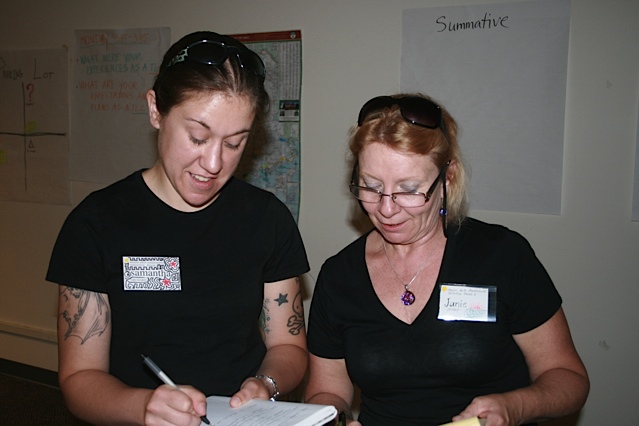
Dance teacher MaryEllen Schaper and Early Childhood/music educator Judy Fricke compare notes

Dance teacher MaryEllen Schaper and Early Childhood/music educator Judy Fricke

The answers were varied but also clustered. During the institute we spent a day discussing proficiency.  Participants wrestled with “what does it look like in the visual or performing arts classroom when put up against a standard?” This work helped to prepare for the high school diploma coming in 2018 that will be based on students showing proficiency of the standard. No longer will schools be graduating students based on their seat time but by demonstrating accomplishment of the standards. At the local level you will be making the decision on what that looks like.

After a day of discussions while looking at and/or listening to student work samples some teacher leaders still had circling around in their heads: “What is proficiency?” “How to organize teaching/assessment to check student proficiency.” “I get the importance of standards but it still boggles my mind how differently we “interpret” them and how differently we use them across the state.”How do we make sure that EVERY school district in Maine offers instruction in VPA that is sufficient for all students to become proficient?” This is not an easy question to answer however, everyone agreed that the conversations are important, necessary, and that they were glad to have the opportunity to be involved in the discussion. As I typed this weekend I wondered: how many teachers across the state are having this type of conversation?!

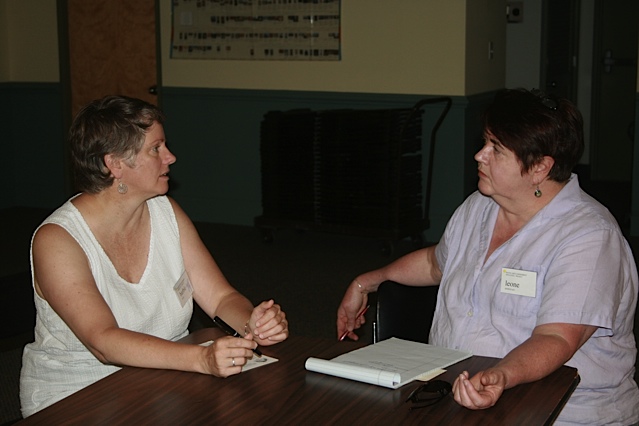
Visual art teacher Charlie Johnson and music teacher Patti Gordan

Visual art teacher Charlie Johnson and music teacher Patti Gordan

And for question #3:

“Student feedback informs instruction. Formative assessments. Summative assessments.” “Collaboration and good leadership create a vibrant environment for professional growth.” “I can do this has changed to I AM doing this. The process is far enough along to look back and see success.”

Much of what I read reflects the confidence these teacher leaders have and their willingness to learn from each other and understand that learning is ongoing. They’ve made a commitment to teaching but they’ve also made a commitment to go above and beyond to be a leader. Thirty five teacher leaders are preparing workshops this summer that combines what they learned with their experiences and past knowledge. They will gather in the middle of August to share their workshops for feedback from their colleagues. In the fall they will begin a round of  workshops at the regional, mega-regional and statewide level. It is a pleasure to watch their workshops form and their creativity in action. I am grateful that they are doing this important work that benefits all arts educators and ultimately our students are the big winners. So, THANK YOU TEACHER LEADERS!

I suggest you watch this blog for the schedule of workshops taking place during the school year. One date I do know at this point is the statewide conference called Arts Education: Leading the Way being held at UMaine, Collins Center for the Arts, Thursday, October 24. The cost for the one-day conference is $75 which includes a choice of 35 workshops, a keynote, performances, and lunch. You can purchase your ticket at https://tickets.collinscenterforthearts.org/auto_choose_ga.asp?area=116. Our conference this year precedes the Maine Arts Commission two-day conference, The International Conference on Arts and Culture: Strengthen the Core, 2013.

Sitting leadership team member Catherine Ring, (standing) music educators Jen Nash and Bill Buzza, and art educator Shannon Westphal

(Seated) leadership team member Catherine Ring, music educators Jen Nash and Bill Buzza, and art educator Shannon Westphal
h1

Brain Awareness Week

March 13, 2013

This week at UNE!

Screen shot 2013-03-11 at 1.21.01 PM

Screen shot 2013-03-11 at 1.21.15 PM

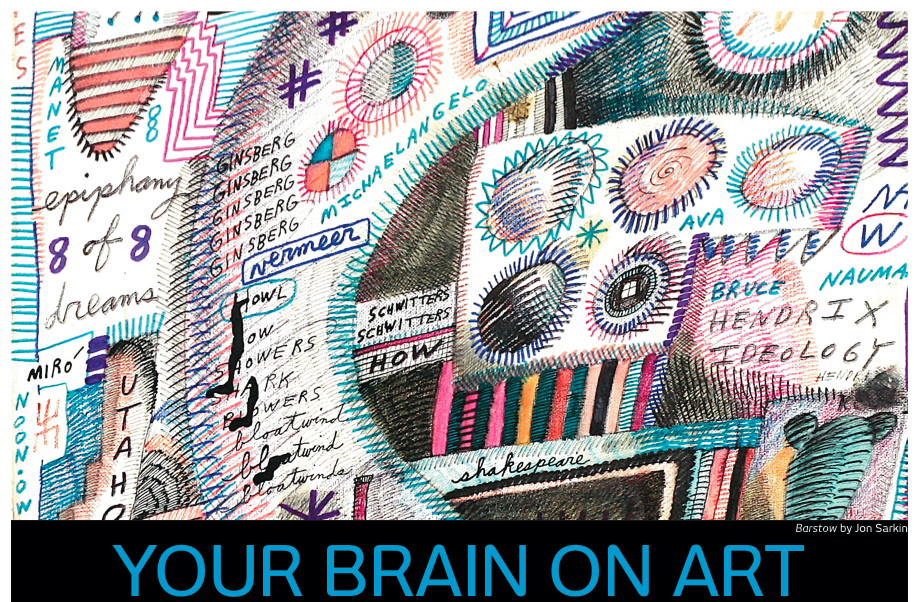
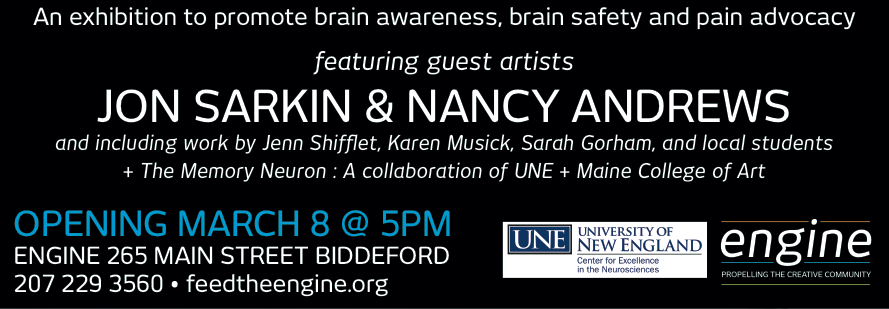
UNE’s series of exhibitions, workshops and other events related to Brain Awareness week, March 11- 17 information at http://www.dana.org/brainweek/.

Ann Thompson will be leading a workshop called “Knit a Neuron” on March 14th, (Einstein’s Birthday! coincidentally) and March 23rd. Moving on from Brain Coral to Brains! FMI please go to http://knitaneuron.blogspot.com/.

All Events are listed on the Engine website and Facebook Page at http://feedtheengine.org/.

h1

Happy New Year!

January 1, 2013

Reflecting

I have taken some time today to reflect on 2012 and realize how fortunate I am to work with incredible arts educators in Maine and throughout the United States. Educators who are dedicated, passionate, and fully committed to providing an outstanding arts education for every student!

The year has been filled with many successes, some challenges, and sad losses! I wish I had time to go back through all the blog posts that I wrote in 2012 to help me remember all of the successes, challenges, and losses but instead I will provide the highlights.

Successes

The biggest success is the Maine Arts Assessment Initiative (MAAI). The second phase of MAAI officially kicked off in the spring with the identification of 20 teacher leaders. These arts educators joined the 18 teacher leaders from phase one. They participated in a 4-day institute in August at the Maine College of Art (MECA) in Portland where they expanded their knowledge in the areas of assessment, leadership, technology, and creativity. They have created workshops that are being delivered throughout this school year at the regional and mega-regional level. (Registration for the mega-regional workshops is now open – FREE and contact hours are available.) The topics of the sessions are as varied as the individual teacher leaders. I am so grateful for their commitment to the work that is making a difference for arts teachers and in arts classrooms across Maine each day. The impact on students learning is amazing!

And, uniquely the Mega-regional workshops are being co-sponsored with the Maine Learning Technology Initiative (MLTI). At these workshops their will be at least one session that is integrated with an MLTI integrator to provide a first time opportunity for educators!

The MAAI would not be possible without the commitment of the leadership team who have consistently shepherded the work. A GREAT BIG THANK YOU to Catherine Ring, Rob Westerberg, Jeff Beaudry, Bronwyn Sale, Pam Kinsey, and Matt Doiron. Their willingness to lead has made a difference! Close to 1000 arts educators have taken advantage of the professional development opportunities during the last year and a half.

The MAAI is aligned with the Maine Department of Education’s Strategic Plan: Education Evolving: Maine’s Plan for Putting Learners First.

In July Catherine and I flew to Denver for a national conference on arts assessment held at the Rocky Mountain College of Art + Design. I was proud to let others know of the grassroots efforts that Maine arts educators are involved with.

Art educator Chris Milliken, on sabbatical from Wells schools, has been following and doing research on the MAAI during this past year. He will join art teacher Lisa Marin and present a session on their findings at the Mega-regional workshop at Ellsworth High School on March 29, 2013.

Literacy is a statewide focus with the Literacy for ME being launched this fall and arts education has stepped up to become an integral part of the cross content literacy connections. Arts educators Jen Nash, Suzanne Goulet, and Lisa Gilman have been facilitating literacy webinars. Suzanne is also co-facilitating face to face sessions.

We have had 4 wonderful art exhibits at the Maine Department of Education during this past year from Maranacook Community Schools, Bangor Elementary and Middle Schools, Lake Region High School, and Messalonskee High School. Along with the exhibits we had receptions at the Blaine House with music and dance performances from each school/district. Participating and collaborating are First Lady Ann LePage, the Maine State Board of Education, and the Commissioner of Education, Steve Bowen.

First Lady Ann LePage partnered with the Barbara Bush Foundation to create a new baby journal to present to parents at hospitals across Maine when their babies are born. We did a call for K-8 artwork and 867 young artists submitted work. Thirty two pieces were selected to be published in the book which will be completed in June 2014.

The Maine arts education list-serv has grown to 1200 and the meartsed blog is growing as a source of information, not only for arts educators but for all educators. If you are not on the list-serv but would like to be, please email me at argy.nestor@maine.gov. On December 5, 2013 the blog set a record high day of 976 visitors. And a record high week happened during that same time of 2508 visitors. Thank you for taking the time to visit and informing others about what is available on the Maine arts education blog.

Challenges

  • Common Core standards for ELA and Math were released this year and teachers are being asked to incorporate them into their curricula.
  • We are waiting patiently for the next iteration of the national arts standards to be released in March March 2013.
  • Arts education in Maine is underserved. As the economy continues to be a challenge so is providing adequate arts education programs and teachers.
  • Determining how to provide quality arts education to be ready for the “proficiency based graduation requirement” slated for the graduating class of 2018.
  • What will determine “teacher effectiveness” for arts educators (the non-tested content)?

Sadness

In March music teacher Beth Polletto died in a car accident driving to school. Beth taught at Gray New Gloucester and Georgetown Central School. In May art teacher Jackie McTigue died in a car accident on her way to school. Jackie taught at Glenburn Elementary School. Both teachers were amazing arts educators and have left a huge hole. My friend and colleague 2nd grade teacher and Maine’s 2010 Teacher of the Year Kevin Grover died on Thanksgiving day after returning from a run. He is greatly missed by family, friends, and colleagues.

Looking forward

photoBeing forever optimistic, I know that 2013 will be filled with many more successes and that the challenges will be small mountains for us to climb. I invite you to collaborate with your colleagues to face the challenges and enjoy the successes. I hope you will continue to use the meartsed blog for resources and to access information. Many of you have heard me say “none of us is as smart as all of us”. Please continue to share information that I can pass on to others through the blog. I appreciate it!

I am confident that 2013 will be filled with opportunities for arts education to move forward. For example part of phase 2 of the MAAI is videotaping arts classrooms to respond to your request “what does a standards based arts education classroom look like?” So, Debi Lynne Baker (newly retired art teacher) will be visiting arts classrooms in the next few months and creating 4 short videos with examples. This is just one example of resources being developed for arts teachers.

I enjoy the challenges that my work at the Maine Department of Education provides for me. I especially love the opportunity to interact with you, the readers of the meartsed blog. So please take a moment when possible and drop me an email at argy.nestor@maine.gov or make a comment at the bottom of a blog post. You can subscribe to the blog by clicking on “Sign me up!” located on the right side of the front page of the blog.

I hope your year is filled with love and laughter and that you continue to provide outstanding opportunities for your students in arts education! Best Wishes for a wonderful 2013 and THANKS so much for all the good that you do in education!

Only one photo and one quote included in today’s post. Hopefully the photo will put a smile on your face and the quote will provide you with some “food for thought” as we dive into 2013!

The purpose of arts education is not to produce more artists, though that is a byproduct. The real purpose of arts education is to create complete human beings capable of leading successful and productive lives in a free society. – Dana Gioia, Chairman of the National Endowment for the Arts

h1

MAAI Resources!

September 5, 2012

Maine Arts Assessment Resources

Recently revamping the Maine Arts Assessment Initiative wiki moved to the top of the list of “things to do”. It was prompted by a question from the field, a high school art teacher who emailed asking if the information (“notes and/or minutes”) from the summer teacher leader assessment institute sessions was available. He has been following the work of the Maine Arts Assessment Initiative (MAAI) including the blog posts, webinars, and other resources we have made available on the wiki http://maineartsassessment.pbworks.com and Department assessment webpage http://www.maine.gov/education/lres/vpa/assessment.html. It was as if the teacher had whacked me upside the head. I thought “why don’t we post the handouts, links, and information that we provided in each of the sessions?”

That is when I moved the task up to the top of the “to do” list and Catherine Ring and I skyped to determine who had time to do what, and where we wanted to make changes on http://maineartsassessment.pbworks.com to provide as many resources to all of you as possible from the summer institute.

This is another example of the MAAI transparency. If you want to get to the summer resources page quickly here is how to do that. Go to http://maineartsassessment.pbworks.com read through the front page, and towards the bottom you will see in capital letters INFORMATION AND RESOURCES. Click there for the  Table of Contents. Click on 2012 Summer MAAI Institute Resources which will take you to a TON, I mean MEGA amounts of resources on the four main topics of the summer institute; ASSESSMENT, LEADERSHIP, TECHNOLOGY, and CREATIVITY. The workshop facilitator is listed with the information so you know the sources. Along with the four topics there are many other resources including books, .pdfs, articles, research, and so much more it will take you several rainy days to get through all of it. Is everything included from the summer institute? No, this would be impossible since the Teacher Leaders and other participants shared continuously throughout the 4-day institute held at MECA in July/August. But you know what it is like when you get together with arts educators; the willingness to share is unbelievable! Is it only from the summer institute? No, but most of it is. There are arts education resources that have been shared during other workshops and on the Department site.

My suggestion is to share this page with your colleagues, administrators, and determine what you can use for your local curriculum and assessment development work that you are doing this school year. Please let me know how you use the resources that we’ve provided for all of you!!

A great big THANK YOU goes to the MAAI Leadership Team who facilitated the MAAI summer sessions and our New England colleagues who stepped in and did sessions on the Common Core State Standards and National Arts Standards. I won’t mention any names here with fear of omitting some but please know that it is several amazing arts educators!

h1

Day 4: Maine Arts Assessment Initiative Institute

August 9, 2012

Presentations, questions, next steps

The last day of the 4-day summer institute gave the teacher leaders from the second phase of the MAAI the opportunity to share their ideas for regional workshops. The opportunity was equally valuable for the leadership team and the first phase teacher leaders to learn from the presentations. The topics varied as much as the 20 teacher leaders do in their learning and teaching.

Part of the afternoon was spent on formative assessment “in action” through MLTIs (Maine Learning Technology Initiative) version of Jeopardy. The game was created by Tim Hart who works for Apple with MLTI and the questions were created by the teacher leaders from the first phase. It was a great fun and an example of how formative assessment doesn’t have to be stressful and serious. The categories matched our work for the week: Assessment, Technology, Leadership, and Creativity.

The day concluded with participants providing feedback including their “takeaways”. I’ve included some of the points so you can get an idea of the opportunity that these teacher leaders had and some of what they will take into their classrooms, schools, and regions.

TAKEAWAYS:

  • The creative process is teachable and assessable.
  • Lots of awesome arts teachers in Maine.
  • The MAAI is growing strong.
  • None of us are as smart as all of us.
  • Some ideas about sparking creativity.
  • There is a broad spectrum of understanding w/regard to standards.
  • Ways of creating digital portfolios.
  • Different methods that can be used to track progress.
  • There are many ways to approach delivery of content.
  • New people and what they’re doing.
  • Bento (data)
  • News: Nationally & State.
  • Creative thinking/problem solving.
  • SCAMPER
  • Where we are with Core and National Standards.
  • How to make the computer talk.
  • How to engage 30+ people in activities that are fun and they can learn.
  • We are all resources and can learn from each other.
  • I’ve learned a better understanding of formative vs. summative assessment.
  • More techniques for meaningful assessments.
  • Numerous resources and where to go for more information on any topic we discussed.
  • New Skills – technology, vocabulary.
  • New colleagues, friends & collaborators.
  • Renewed energy, we can do this.
  • Technology info. i.e. – MTLI minutes – note-share, script, sketch-up, etc.
  • A ton of resources books, online sites.
  • Ideas from discussions w/peers.
  • Activities & Assessments I can use w/my students i.e. consensogram, stickies, games.
  • Become a strong leader.
  • Assessing is important for everyone involved.
  • MLTI!!
  • There are many colleagues out there, willing to help!
  • The arts are Central, not peripheral.
  • Assessments can be straight forward & clear, not as scary as first thought!
  • Maine Learning.Net
  • Connections/Friendships
  • More confidence in myself & the Initiative.
  • Creativity Research
  • A better understanding of Standards-based assessment.
  • Data collection tools.
  • Quantifying, creative thinking/learning.
  • New energy and thinking process.
  • Inspirations.
  • Respect.
  • Using mind maps is very helpful.
  • HOW POWERFUL IS PASSION!
  • Apply what I’ve learned regarding assessment (Just do it).
  • Continue communication and observation of great educational leaders.
  • I can do this!
  • Other educators have problems similar to mine.
  • Arts teachers are really enthusiastic.
  • I know more than I thought I did.
  • I can use new technology and enjoy it!

h1

Day 3: Maine Arts Assessment Initiative Institute

August 8, 2012

Leadership and Creativity

On day 3 of the MAAI institute teacher leaders participated in two Leadership sessions and a session on Creativity. Brunswick High School Art teacher Jennie Driscoll facilitated the first leadership session through hands-on experiences that led to identifying the characteristics of leaders. Some of those identified were risk taker, communicator, confident, humility, trust, and compassion.

MAAI leadership team member and Executive Director of the New England Institute for Teacher Education Catherine Ring facilitated the second leadership session where participants took a close look at their role as leaders; in their schools, districts, communities and beyond. They looked at the research and explored questions including How do we work with adults to encourage change?

Leadership team member and Bates College instructor Bronwyn Sale facilitated the Creativity session.  Included in the Maine Learning Results: Parameters for Essential Instruction the Visual and Performing Arts include Standard C. Creative-Problem Solving. As arts educators this standard represents creativity, the creative process, creative thinking, and creative problem solving. All of these were examined in this session and should be taught intentionally in the arts classroom.

Teacher leaders continued working on their individual action plans putting together what they were learning during the institute. The plans include their ideas for their regional workshops that they will facilitate throughout the school year. The day ended with a celebration of the good work the teacher leaders are doing at a reception with MECA’s President Don Tuski in the college’s gallery ICA.

h1

Maine Arts Assessment Initiative Summer Institute

July 30, 2012

First day

The last week has been crazy, busy getting ready for the summer institute which starts this morning. The Maine Department of Education’s second summer institute of the Maine Arts Assessment Institute gets underway today at Maine College of Art Thirty five teacher leaders started arriving in Portland yesterday to be ready for the early start at Maine College of Art. The leadership team met to go over the details of the daily schedule and participants continued to communicate electronically.

Over the past six weeks the 20 phase 2 teacher leaders have been communicating on the initiative wiki by responding to questions and having conversations on assessment, leadership, and technology. The standards based, student centered institute will continue to ask questions and provide the time for participants to discuss ideas, share practice, and explore options. Two essential ideas identified by Stiggins in Classroom Assessment for Student Learning:

  1. Teachers must be masters of the five standards of assessment quality in order to communicate accurate, dependable assessment information to any audience or assessment user.
  2. Students are the key users of assessment information and one of the best practices for teachers to improve student use of assessment information is to involve them directly in classroom assessment in appropriate ways as much as possible. 

    Throughout the week I will blog on the institute and keep you posted on the progress. I am excited about the possibilities and opportunities this provides, not only directly for the institute’s participants but for all Maine arts teachers and arts classes this could reach. One outcome of the week is that the teacher leaders will put together a workshop to present at the regional level. This allows the initiative to come to your region of the state! This work aligns with the Department’s strategic plan Education Evolving.


h1

Making Art with Teens at the Portland Library

March 10, 2012

I met Justin Hoenke, the Teen Librarian at the Portland Public Library almost a year ago while visiting the library. At that time I wrote a blog post that included our meeting. The post below called Making Art With Teens (part 1), written by Justin with his permission is being reposted from his blog called Justin the Librarian blog.

In late 2010, it donned on me that the walls in my teen library were quite bare.  My teen library, which reopened in April 2010 after a $7.3 million dollar renovation, had all the wonderful elements of a new building: study rooms, lots of seating, a lot of windows, light and energy, and more.  But the walls were empty, boring, and stale.  Those are the things that a teen library does not want to be.  After some thinking, reading, learning about the community, and talking to others at my library, an idea became clearer to me.  What if it were the teens in our community that covered the walls with some amazing art?

I knew that in order to make this program happen we had to have a collaborator.  It’s one thing to be a teen librarian with an idea, but another to actually execute it.  The Maine College of Art, which is located just a few short blocks from my library, was the obvious choice for a partner.  I’ve always enjoyed seeing the work of the students at the college.  From that, I could tell that they were a solid organization to partner with on the project.  Along with my director and our programming coordinator,  we met with a few instructors from MECA and pitched our idea.  Our first step was to create a position description which MECA students could apply to (written by myself and our programming coordinator Rachael Weyand):

The Portland Public Library seeks students interested in or majoring in Art Education to collaborate with the Teen Center to create unique and original art with teenagers. Teens will have varying experience with art and will look to interns to help guide them through the process or creating art. These works will remain in the library’s permanent collection, will be displayed in the library and will be available to be checked out through circulation.

Interns will work closely with the Teen Librarian to define how collaborations will work before partnering with individual teenagers on projects. Work will take place either at the library or at MECA, depending on the discipline. This pilot project will rely on flexibility and creativity of interns in helping to create this program.

Once the position was posted, students could apply for the position.  MECA then selected a student for the position (I’m not sure how this was done, as it was all through the school).  We started working with our MECA intern Peter Hyde in mid January 2012.  Our first plan was for all of us to get on the same page and make sure we had the same goals in mind.  We mapped out a program that we would all feel comfortable with, which ended up looking like this:

  • The Library and the MECA intern will interview and select four teens ages 12-18 who will then work one-on-one with the MECA intern for two months in developing a piece (or pieces) of art which will then be housed in the Teen Library.
  • MECA will provide the studio space for the intern to work with the teens, and the Teen Library will provide the budget for the materials needed by those participating.

To get teens interested, we put the word out via social media (Facebook, Tumblr, library blogs), advertised the program heavily on the digital signage within the library, and also directly contacted local schools about the project. Our message to the schools was simple:

Hello, and I hope you are well. Thanks for taking the time out to read this email. I am looking for teens ages 12-19 who may be interested in creating art at the Portland Public Library. We at the library are proud to announce an art collaboration project with the Maine College of Art (MECA). For the next few months, selected teens from the Portland Public Library will be working with MECA student on an art education internship. The goal is for the MECA student (who applied for the position and was selected by the school) to work with teens to produce art created by teens with the assistance of the MECA intern that will be displayed in the teen library and possibly can be checked out by patrons. The medium which teens will work in will be depending on what the teen would like to work with. A majority of the artwork will be created at MECA with the intern supervising the teens.

I am emailing you to ask you if you wouldn’t mind passing this information along to any teens that you feel may be interested. They can contact mem Teen Librarian Justin Hoenke at 207-871-1700 ext 772 or visit me any Monday-Friday at the Library.

Once the word was out that the program was happening, teens that were interested started asking about the program and how they could get involved.  To gauge teen interest, Peter and I sat down with the teens who wished to be part of the program.  We talked to them about art, about the general idea of the program, and why they would want to be involved in the project. All of the teens we spoke with responded with great enthusiasm towards the project. Our final step was to select the four students that would work with Peter over the next two months.

And that’s where we leave off for now. I will be following up this blog post over the next two months with program updates, photos, and more. Thanks for listening.

h1

President Tuski Visits Belfast High School

November 7, 2011

Maine College of Art

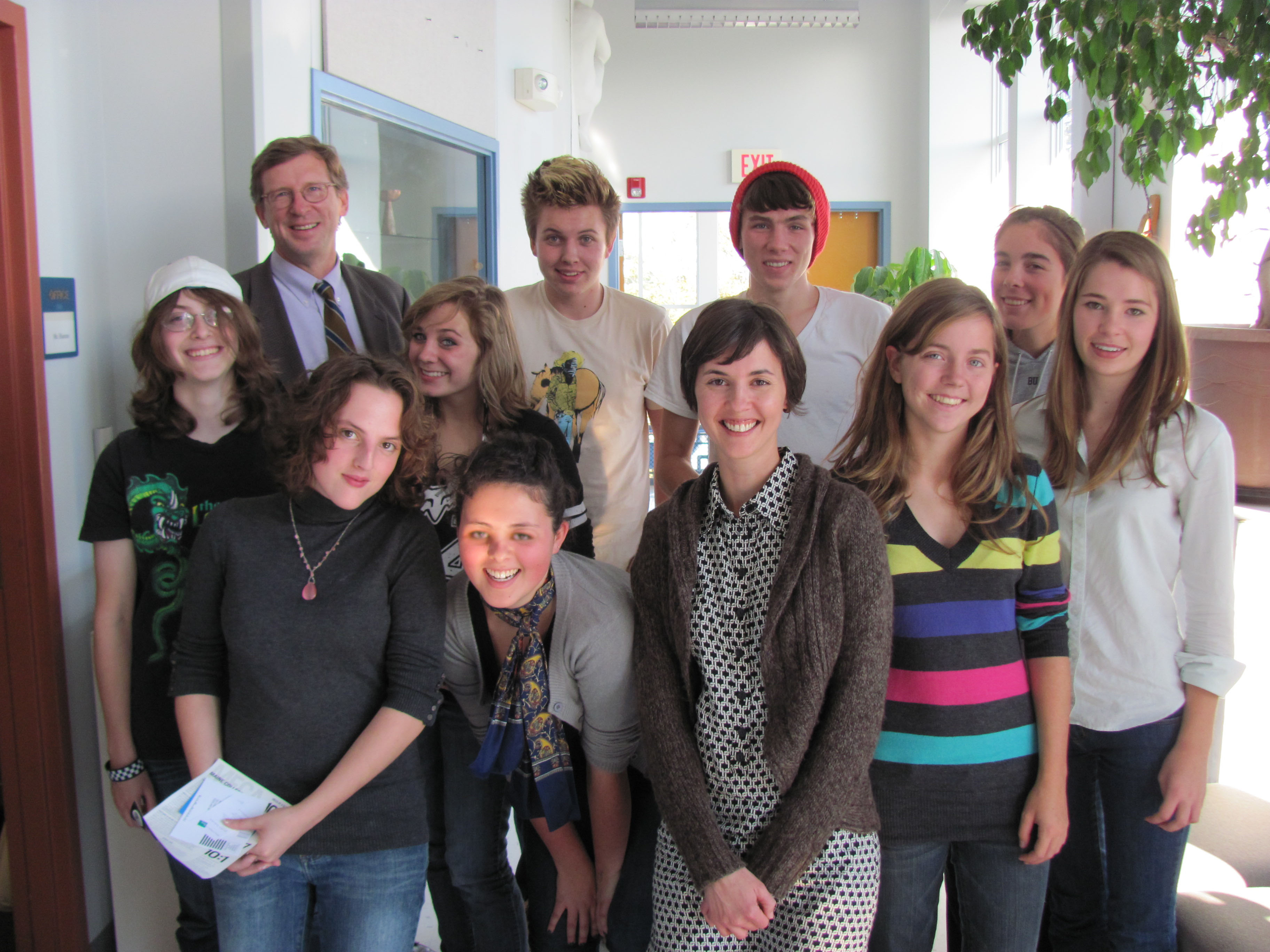
The president of the Maine College of Art (MECA) , Donald Tuski, visited Belfast Area High School (BAHS) on Oct. 26th. He was there, along with admissions representative Shannon Cote, to speak to Mr. Hamm’s Art Portfolio class and to tour the Fine Arts facility. Tuski says: “I just love what you have going on, here in Belfast“. BAHS students have traditionally received generous support from the Portland College due to their strong drawing portfolios and diverse experiences in the arts.

Cortney Rumney, Gately Conley, Lila Carpenter, Shannon Cote (MECA Associate Director of Admissions), Kate Howard and Elizabeth MacAvoy; behind them, Kimberly Gatz; and, in back, Donald Tuski (MECA president), John Loxterkamp, Ben Shepherd and Krissy Martin

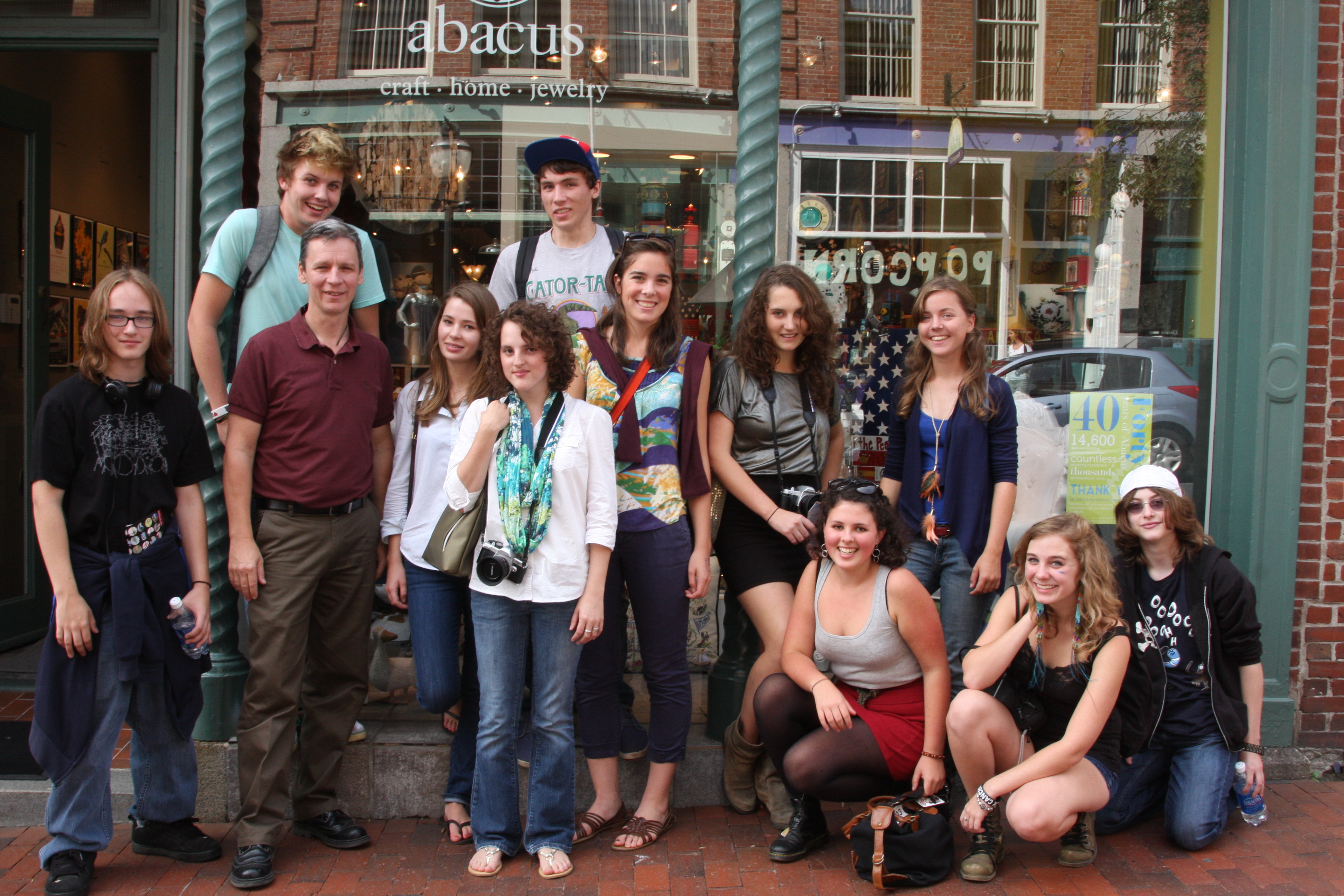
This was Donald Tuski’s first high school visit since he began his presidency at MECA two years ago. BAHS Art Portfolio students recently visited MECA and toured the facility as well a few galleries in downtown Portland.

Pictured in front of Abacus gallery, Zakary Alderson, John Loxterkamp, Charles Hamm, Elizabeth MacAvoy, Gately Conley, Ben Shepherd, Krissy Martin, Clare Olson, Lila Carpenter, Kate Howard, Kimberly Gatz, and Cortney Rumney

Post contributed by and photos taken by Charles Hamm.