Posts Tagged ‘Music’

h1

US Department of Education

April 6, 2012

New study: Arts Education in Public Elementary and Secondary Schools
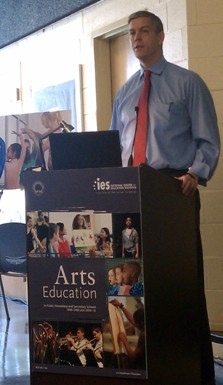
US Department of Education Secretary of Education, Arne Duncan

On April 2, the U.S. Department of Education released a study entitled Arts Education in Public Elementary and Secondary Schools 1999-2000 and 2009-10. This study was previously published in 2002, prior to implementation of the No Child Left Behind Act (NCLB). Arts education advocates are very pleased to finally see an update, even if a full decade later.

The report offers mixed results in support of arts education. According to the report, music and visual art are widely available in schools in some form in schools nationwide; however, dance and theater are far less available. U.S. Education Secretary Arne Duncan stated, “despite the importance of providing equal educational opportunities in the arts, today’s report shows we are falling well short of that goal.”

Despite being designated a “core academic subject” in NCLB and being included in mandated elementary school curriculum in 44 states, this survey demonstrates that access to arts education remains elusive to a tremendous number of students across the nation.

From the Department’s announcement of the study we learned that:

  • 1.3 million of our nation’s public elementary school students receive no specific instruction in music, and nearly 4 million students receive no specific instruction in the visual arts.
  • 800,000 public secondary school students do not receive music, and 11 percent of secondary schools do not provide the visual arts.
  • Only 3 percent of elementary schools offer any specific dance instruction and only 4 percent offer any specific theater instruction. In secondary schools, the numbers improve somewhat as 12 percent offer dance and 45 percent offer theater.

Finally, this report found that the nation’s poorest students, the ones who could benefit the most from arts education, are receiving it the least.  A decade ago, the data showed that 100 percent of high poverty schools offered music instruction, but currently, only 80 percent offer music instruction. The percentage offering visual arts, dance, and theater is even lower.

In his remarks, Secretary Duncan called the disparity between high-poverty and low-poverty schools “deeply disturbing” and “absolutely an equity issue and a civil rights issue.”

For further details on this federal study, read this post on ARTSblog, “Ten Years Later: A Puzzling Picture of Arts Education in America.”

This information was provided by the Americans for the Arts.
h1

Arts Assessment Webinar: What We’ve Learned

April 2, 2012

Sharing the lessons learned over the last year and a half…

April 4, 2012

The Maine Arts Assessment Initiative was launched in the Summer of 2010 as a first-in-the-nation state effort to bring best practices in arts education to the forefront by developing and refining assessment strategies at the grass roots level. The stories of the journey are numerous, and lessons learned along the way are many. These have deep ramifications not only for the Initiative as it moves forward, but for anyone associated with arts education in Maine: parents, students, teachers and administrators. Join Catherine Ring and Rob Westerberg on their webinar on Wednesday, April 4 from 3:30 to 4:30 pm as they unpack these lessons learned.

Drawing from recent data; feedback from over two hundred professionals in the field, feedback from the Fall Conference, Regional Workshops and prior MAAI webinars, Catherine and Rob have organized this presentation into an informing set of common themes. With guest presenter Argy Nestor, Visual and Performing Arts Specialist at the Maine DOE, they will attempt to make sense of it all in a way that can help focus and direct future work for all of Arts education in Maine and beyond. Participants will be instructed to provide live, real time feedback as the webinar unfolds, and everyone’s voice is encouraged to be heard! Active MAAI educator or first time participant,  single listener or in a group, as an educator, parent, administrator or student, this is THE webinar that you will want to be sure to put on your calendar and attend!

To join the meeting:

Go online to http://stateofmaine.adobeconnect.com/pk2014412a/

Type your name in the field labeled “Enter as Guest”

Dial in access: 1-866-910-4857 – Passcode 140893

h1

Musical Revue

March 29, 2012

Arts Assessment Teacher Leader Allysa Anderson’s students perform

Camden Rockport Middle School presents Its Our Time, a musical revue Friday, March 30th, 6:30 p.m., Strom Auditorium Camden Hills Regional High School. With one fourth of the school population participating students will share songs, dance, and more from a variety broadway shows.

h1

Another Arts Teachers’ Story: Alice Sullivan

March 27, 2012

Featuring one teacher’s journey as an arts educator

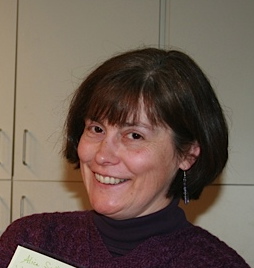
This is the second in a series of blog posts telling arts teachers’ stories. This series contains a set of questions to provide the opportunity for you to read their stories and to learn from others. This post features Alice Sullivan who has been teaching music for 27 years. Alice is one of the Maine Arts Assessment Initiative’s Teacher Leaders, Phase I, and represents the region of Washington County.

Alice is currently teaching, grades K-12, at Woodland Jr. Sr. High School, Woodland Elementary School and Princeton Elementary School. She has been there for 6 years teaching 200 students, band program grades 4-12, some classroom music K-4 and junior high general music, digital arts class and music theory at the high school, and one small elementary chorus.

What do you like best about being a music/art/drama/dance educator?

I really like the opportunity to use my organizational skills in an environment where I can also be creative. The music room is a great place to find a balance between hard and fast standards and finding numerous ways of meeting those standards. Twenty seven years of concerts with no two being the same, but every year I strive to provide every student with the same well rounded music education.

Tell me what you think are three keys to ANY successful arts ed program?

  •  a commitment to stretching the limits (your own and those around you)
  • a belief that what you do is important
  • enough confidence in your skills to take risks

What specific way(s) do your assessment practices tie into the success of your program?

Developing solid assessment practices sends the message to those around you that you believe your program is valuable and worthy of reflection. This instills a sense of importance in your students and as a result they strive to reach higher goals. I often say to my students – “who wants to belong to the good enough club”? An assessment is a tangible way for my students to prove the level they have attained, to themselves and others.

What have been the benefits in becoming involved in the arts assessment initiative?

There have been so many benefits to being part of the arts assessment initiative. The first that comes to mind is the great opportunity to network with other educators. It has also helped to keep assessment practices foremost in my daily teaching. With so many things to do each week, priorities become a necessity. Having weekly connections through the arts initiative wiki has ensured that assessments make my priority list.

What are you most proud of in your career?

I’ve always believed that music is a gift that all students can and should receive. My classes have always been available to all students. I’m most proud of the moments when the reluctant musicians realized they did have musical talent.

What gets in the way of being a better teacher or doing a better job as a teacher?

SLEEP!

Apple or PC?

Both – depends on the job I want to get done.

What have you accomplished through hard work and determination that might otherwise appear at first glance to be due to “luck” or circumstances?

Exceptional concerts are a reflection of hard work and determination. A good performance is often attributed to talent or “good” students. I believe even very young and inexperienced performers can present quality programs with hard work and determination.

Look into your crystal ball: what advice would you give to teachers?

Enjoy what you do. Focus on the positive forces in your environment and link arms with those who also have a positive outlook.

If you were given a $500,000.00 to do with whatever you please, what would it be?

I would travel. I want to see the world and share those experiences with the people around me.

This is a link to the wiki that Alice created that includes her marvelous resources: https://meaningfulassessments.wikispaces.com/. If you have comments or questions for Alice please put them in the “comment” section below.

Thank you Alice for telling your story!

h1

Music and Excelling in School

May 21, 2011

All State Music Festival continues

This post is taken from the WCSH6.com website and submitted there by Sam Moore Young

The correlation between participation in music and excelling academically is on display at the All State Music Festival on the Gorham campus of USM.

Poland Regional High School students Ben Albee and Tyler Myers are prime examples.  Myers, singing bass in the All State Chorus, is the salutatorian of his graduating class. Albee, playing trombone in the All State Orchestra, is also an honor student and will be Master of Ceremonies at graduation.

There are many students at the MMEA All State Music Festival who are the top students at their schools including Kaitlyn Kinsey, playing flute in the All State Band, who is Valedictorian of her class at Fort Fairfield High School.

h1

Turn Around Habits

April 15, 2011

Change of Frame of Mind

Gareth Malone is a charismatic choirmaster who works with young people (and others) and takes them beyond their dreams. He proves that groups of people can be taught to sing well enough to make a difference and bring communities together. One of his students says that her “frame of mind” was changed and it impacted all of her life.

“Gareth’s belief that people should have access to sing beautiful music drives his fearless passion to unite people in song. He feels a choir allows people to come together and express themselves as a community which can be a deeply personal and touching human experience.” From The Choir website.

I have enjoyed watching the clips of the young people Gareth has influenced and the segments of performances of beautiful music. This website has several short BBC film clips with individual stories http://www.bbcamerica.com/content/401/the-choir-videos.jsp

This is The Choir website and has video clips of community performances. http://www.bbc.co.uk/sing/choir/ The Choir is a two-time BAFTA, British Academy of Film and Television Arts award winner.