Posts Tagged ‘poetry’

h1

So Long 23, Helloooo 24!

January 1, 2024

Peek back, move on

Traditionally I make a Greek New Year’s bread called Vasilopita which is baked with a coin inside. As the new year arrives the bread is cut, a slice for each family member, friends and neighbors. Whoever is the finder of the buried coin is blessed with fortune during the year. I wish you all the best of luck and good fortune during 2024!

Recently I learned about the Pridrangar Lighthouse that stands 110 feet from the ocean’s surface. The name Pridrangar means “three rock pillars” which reflects the giant sea stacks upon which the lighthouse rests. It is located in Iceland, six miles off the southern coast and was constructed in 1939. Experienced mountaineers were recruited to scale the sea stack to build it. When life is challenging perhaps giving thought to how difficult it was to build the lighthouse will provide some ease in your load.

Today I pause for a short time to review my 2023. I am feeling all the emotions of living each day to the fullest. I think about the challenges I’ve taken on including planning the Sestercentennial (250 years) for my small Maine town, the new things I’ve learned like carving wooden spoons, the medical situations I’ve faced including carpal tunnel surgery, the collaborations I’ve been part of including stitching a 25 foot by 7 feet piece of art that will hang in a law firm in Philadelphia. I’ve been thrilled to publish a book after working with a poet friend for almost 2 years, to visit with friends that I haven’t seen in 50 years, and to travel to a country I’ve never been to. I am grateful for the small things in life including watching amazing sunrises from my front yard, paddling along silently as an eagle flies overhead, walking through the woods to look closely at tracks in the snow. I never lose sight of how fortunate I am which reminds me to have an open heart when sewing hundreds of dresses and pants for children in other countries or taking time to make cards for friends or going to lunch with an older friend once a month. As with many of you, I am feeling the tragedy of the shootings in Lewiston. The many young children, relatives and friends who have lost loved ones during a few minutes of a day. My heart breaks for people around the world who endure the daily terrors of war. I think about the environment and work to minimize my negative impact.

I am mindful of the importance of light, reaching as many as possible. My biggest question as a teacher: Is what I’m doing in the best interest of every learner? The question I ask today is: Am I contributing to help make the world a better place? As I consider my hopes and dreams for 2024 please know that I appreciate the work educators do every day in the classroom. You may have heard me say this during the pandemic and it still rings true today: Whatever you decide to do, is the right thing and enough. Thank you for continuing to spread your light. As we look up at the sky on a clear Maine night and see the same stars we are all connected.
h1

I Worried

February 28, 2023

By Mary Oliver

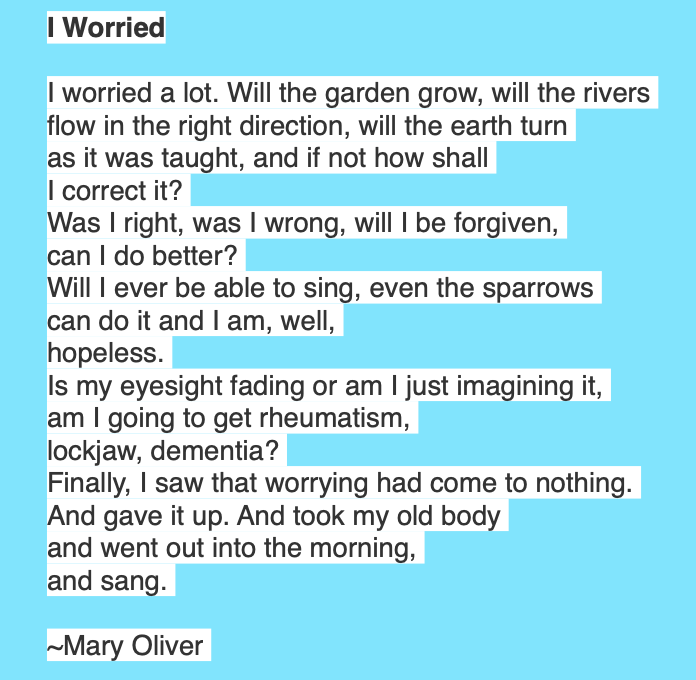
I enjoy reading Mary Oliver’s poems, she has written hundreds of them. They offer hope when the world appears dark. They help me pause and start my day in a positive place. This one called I Worried reminds me that ‘stuff happens’ that I have no control over. One of the questions my husband and I started asking ourselves when our children were very young to help put things in perspective: “Is this a dance or a wrestle?” Almost always we found that the situation warranted a dance. So, I say: DANCE ON!

h1

Seeing Mercer, Maine

January 24, 2023

Poem for thought

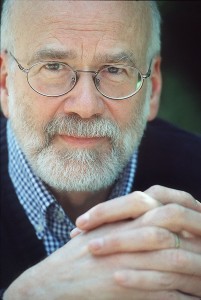
Wesley McNair served as Maine’s Poet Laureate, 2011-15, during which he had two initiatives. He successfully brought poetry to all regions of Maine and made it accessible to people from all walks of life. Mr. McNair has been writing poetry for 40 plus years, authored 20 books, had a poem included in Garrison Keillor’s Writer’s Almanac, and has received several awards, recognition, and support for his writing. Mr. McNair has a slow and steady voice that draws the listener with hopes of not missing a word. His slight of humor and gentle smile is engaging.

I was fortunate while at the Maine Arts Commission to work with Mr. McNair in the Poetry Out Loud program. High school students who participated in Poetry Out Loud had the opportunity to spend time with him, engage in conversation and be inspired by his readings. I was inspired alongside them and now I listen to a poem being read each morning. Poem-a-Day is a program of the Academy of American Poets and makes it easy and fun to access poetry. The poems that I connect with are stashed away for future reading.

I read one of Mr. McNair’s latest poems (below) recently and knew that I wanted to share it with you, the readers of my blog. Mr. McNair lives in Mercer, Maine, population 640.

Wesley McNair

Seeing Mercer, Maine

By Wes McNair

Beyond the meadow
on Route 2, the semis
go right by,
hauling their long
echoes into the trees.
They want nothing to do
with this road buckling downhill
toward the Grange and Shaw
Library, Open 1-5 P.M. SAT,
and you may wonder
why I’ve brought you here,
too. It’s not SAT,
and apart from summer, the big
event in town’s the bog
water staggering down the falls.
Would it matter if I told you
people live here – the old
man from the coast who built
the lobster shack
in a hayfield;
the couple with the sign
that says Cosmetics
and Landfill; the woman
so shy about her enlarged leg
she hangs her clothes
outdoors at night? Walk down this road
awhile. What you see here in daytime –
a kind of darkness that comes
from too much light –
you’ll need to adjust
your eyes for. The outsized
hominess of that TV dish,
for instance, leaning
against its cupboard
of clapboard. The rightness
of the lobsterman’s shack –
do you find it, tilted
there on the sidehill,
the whitecaps of daisies
just cresting beside it
in the light wind?

h1

National Poetry Month

April 1, 2021

Happy new month

We can, and many educators do, use poetry and creative writing in their classrooms whether they teach English Language Arts or another subject. Many arts educators use poetry to enhance, dove-tail, and/or integrate into their arts subject. When Amanda Gorman recited her poem at the Presidential Inauguration in January it made a huge impression on citizens of all ages. If you’re not incorporating poetry into your arts classroom I can’t think of a better time to do so.

In recognition of National Poetry Month this post is about resources and opportunities about learning more about poetry. You may find it useful for yourself and for your students. If you have any resources please feel free to share at the bottom of this post or email me at meartsed@gmail.com and I can include them in a blog post for others to learn from.

POETRY RESOURCES

  • Tim Needles is an artist and a veteran art teacher who uses poetry in his art classroom. The article Video Poems Add Digital Literacy to Creativity and Expression was authored by Jerry Fingal for the International Society for Technology in Education (ISTE) blog. Needles suggests places for teachers to start and tips for success in using the simplest forms of technology when making a visual poem. He also goes into ideas for connections with other subjects including STEAM ideas. “Teachers can start with simple poetry, like a haiku, and use whatever technology is available. As for images, nature is always good for visuals.” An aside, if you’re interested in technology standards ISTE is the place to look.
  • Poets.org is a website filled with resources. You can subscribe (on the front page) and receive in your email box a “poem-a-day”. Each month there is a guest editor which changes the flavor month to month. You can read the poem or listen to it being recited. At the end there is a small segment called “about this poem” which provides interesting information about the poem. Very informative.
  • The Academy of American Poets is providing their Annual Gala, this year entitled Poetry & the Creative Mind. It is normally held in person but this year, the 18th celebration, will be held virtually. You can register at no cost. The event is on April 29, 7:30, and marks the 25th anniversary of National Poetry Month.
  • The Poetry Out Loud finals are held annual with each state represented by one high school student. If they’re lucky to make it through the three rounds they will each recite 3 poems that they have practiced over and over and know insider out. This year the national event will be held virtually with the semi-finals held on Sunday, May 3 and the finals on May 27. Both events will be streamlined on arts.gov.  You can learn more about the events at THIS LINK. The Poetry Out Loud site has a huge collection of poems that you can download.
  • If you’re interested in joining a group of people who are working on writing poetry consider participating in The Poetry Place. Maine Teaching Artist Brian Evans-Jones established the Poetry Place. Brian is a member of the Maine Arts Commission roster and has participated in the Maine Arts Leadership Initiative (now MAEPL). For several years he was involved in Maine’s Poetry Out Loud (POL) program as a judge and he worked with two of our state representatives who represented Maine in the national POL program.
  • The Poetry Foundation has numerous resources including poems that you can read, download, and listen. Check out their site for all they have to offer.

Amanda Gorman

Just after the presidential inauguration Amanda told “CBS This Morning” co-host Anthony Mason: “Poetry is a weapon. It is an instrument of social change…and poetry is one of the most political arts out there because it demands that you rupture and destabilize the language in which you’re working with. Inherently, you are pushing against the status quo. And so for me, it’s always existed in that tradition of truth-telling.”

h1

What If

March 13, 2021

I’m sharing this poem called “What If” that was written on March 20, 2020. It provides a different way to look and continue to process the Covid pandemic that has impacted our lives. There was fear a year ago that has provided us with knowledge, experiences, and other opportunities that may not have occurred if it wasn’t for the pandemic. This may provide you with a moment to ask yourself, What if….

What if….

Amongst all the fear and confusion, there’s this…❤️ a different perspective …

There is so much fear, and perhaps rightfully so, about COVID-19.

And, what if…

If we subscribe to the philosophy that life is always working out for us, that there is an intelligence far greater than humans at work…

That all is interconnected.

What if…

the virus is here to help us?

To reset.
To remember.

What is truly important.

Reconnecting with family and community.

Reducing travel so that the environment, the skies, the air, our lungs all get a break.

Parts of China are seeing blue sky and clouds for the first time in forever with the factories being shut down.

Working from home rather than commuting to work (less pollution, more personal time).

Reconnecting with family as there is more time at home.

An invitation to turn inwards — a deep meditation — rather than the usual extroverted going out to self-soothe.

To reconnect with self — what is really important to me?

A reset economically.

The working poor. The lack of healthcare access for over 30 million in the US. The need for paid sick leave.

How hard does one need to work to be able to live, to have a life outside of work?

And, washing our hands — how did that become a “new” thing that we needed to remember. But, yes, we did.

The presence of Grace for all.

There is a shift underway in our society — what if it is one that is favorable for us?

What if this virus is an ally in our evolution?

In our remembrance of what it means to be connected, humane, living a simpler life, to be less impactful/ more kind to our environment.

An offering from my heart this morning. Offered as another perspective. Another way of relating to this virus, this unfolding, this evolution.

It was time for a change, we all knew that.

And, change has arrived.

What if…

– Gutpreet Gill

h1

Spoken Word

September 7, 2020

Brandon Leake – America’s Got Talent

I’ve been thinking, listening, reading, having conversations and researching on how to address racial justice in my teaching and learning. I think the world works in magical ways when ‘stuff’ happens that I’m not looking for. And sometimes ‘different stuff’ intersects which, in this case, has led to this blog post.

First I want to say that my favorite podcast at the moment is Cult of Pedagogy started by a middle school Language Arts teacher Jennifer Gonzalez. Jennifer has brought together an experienced group of educators who help make the Cult of Pedagogy. If you’re looking for a podcast that will push on your thinking and curious where you might find ideas that are sometimes raw and grounded in reality combined with thoughtful educational research, then I suggest that you check out Cult of Pedagogy. Many of the episodes are Jennifer’s interviews with teachers, learning experts, parents, and other people who make things happen in education. There are a handful on the social justice topic. If you’d rather read than listen, each new episode comes out also in an email, on Sunday’s. You can learn about all that she has to offer and sign up for her weekly emails on the START HERE PAGE. An example of the podcast resources that Jennifer provides is episode #147 Why White Students Need Multicultural and Social Justice Education  from June 7th an interview with Sheldon Eakins who founded the Leading Equity Center, an online resource for educators.

I was first introduced to poetry by my 7th grade language arts teacher Mrs. Leeds. Each week on Friday we would learn about a poem, write it down in our poetry notebook, and over the next week memorize it and each student in my class would stand and recite it. I can dig into my memory today and recite Stopping by Woods on a Snowy Evening by Robert Frost and In Flanders Fields by John McCrae and probably a few others. Every so often I rediscover my poetry notebook and think about how nervous I was standing up in my front my class. I don’t recall actually learning how to recite poetry. We’ve come a long way in this area; now we have poetry slams, hip hop, jazz poetry, beat poetry, spoken word, and Poetry Out Loud (POL). POL is a partnership of the National Endowment for the Arts, Poetry Foundation, and the state and jurisdictional arts agencies. The Maine Arts Commission administers the recitation program.

I’ve been curious for some time about how ‘poetry’ has, for the most part, been taught in English or language arts class. Why poetry is considered an art form yet in schools we don’t include it when we reference visual and performing arts. In our standards documents it’s not clearly defined as part of the arts. When I try putting poetry in context I explain it like this: in schools poetry is behind the English teaching door and in the real world it is part of the performance arena.

I wanted to better understand this separation so I did a little sleuthing on the internet and, of course, I start with the Greeks. From the Ancient Greek word ποιεω (pronounced poieo) which means ‘I create’. Definition: an art form in which human language is used for its aesthetic qualities in addition to, or instead of, its notional and semantic content. In most poetry, it is the connotations and the “baggage” that words carry (the weight of words) that are most important. Poetry.org.

And further on about ‘spoken word’. Spoken word is poetry, and more recently spoken word poetic performance art that is word-based. It is an oral art that focuses on the aesthetics of word play such as intonation and voice inflection. It is a “catchall” term that includes any kind of poetry recited aloud… Unlike written poetry, it has less to do with physical, on the page aesthetics and more to do with phonaesthetics, or the aesthetics of sound. Wikipedia

A focus on words, sounds, presentations and performances using poetry has become more prevalent in our society since about the 1980’s but certainly it is embedded and has been for years in many cultures and their traditions. The connection between poetry as a performance and music is closely aligned.

In fact, in Ancient Greece, the spoken word was the most trusted repository for the best of their thought, and inducements would be offered to men (such as the rhapsodes) who set themselves the task of developing minds capable of retaining and voices capable of communicating the treasures of their culture.

I think poetry’s biggest potential is to light kids up and engage them in learning about themselves and the world. If only Mrs. Leeds had someone guide her in the pedagogy of teaching poetry. A good reason to promote integrated curriculum.

Here’s where the intersection of learning takes place for me. On my phone last week a video from America’s Got Talent popped up. A powerful performance by Spoken Word Artist Brandon Leake began to help me formulate curriculum for racial justice. You can LEARN more about Brandon and the organization he established Called to Move. I suggest using Brandon’s performance with your students.

h1

Two Mindsets

September 3, 2020

A Poetic Tale

Many of you have read Carol Dweck’s Mindset and have incorporated some of this line of thinking into your work as an educator and perhaps applied it personally. If you’re not familiar with the book Dr. Dweck provides insight on the power of mindset, how we think about talents and abilities and how mindset influences success in school and every part of life.

People with a fixed mindset—those who believe that abilities are fixed—are less likely to flourish than those with a growth mindset—those who believe that abilities can be developed.

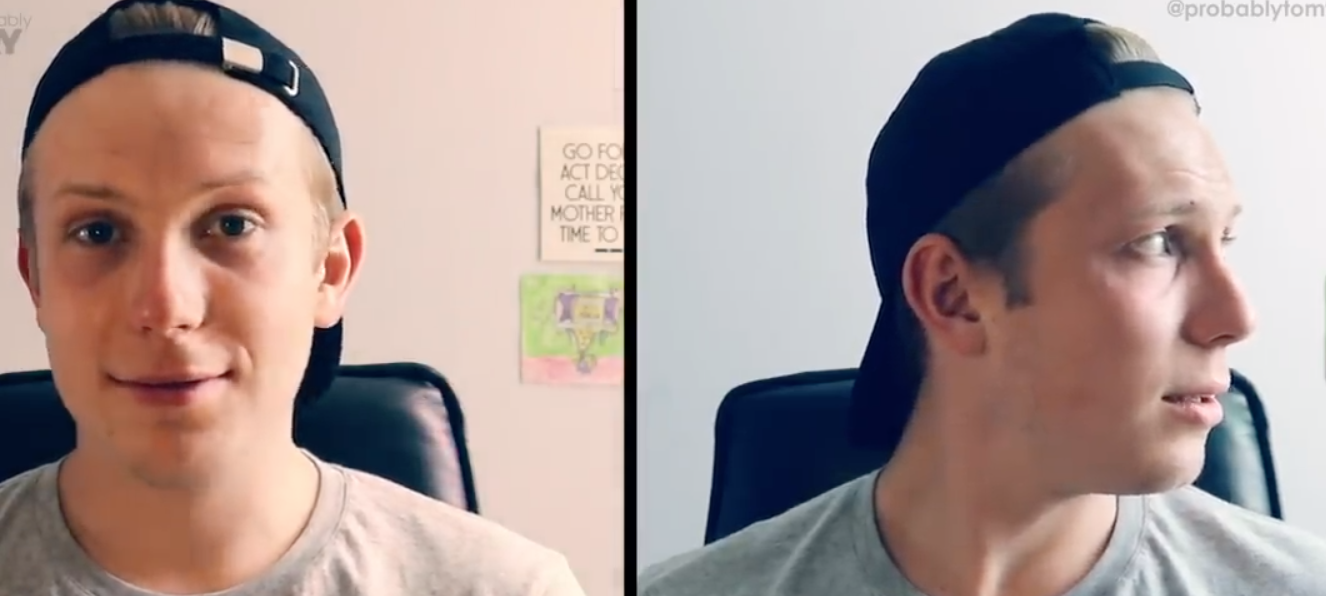
In this video called A Tale of Two Mindsets, the young British poet and filmmaker Tom Roberts provides examples of what each mindset might sound like in dealing with today’s reality.

Roberts also created the poem The Great Realisation, a bedtime story video about the world in March and leading up to it. In 48 hours it went viral and had over 20 million views. Find it at THIS LINK. Roberts uses the name Tom Foolery in his posts.

https://biggeekdad.com/2020/08/a-tale-of-two-mindsets/

h1

Poetry Parlor

May 5, 2020

Maine Teaching Artist Helps Poets Boost Their Skills Online

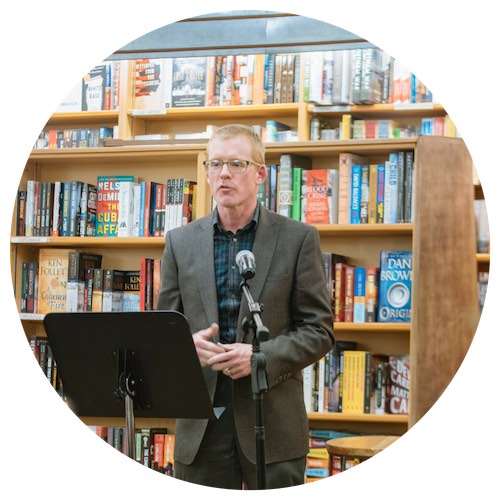
Brian Evans-Jones is a Maine-based poet and Maine Artist Leadership Initiative (MALI) Teaching Artist Leader. After moving to South Berwick from Britain in 2014, he has taught poetry and writing in schools across Maine, from Kittery to Calais to Van Buren. Now he’s expanding his reach by teaching poetry online to adults.

His new project, Poetry Parlor, is an online membership club for anyone who wants to learn about writing poetry. Each month, members read and discuss a high-quality poem by a contemporary poet, and then write a poem of their own based on what they’ve learned. Members then get feedback on their poems from other members, in a video from Brian, or via a monthly Zoom call with Brian (depending on membership level). There’s also a private Facebook group for members to interact and support each other. So far 18 poets have tried out the Parlor, with some very positive feedback about what they’ve learned.

The idea for Poetry Parlor began when Brian thought about how he could reach more poets. He said, “I’ve taught poetry to adults since 2008, but I hadn’t found the same opportunities to teach it in Maine that I used to have in England. I really love teaching adults, and I was missing it, so I thought about online teaching. I particularly wanted to help writers who were passionate about learning poetry, but who didn’t have time or money for a college course—and of course online is more flexible for them. Plus, I’ve always loved helping writers create community for support and learning. So I came up with the Poetry Parlor, and it has been just so exciting to see members joining in, creating poems and already learning a lot, even after just two months.”

Poetry Parlor started in March, and May is its third month. New members are welcome at any time; if you join late in the month, your membership will be applied to the next month’s activities. Brian says, “We have a committed, friendly, and very supportive community of poets in the Parlor, ranging from someone who has a book coming out, to someone who wrote his first ever poem this month! I’m look forward to welcoming more folks who’d like to try us out.”

For more information and to join, please go to CLICK HERE.

HELP US CELEBRATE THE 4,100th blog post – For the next two weeks Brian is offering 50% off the first month of Standard membership of the Poetry Parlor. Use the code: MAINEARTSED50 when signing up for a membership. In addition, if you check out Brian’s site and return to this blog post and ‘leave a comment’ below about Brian’s Poetry Parlor you will receive a FREE handmade face mask! If you have any questions please don’t hesitate to contact me at meartsed@gmail.com.

h1

Pull a Poem Out of Your Pocket

April 4, 2019

Add some poetry or more poetry

Considering what to do to celebrate National Poetry Month with your students? Check this great idea out. It combines creativity, theater, poetry and much more. CLICK HERE to read the article found on Curriculum Matters blog, written by Brenda Iasevoll on April 27, 2018.

h1

Two Poems a Day

March 23, 2019

Random mailings

This 32-year-old poet (and firefighter) Natalie Potell mails poems to strangers without including a return address. Natalie is Prince William County’s poet laureate and she doesn’t want people to feel pressure to reply. “Read it. Enjoy it or don’t enjoy it.”
It’s a pretty amazing way to share her love of poetry and plants seeds in a surprise sort of way. What could you do to make an impact in a surprising sort of way? READ the entire article.