Posts Tagged ‘Rob Westerberg’

h1

Successful Mega!

December 2, 2014

MAAI Mega MDIHS

The feedback is clear – the Maine Arts Assessment Initiative’s Mega – regional workshop at MDI High School last week was a success! Participants learned new information and the work that is done each day in classrooms across Maine was reinforced. Once again the highlight was the opportunity for Arts educators to come together for a professional development opportunity that was designed specifically for them.
Screen Shot 2014-12-01 at 10.48.20 PM

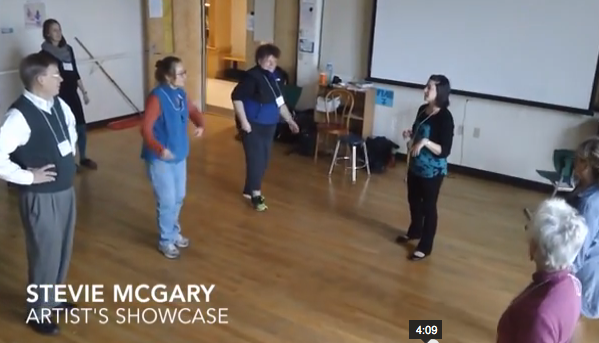
A HUGE THANK YOU to Charlie Johnson and his colleagues at MDI High School for hosting, to the MAAI Teacher Leaders who provided outstanding workshops: Janie Snider, Lisa Ingraham, Shannon Westphall, Frances Kellogg, Sue Barre, Charlie Johnson, to Teaching Artist Stevie McGary for the workshop and artists showcase, and to Catherine Ring, Rob Westerberg, and Nancy Salmon who provided technical assistance and leadership for the day!

I LOVE reading the feedback and how the day influenced participants thinking and teaching. Don’t take my word for it, below is what some of the participants said. I will post more in the near future along with a video that Charlie created to document the day.

  • I can’t believe how quickly this day flew by! As always, I wish that we had more time like this and opportunities to meet… I love these MAAI conferences, I always leave feeling more grounded and ready to take action
  • I like the Habits of Mind posters and the idea of the check list to keep throughout a project to assess each habit… These were really solid examples of what can be done.
  • I have already been implementing a few of these processes into my curriculum. Now, I just need to communicate this to my students in a clearer, more consistent manner.
  • Our district is focusing on Habits of Mind. I didn’t realize Studio Habits of Mind are different, but similar. Definitely a lot of useful information.
  • On the arts assessment website http://www.maineartsassessment.com there is a proficiency toolbox that I will be able to revamp my assessments at my school.

I LEARNED…

  • how to authentically apply the learning results to assessment
  • how to create a simple rubric for standards is an easy way to keep track of what 1, 2, 3, 4 etc actually means
  • simple, quick class assessments concrete examples of student growth — A+
  • about how to apply assessments to the art classroom and how to make the language usable for students of all ages
  • recording with the ipad for quick assessment
  • strategies for holding myself and my students accountable for what they are learning and creating in the art room
  • engage and persist can be a way to think about behavior in a positive way
  • about some fun and creative resources to help with assessing my students
  • how students demonstrate their learning through a hands-on project (pinhole cameras)
  • even a quick 60-second movement can benefit across the school day
  • how to clearly describe different standards and allow students to have an important part in the grading process
  • some quick and effective ways to assess students on the fly in the elementary music setting, and how to score and record them.
  • all about the site: http://www.maineartsassessment.com/, I LOVE IT. Need to spend loads of time there.

The above list includes just some of the feedback from November 25. If this is information that you’d like to learn more about please be sure and attend another Mega-regional workshop that is planned for this school year. The dates and locations are below and the link to the registration is http://mainearts.maine.gov/Pages/Education/MAAI-Mega-Regionals-2014-2015#

h1

Are the Arts Academic?

November 17, 2014

What do you think?
Last week while I was in New Orleans at the Professional Development Institute held each fall for the “Arts Ed Managers” (people in positions like mine at the Arts Commissions, or Arts Councils, as they are called in many states), we visited an Arts high school that had the morning devoted to “academics” and the afternoon devoted to the “Arts”. The school is 40 years old but in more recent years it added the “academics” so students could spend the entire day there to receive all of their instruction. I asked one of the administrators why they considered the Arts as non-academic and thought about the handful of conversations I’ve had with York High School music educator Rob Westerberg on the topic. When I returned I asked Rob if he would write a blog post on the topic and below is the post. It would be great to hear what you have to say on the topic. As you read through it please think about where you stand on the topic and I invite you to post a comment at the end of the post. Consider having this discussion with your own school district arts staff. Thank you Rob!

IMG_0727In 2010, a student applying to Stanford University posed this question on an online forum called “College Confidential”, asking if their music teacher’s recommendation letter would count as an academic teacher recommendation. This was the primary response: “A music theory teacher, or music history teacher, I could make arguments for. A band director does not teach an academic subject, any more than a football coach or a driver’s ed instructor does.” In contrast, that same year, Indiana published their Academic Standards for Music which states, “The ultimate goal of a fine arts curriculum is to enable students to be proficient creators, performers, critics, listeners, and observers of the arts. Students who attain academic standards in the fine arts will be able to use the arts to think and learn independently, know themselves and the world around them, and communicate in the art forms studied.

So which are the Arts: co-curricular or academic? Let’s take a closer look at the two diametrically opposed perspectives.

As for the insinuation that the Arts are co-curricular, the Glossary of Educational Reform (created by the Great Schools Partnership) defines co-curricular in part as, “typically, but not always, defined by their separation from academic courses. For example, they are ungraded, they do not allow students to earn academic credit” I don’t think too many would argue with this definition, simple though it may be. But Great schools partnership continues with, “A few examples of common educational opportunities that may be considered co-curricular include student newspapers, musical performances, art shows, mock trials, debate competitions, and mathematics, robotics, and engineering teams and contests.” We can decry that the music and art references are entirely misplaced, but we’d be in the vast minority. And we could argue that the Arts are more academically rigorous than the other examples, but we’d be very wrong (more rigorous than robotics – really??).

Yet having said all that, there’s one argument the Arts have that sticks: many of our performingIMG_6137 arts presentations and art shows are tied to academic coursework. So let’s look at that end of the spectrum. The Indiana document, which clearly states the Arts as academic, embeds one extraordinarily important caveat: students are to “attain academic standards”. Let’s roll with that. Great Schools Partnership definition of standards: “concise, written descriptions of what students are expected to know and be able to do at a specific stage of their education—that are used to guide public-school instruction, assessment, and curricula.” Got that? Academic courses are entrenched in curriculum, instruction and assessment. Again, I find it hard to believe anyone would argue this definition.

Now back to the original question: are the Arts co-curricular or academic? To witness arts education across Maine, the answer seems to be a big, resounding, “depends.” It depends on whether or not you base it on what we say, or you base it on what we do. Based on what we say, we’re indeed academic. Based on what we do, it’s usually anything but. I’ll tell you why. We are resistant to changing the way we do things to actually reflect the definition of being an academic subject; we run our Visual Art and Performing Art classes the way we were exposed to when we were in High School. We run them the way we were taught in College. We run them the way we’ve been allowed to by administrators who are happy to have us do what we want because they largely do not see us as academic anyway. At the elementary level, we are viewed as keeping the kids occupied so classroom teachers can have a prep. At the Middle and High School levels, as long as the exhibits and concerts look and sound great, we’ve always received pats on the back and told to keep up the good work.

IMG_3615As Maine implements its proficiency law, it’s about time we in the Visual and Performing Arts took a cold, hard look in the mirror. We are in the extraordinary position of linking arms with the other academic subject areas and joining them in this work if we choose to, holding every individual student academically accountable. I have heard for years from colleagues – verbatim – that “you can’t (or shouldn’t) assess the arts”, and “some kids are just more talented than others”, and “we teach kids, not stuff”, and “when will there be time to rehearse?”, and “I just want my kids to be happy in my classroom.” You know what? We can go there… we can absolutely determine as a state that these are our mantras, and that we are here to enrich our students lives in awesome, meaningful and lasting ways. Game on. Just don’t whine when we finally get removed from the school day, and get completely marginalized as co-curricular in nature. The alternative of course is to move forward as fully fledged, card carrying members of the academic core. But doing so means having to get off our soap boxes, out of our comfort zones, and articulating exactly what we are. Academically. No more, no less. By definition, that means developing standards and proficiency for every student. Every individual student. No more excuses. Does this mean reinventing what we do, how we do it and what that all looks like in practice? You bet it does. But before we complain about it, we need to ask ourselves if the alternative is acceptable. It’s time to get off the fence for once and for all and determine what we are. If we’re truly academic, it’s time to act it.

h1

Art and Music Courses

August 24, 2014

Course Opportunities for Art and Music Educators

As arts educators, we know how important a quality arts education is for every student. That is why we are constantly seeking to improve teaching and learning  in our classrooms. And the arts have never been more relevant and essential than they are right now – in the 21st century.  But where do we find quality, professional development in arts education?

The New England Institute for Teacher Education is proud to announce that it will be offering three courses in Visual Art and Music Assessment practices this fall to any Art or Music educators, K-12.  The courses are all taught by leaders in art and music education who have played an integral role in the Maine Arts Assessment Initiative in the past three years.

Don’t miss this special opportunity to work with Rob Westerberg, who will be bringing the Music course to Hanover, New Hampshire (Vermont and New Hampshire music educators, take note!), Jake Sturtevant who is teaching Music Assessment in Standish, Maine, or Catherine Ring who is teaching Visual Art Assessment in Bangor, Maine.  All of these courses meet on teacher-friendly schedules (two weekend sessions with 10-12 weeks in between) and are tailored to meet each individual’s needs.

If you want to be in on the most current thinking, research and best practices used in arts classrooms, this is a great way to get started and connect to a network of other professionals and a wealth of shared resources. Over 85 arts educators have taken advantage of arts assessment courses through the New England Institute and many have taken on leadership roles in their schools and districts as a result of their work. Three graduate credits will be awarded upon successful completion through the New England Institute’s academic partnership with Endicott College.

So please join us. We’re excited to share what we have with you and to learn from you!

Questions?  Call the New England Institute at 207-367-5807 or email newenglandinstitute@gmail.com.

Catherine, Rob and Jake

FLYER (1)

h1

Roundtable Music Ed Webinar

May 28, 2014

Review of webinar

Screen Shot 2014-05-27 at 9.42.14 PMThe fourth in a series of webinars for the Maine Arts Assessment Initiative was held on Tuesday, May 20, entitled “Maine Music Educators Roundtable”. The webinar was facilitated by Rob Westerberg, choral director at York High School in direct response to concerns from music educators in the field around a broad selection of topics. The hour included participation by Maine’s Visual and Performing Arts Specialist at the Maine Department of Education, Mr. Kevin Facer.

Roundtable guests were: Drew Albert – vocal and instrumental, Maranacook Community High School, Andria Bacon – instrumental/strings & general, RSU #64; Corinth, Bill Buzza – instrumental & general, Edward Little High School, Jen Etter – vocal music, York Middle School, Jen Nash – instrumental/strings & general, Sebasticook Valley Middle School and Ashley Smith – vocal & general at Brunswick High School. After a brief introduction, the roundtable went to work fleshing out thoughts around topics which included:

  • Effect of common core on music programs
  • Proficiency & standards based assessment
  • Music teachers as leaders in your own schools
  • National Standards release and ramifications
  • Teacher evaluation implementation

Additional discussion prompts were also presented:

* “I feel our district is caught between common core, national standards, Maine Learning Results and our own ad lib set of standards created from the consortium of schools we belong to. It’s mind numbing that we have so many versions of what is ‘important’ in a curriculum versus what should be required of Maine students in order to receive a high school diploma.”

*How can we create an effective mentoring system for teachers who are in need of improving their pedagogical skills?

*As we deal with budget issues, our teachings loads are increasing as we are being asked to do more with individual assessments. We cannot administer these assessments without adequate time in our schedules.

Many viewpoints were presented on all of these topics, providing a practical platform for further discussion by music teachers within and between school districts. The archived recording of the session is located at http://stateofmaine.adobeconnect.com/p5rre115tqg/. Accordingly, a follow-up meeting plan has been developed to facilitate this discussion, applicable for school district professional days or regional meetings between music educators. The meeting plan is located at http://mainearts.maine.gov/Pages/Education/MAAI-Webinars.

On Wednesday, June 11, 3:30 to 4:30 the MAAI will be holding a webinar hosted by Catherine Ring, featuring the ongoing work of the Resource Bank team for Visual and Performing Arts. Teacher leaders on the Resource Bank team will be our guests. Please plan on joining us for an exciting conversation and a sneak peak of some of the rich resources created by the team on that second Wednesday of June. 

h1

Maine Music Educators Roundtable

May 17, 2014

Tuesday, May 20, 2014

As a supplement to the series being presented by the Maine Arts Assessment Initiative this Spring, MAAI will be holding a webinar entitled, “Maine Music Education Roundtable” on Tuesday, May 20 from 3:30 to 4:30. Hosted by Rob Westerberg, choral director at York High School, this webinar is being held in direct response to music educators in the field who are asking subject specific questions pertaining to their own classrooms and issues confronting them in the current educational climate. The roundtable format will intentionally make this hour conversational in nature, leading to what will no doubt be a rich dialogue around current topics in Music Education. Topics will likely include issues around proficiency, standards, creation and assessment of individual student learning targets, PK-12 curricular alignment and advocacy. All attendees will also be encouraged to ask their own questions, voice their own concerns, and share their own perspectives. Roundtable guests will include music educators from across the state. Please plan to join us so that YOUR voice can be heard as well!

  • To join the meeting, please click here.
  • Enter as a guest and sign in using your first and last name please.
  • Click enter room.
  • Please be wired and do not use a wireless connect.
  • No telephone is required. (There is no call-in number).

I suggest that you join the webinar at 3:20 and go to the top left corner of you screen, click on the drop down menu, Meeting, Audio Setup Wizard and follow the directions to check your audio.

h1

Maine Arts Assessment Initiative Webinar

May 6, 2014

Providing you a special professional development opportunity just for teacher appreciation week

DON’T MISS THIS PROFESSIONAL DEVELOPMENT OPPORTUNITY

Rob Westerberg and Catherine Ring will be hosting their third 2014 webinar in a series of four as part of the  Maine Arts Assessment Initiative (MAAI).  The webinar entitled “LD 1422: Proficiency And The Arts” will take place on Wednesday, May 7, 2014 from 3:30 – 4:30.  Primary discussions will be based around:

  • What is LD 1422 & what does it mean?
  • What is “proficiency”?
  • What does proficiency in the Arts look like?
  • Next steps

The overarching goals of this webinar will be to help arts educators move forward proactively as our schools and our state moves toward a proficiency based diploma. While LD 1422 is spelled out specifically for high Schools, the domino effect has critical ramifications for all PK-12 music, art, dance and drama teachers.

For best chances of success please join the webinar 10 minutes early and do the following:

  1. Join the meeting by clicking: https://stateofmaine.adobeconnect.com/_a827390218/maaimay2014/  Enter as a guest.

  2. Use a hard-wire connection, not wireless.
  3. Test your sound by going up to the top left, click on Meeting and Audio Setup Wizard and follow the directions.

At the conclusion of the webinar there will be a link for you to complete a short feedback survey. You will receive one contact hour for completing the feedback form (issued at the end of May).

Please be sure to join for what promises to be an engaging, insightful hour on the topic that will continue to impact every one of us as arts educators in the state of Maine! One contact hour is available for participating. If you miss the session live it will be archived afterwards for your viewing. Please watch the Maine Arts Education blog for the link to it.

If you have any questions please email me at argy.nestor@maine.gov.

h1

Webinar Archive CC and the Arts

April 11, 2014

April’s MAAI Webinar

This post was provided by music educator Rob Westerberg.

The second of a series of four webinars for phase 3 of the Maine Arts Assessment Initiative was held on Tuesday, April 8, entitled “Common Core and The Arts”. Catherine Ring and I facilitated what ended up being a pretty full hour with guests Marcia McCaffrey, Arts Consultant at the New Hampshire Department Of Education, and Jenni Null, Fine Arts Coordinator in S.A.D. #61. The dialogue focused around three broad topics:

  1. what is the Common Core and what are it’s origins,
  2. how does it tie in to Visual and Performing Arts, and
  3. how do we confront authentic concerns and questions we have around it all?

A focal point of the webinar was a resources page on which we provided live links (those links are still live in the archived webinar, which you can access at the end of this blog post) to abundant information on the Common Core, practical connections to the Arts and yet even more links that can assist Arts teachers, informing their work at integrating Common Core. As those links were shown, we had a rich conversation that included articulating the difference between “enrichment” and authentic integration. We also spent time addressing specific concerns from the field, stating that some have been coerced into sacrificing their own work to accommodate ELA prompts and increase math achievement scores. Others have had their face time with students slashed so those students can receive remedial help in other subjects. Rather than skirt these issues, confronting them head on brought about many insights and ideas for moving forward.

It became apparent that the issues we confront here in Maine have less to do with the Common Core than practical implementation of them in local controlled school districts. In short, it is evident that the Common Core standards hold many promises for all of us in Maine, including the potential for exciting collaborative work in the Arts. But implementation of this requires much prep work and a commitment to ideals that squarely place the focus on students, not programs. Successful implementation will require “intentionality” and school leadership where a broad understanding of how the arts appropriately contribute to the Common Core is present.  There is not only a place for the Arts at the table, but the scenario exists in which we potentially play a larger role than ever before in the development of our students in the 21st Century.

As Marcia McCaffrey pointed out, the College Board has come out with a Review of Connections Between the Common Core and National Core Arts Standards Conceptual Framework and specific ways to approach alignment.  Marcia provided an overview of this research which will be posted at http://mainearts.maine.gov/Pages/Education/MAAI-Webinars in the near future.

On Wednesday, May 7, we will be holding our third webinar in which we will be discussing how the Arts are impacted by the Maine law mandating Proficiency in all subject areas – including the Arts – and what that will look like for us as we move forward. No doubt it will tie into additional Common Core topics as well as the revision of the National Core Arts Standards that will be released in early June. Please plan on joining us from 3:30 to 4:30 on that first Wednesday of May. In the meantime, you can access the archive of the April 8 webinar at http://stateofmaine.adobeconnect.com/p7qnkdt5lp2/. In the near future along with Marcia’s presentation there will be a Meeting Plan which you can use individually or with your colleagues, along with additional information on the Maine Arts Commission website at http://mainearts.maine.gov/Pages/Education/MAAI-Webinars.


h1

Common Core and the Arts Webinar

April 7, 2014

Maine Arts Assessment Initiative Webinar to be held – April 8

Rob Westerberg and Catherine Ring will be hosting their second webinar in a series of four for 2014 as part of the Maine Arts Assessment Initiative (MAAI).  The webinar entitled Common Core and the Arts will take place on Tuesday, April 8, 2014 from 3:30 – 4:30.  Primary discussions will be based around:

  • Clarification of Common Core, it’s origins and implementation
  • Connections to Visual And Performing Arts
  • Ramifications for our programs

The overarching goals of this webinar will be to demystify the Common Core as it pertains to Arts programs in Maine. Strategies for linking with it as well as strategies for maintaining and building on our capacity to reach our own students in our own subject areas will be discussed as well.

Guests will include ….

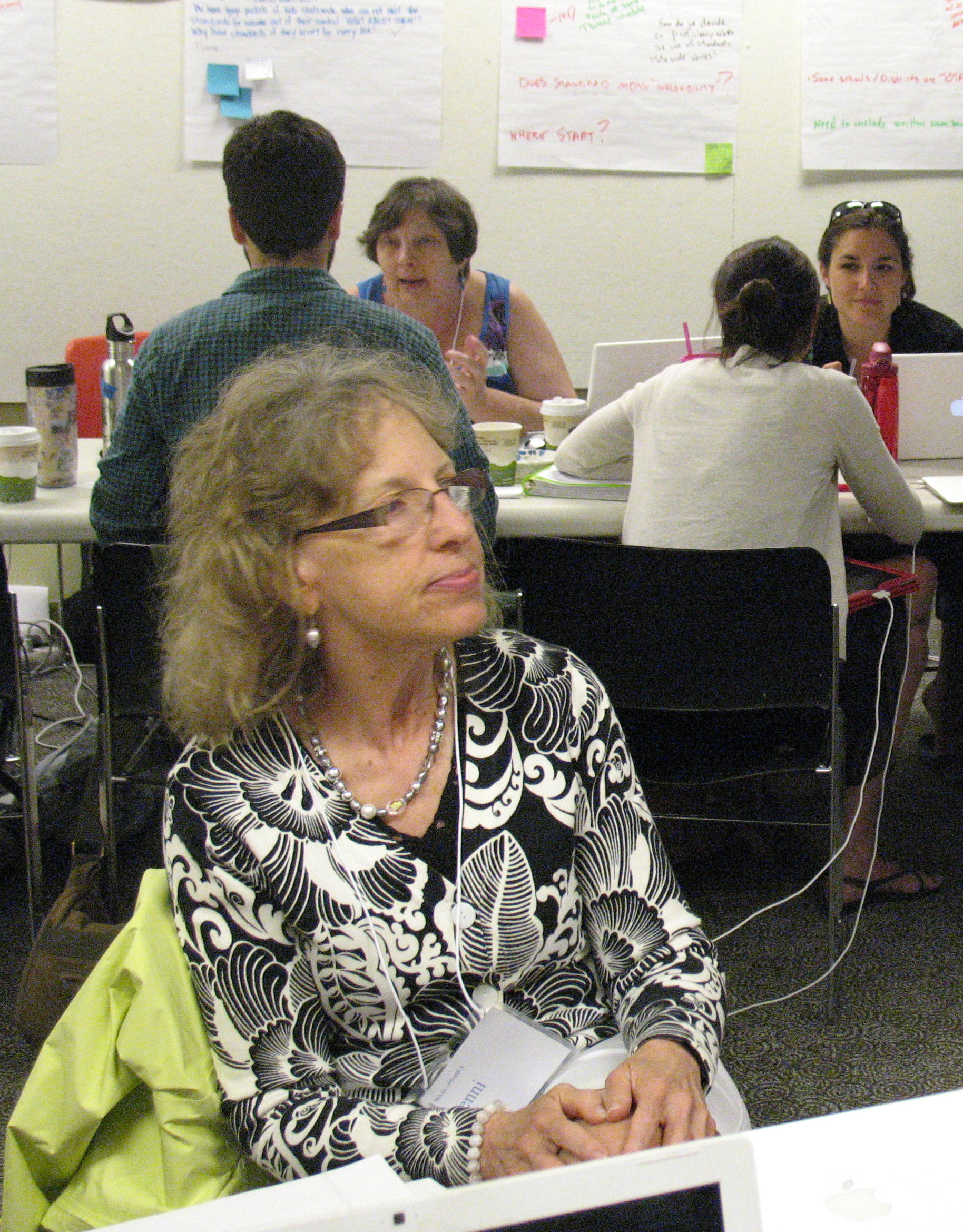
Marcia McCaffrey, Arts Consultant from the New Hampshire Department of Education and Jenni Null, Fine Arts Coordinator, School Administrative District #61 (Lake Region School District: Bridgton, Casco, Naples, Sebago). The duo will provide valuable ideas, information and food for thought!

IMG_0012

Marcia McCaffrey

Jenni Null

Jenni Null

To join the meeting, go online to http://stateofmaine.adobeconnect.com/maaiapril2014/. Please click here for more information about other webinars and the Maine Arts Assessment Initiative. For best success please join the system 10 minutes early to make sure you can hear, and use a hard-wire connection (not wireless).

Please be sure to join for what promises to be an engaging, insightful hour on the topic that will continue to impact every one of us as arts educators in the state of Maine! One contact hour is available for participating. If you miss the session live it will be archived afterwards for your viewing. Please watch the blog for the link to it.

Screen shot 2014-04-04 at 12.20.10 PM

Rob Westerberg and Catherine Ring

Maine Arts Assessment Initiative, an initiative of the Maine Arts Commission and the Maine Department of Education, with partners: ACTEM (Association of Computer Technology Educators of Maine), District 3 Music Educators, MAAE (Maine Alliance for Arts Education), MAEA (Maine Art Education Association), MECA (Maine College of Art), MMEA (Maine Music Educators Association), MLTI (Maine Learning Technology Initiative), New England Institute for Teacher Education, and USM (University of Southern Maine).


h1

Maine Arts Assessment Initiative Webinars

February 25, 2014

Webinar series starts Wednesday, March 5

Arts educators Rob Westerberg and Catherine Ring will be hosting the first webinar in a series of four during the next four months. This is the second series offered through the Maine Arts Assessment Initiative (MAAI).  The webinar:

Outreach and Arts Education Leadership

 Wednesday, March 5, 2014

3:30 – 4:30

Primary discussions will be based around:

  • Why are outreach and leadership essential to the success of visual and performing arts in the 21st century?
  • How has the Maine Arts Assessment initiative worked to developed both?
  • What does “leadership” look like in the Arts?
  • What is outreach as it pertains to Arts Assessment and Leadership?

As the Maine Arts Assessment continues in its third year, both of these topics have been focal points. Engaging participants in dialogue around these, and discovering how they can better engage both elements themselves will be takeaways from this webinar.

rob-and-catherine

Please be sure to join them for what promises to be an engaging, insightful hour on the topic that will continue to impact every one of us as arts educators in the state of Maine!

Watch the blog and the Maine Arts Education list-serv during the next week for the details to learn how to join the webinar.

Future webinars are scheduled for April 8, May 7, and June 4. One contact hour is available to participants. All webinars will be archived if you can not be present for the live webinar.

MAAI is an initiative of the Maine Department of Education with contributing partners: Maine Arts Commission, Maine Art Education Association, Maine Music Educators Association, New England Institute for Teacher Education, University of Southern Maine, Maine Learning Technology Initiative, and the Maine Alliance for Arts and Education.

h1

Standards-Based Education

August 22, 2013

Yes, again!

For years we’ve been talking about Standards-Based Education and now due to LD1422 the conversation is taking a giant leap forward. But what does standards-based mean? And, how about proficiency-based, student-centered learning and, standards-referenced? In April of 2012 I wrote a post on this topic but recently the question came up again asking for clarity so this post is provided for that reason.

I feel like educators are continuously trying to get a better understanding of these terms and of course, the bottom line is how does this impact teaching and learning? I remember during many years of my 30 years of teaching sifting through articles, research, and communicating about what I was reading with colleagues to try and make sense of education topics. That hasn’t changed for me working at the Maine Department of Education. The only difference is that much more information “comes across my desk”.

Yesterday I was honored to be part of the interviews for the finalist for the 2014 Maine Teacher of the Year. The process for selection is almost a year long so the three finalists were thrilled to be there and the conversation about teaching and learning was wonderful. I was reminded of the passion teachers have for the important work they do. The next teacher of the year will be announced at a surprise assembly at the teachers school in September. Congratulations to all three finalists! They are grade 4 teacher Mary Graziano from Hartland Consolidated School, grades 6 and 7 ELA teacher Karen MacDonald, from King MIddle School, and kindergarten teacher Suzen Polk-Hoffses from Milbridge Elementary School.

There was a question about standards-based education and I liked the answer the teacher gave which included “It’s not about the grade, it’s about the learning.” Earlier this year I listened to Cole Castorina, a student at York High School say: ” I know that I know it and I have confidence that I understand the concept. I didn’t just learn it for the assessment.” Cole and 2 other students were interviewed for the Maine Arts Assessment Initiative’s video series. You can access the York High School video with music teachers Rob Westerberg and Dan Sovetsky and principal Bob Stevens at this link. It is one thing to look at the chart below and another to hear students, teachers, and administrators articulate what it’s all about!

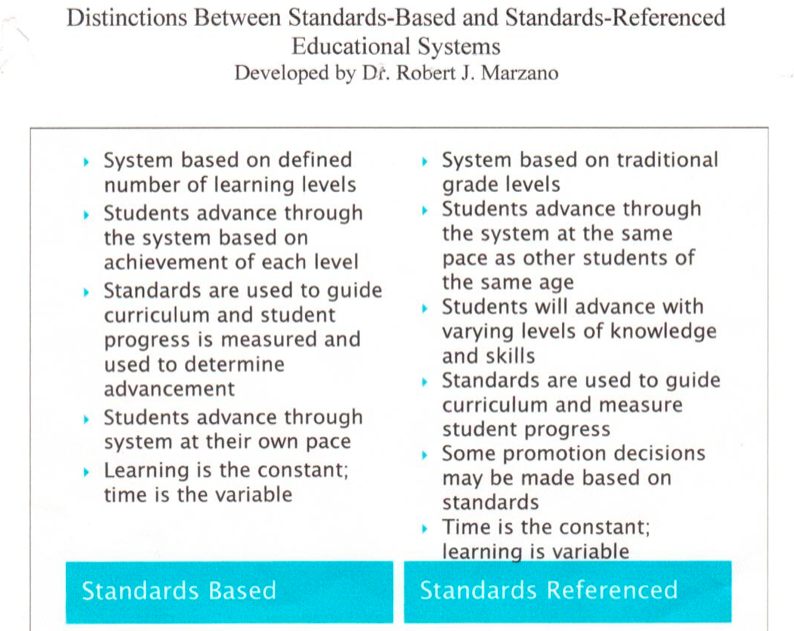
If you are trying to understand the difference between standards-based and standards-referenced researcher Robert Marzano has a diagram that provides clarity that you might find helpful.

Screen shot 2013-08-22 at 8.03.27 AM