Posts Tagged ‘STEAM’

h1

STEAM Camp in Poland

March 14, 2016

STEAM Camp

IMG_1751What happens when you bring together the ARTS and STEM (Science, Technology, Engineering, and Math)? Well, if you ask Jonathan Graffius, Poland Community School PK-6 art teacher, Scott Segal, Director of Poland Rec Department, and Jason Farson, Maine College of Art MAT student, the answer is educational, fun, and engaging for all involved.
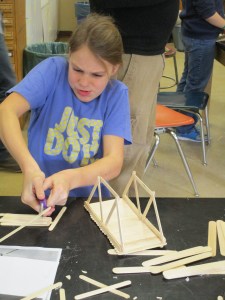
IMG_1739During winter break Jon and Jason designed an opportunity for students called STEAM Camp. According to Jon, “The desired outcome for STEAM camp was that students would develop and apply both critical and creative thinking processes. The objectives were to use instructional practices that were trans-disciplinary, project-based, and highly engaging to young, developing minds.”

I had the chance to visit for a half day and it was all of those things wrapped up in one. The fun learning opportunity was offered to students in grades 2-6 and yes, those age levels are very different, but all students were engaged, taking in what they were able to do and to stretch them in multiple ways.

IMG_1729Jon: “I have offered a lot of visual art camps in the past, however this time around, I wanted to integrate art with other content areas. I have many interests beyond visual art and the STEAM concept allowed me, and the students, to experience the world in a broader way. Conducting this camp through Poland Parks and Recreation expanded outreach into the community; we ended up having students from four different towns spanning five grade levels. Both parents and students thoroughly enjoyed the camp and are eagerly awaiting the next camp.”

DESCRIPTION
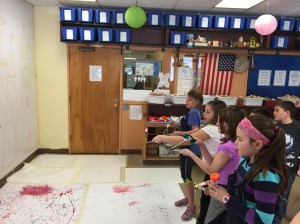
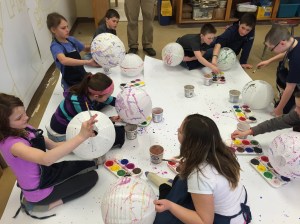
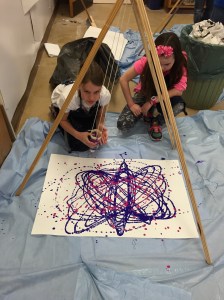
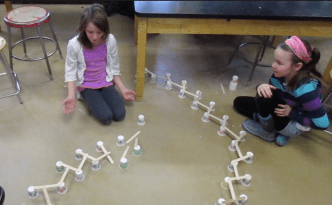
The morning sessions will test students’ skills through exciting team challenges where students will investigate force, momentum, gravity and inertia.  Students will research, plan, build and test their designs through a series of experiments that will expand their understanding of the natural world. These experiments will involve catapults, pendulums, marble runs, chain reactions, paper airplanes, bridges, clay creations, and large paintings. The afternoon sessions will focus on the history, science and art of fingerprints. These individual activates will both challenge the students’ mind and expand their creativity.
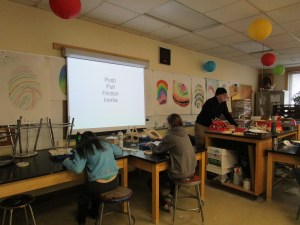
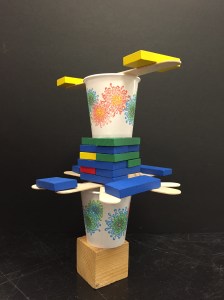
IMG_1722It was so fun to see their large finger prints, talk with them about their catapults and bridges, and see the problem-solving and creativity in action!

There were two sessions, 8:00 – 12:00 AM and 12:30 – 4:30 PM. Students could attend morning, afternoon or both. And guess what? All but one of the 12 participants attended both.

If you have questions or wish to learn more please contact Jon at jgraffius@rsu16.org.
Screen Shot 2016-03-11 at 8.44.26 PM

Cup Challenge

CatapultWar

Lantern Painting

Pendulum Painting

Thanks to Jon for providing some of the photographs and the information for this post! And for creating such a fabulous opportunity for students. Congrats on a job well done!
h1

NSF Funded Research

December 13, 2015

Arts Based Learning of STEM Works

Wondering about the impact on STEM that the Arts are making? If so, I suggest that you check out the following information.

Article: http://m.huffpost.com/us/entry/8724148

Research Project Summary: http://www.artofsciencelearning.org/3rd-year-project-update-report/
 
Related STEAM Resource Website: http://www.artsciencematchup.org/

• The high school students who had arts-based learning showed large and statistically significant pre/post improvements in such creative thinking skills as idea range (13%), problem analysis (50%) and number of solutions generated (37%). In many cases, students who had traditional STEM learning actually declined in these aspects of creative thinking — so the overall differentials between arts-based and traditional learning was even more dramatic (idea range = 22%, problem analysis = 121%, solutions generated = 43%). Thus, it appears as though arts-based learning may be an effective way to “inoculate” learners against the collapse of creativity that may sometimes accompany traditional forms of high school learning.

• Arts-based learning had a far more powerful impact on the collaborative behaviors of adults than traditional learning, based on actual observed behaviors. Examples from the final week of the study: arts-based teams exhibited 56% more instances of empathic listening, 33% more instances of mutual respect being shown, 119% more instances of trust being demonstrated and 24% more sharing of leadership. All differences cited here are statistically significant.

• The innovation outputs of high school student teams who had arts-based learning showed 111% greater insight into the challenge, a 74% greater ability to clearly identify a relevant problem, a 43% improvement in problem solving, and their innovations had 68% more impact. All are statistically significant.

• 120 days after the study, high school students who had arts-based learning were 24% more likely to have been able to apply the learning to school, extracurricular, work or volunteer activities, than students who had traditional learning. They were also 44% more optimistic in their belief that the training would prove helpful in those realms in the future.

h1

STEAM Opportunity

October 23, 2015

Innovation collaborative

The Innovation Collaborative (a multi-disciplinary coalition of arts, sciences, humanities, and education leaders) is launching a research project designed to strengthen STEAM education in K-12 schools. The goal of the project is to promote effective teaching practices at the intersections of science, technology, engineering, the arts and design, math, and the humanities.

Teachers are invited to submit STEAM lesson plans or model projects to the Innovation Collaborative for review by an expert panel. The top entries will be named Innovation Fellows, will be eligible for a stipend, and will be invited to present their work at national conferences.

For more information please go to http://www.innovationcollaborative.org/k-12-effective-practices.html

h1

STEAM Bootcamp 2015

August 20, 2015

 Saluda Trail STEAM Middle School, SC

This is from Edutopia

At the beginning of every school year Saluda Trail hosts a STEAM Bootcamp for 4 weeks to promote common language and direction for all staff and students. The Bootcamp concentrates on building the 21st Century Skills and the 4Cs- Communication, Creativity, Collaboration and Critical Thinking. Through the Bootcamp the entire school is on the same page and track. Watch the video.

https://youtu.be/lhKgg6RDBhk

h1

News from Americans for the Arts

December 18, 2014

All about Arts Education

Screen Shot 2014-12-18 at 8.27.27 AMThe Americans for the Arts website has a plethora of information including this  overview: Americans for the Arts serves, advances, and leads the network of organizations and individuals who cultivate, promote, sustain, and support the arts in America. Founded in 1960, Americans for the Arts is the nation’s leading nonprofit organization for advancing the arts and arts education. Below is information that was provided in their Weekly News Roundup.


  • Sign The Petition – Support Arts Education
    Join us in asking U.S. Secretary of Education Arne Duncan to clarify that the arts are eligible for federal funds. This action will especially help new school administrators, who, in an age of overwhelming education reform, may not know what is possible. With most states now operating under waivers from outdated federal education law, now is a great time for the secretary to set the record straight. Let’s raise our voices in chorus to show that we value a well-rounded education for all students! Read more.
  • Stubhub Supports Arts Education
    StubHub, the world’s largest ticket marketplace, is partnering with The Mr. Holland’s Opus Foundation to raise awareness and support for keeping music education alive in schools across the United States. Watch and share this moving film featuring Trombone Shorty, Grouplove, arts teachers and students on the importance of supporting music education. Read more.
  • Building Social Harmony, One Woodwind At A Time
    The Massachusetts Cultural Council announced this week that it has launched a new music education initiative for underserved students throughout the state — the first statewide program of its kind in the United States. It blends a forward-thinking attitude toward music and arts education and a focus on multiculturalism and community empowerment that, taken together, can dramatically change students’ lives. Read more.
  • Grade Schools Use The Arts To Improve Science Education
    Through an innovative new program developed at UC Irvine, the arts and the sciences – which often occupy opposite ends of the grammar school curriculum – are being integrated to help young students better grasp the basics of Earth, life and physical sciences. Read more.
  • STEM Vs. STEAM: Do The Arts Belong?
    A tug of war is currently looming between proponents of STEM education (science, technology, engineering, and math) and advocates for STEAM lessons, which add art to the mix. Whichever side you come down on, here are some ideas for you to mull over. Read more.
  • Universal Music Classics Partners With U. Miami’s Frost School Of Music
    Universal Music Classics (a subsidiary of Universal Music Group) and the University of Miami’s Frost School of Music have announced plans to forge a business-academic partnership called Universal Music U @ Frost, intended to grow the next generation of artists and audiences for classical music. Read more.
  • UNM Professor Advocates STEAM Instead Of STEM
    Anne Taylor, who taught art education at the university, served as dean of the graduate school and taught in the School of Architecture and Planning, thinks that STEM’s science, technology, education and math aren’t enough. She would like to see an “A” for “Arts and Architecture” added to the acronym. Read more.
  • National Center for Creative Aging Invites Applications for Technical Assistance Program
    Grants of $5,000 will be awarded to help organizations host and provide onsite technical assistance to a MetLife Foundation Leadership Award winner. The Leadership Award Winner will mentor senior staff and will help train staff, partnering organizations, and community members in developing an arts program. The grant also is intended to support the production of a half-day best practices forum that brings together programs, organizations, and community partners dedicated to the arts, education, health, social work, and aging in the community. Read more.
  • These 12 Childhood Art Techniques Can Help Adults Relieve Stress
    Making art doesn’t necessarily sound like a stress reliever. Finding inspiration, keeping concentration, finding your artistic voice — these things demand extreme attention, time and effort. Yet there is something about expressing your creative side that can help put your mind at ease. Read more.
  • The Arts Inspire Success
    Arts education develops a passion for music, painting or acting. Students with a passion for one subject tend to do better academically across the board — an excitement about learning spills over into other areas of the curriculum. Even students who do not develop a lifelong interest in the arts benefit from the skills taught through study of the arts — self-discipline, teamwork, creative thinking and problem-solving. Read more.
  • Why Music Majors Make Some Of The Best Entrepreneurs
    Learning how to play a musical instrument and becoming a musician is an exercise in developing good listening skills, experimenting, overcoming repeated failure, self-discipline, and successful collaboration. It is simply impossible to become a successful music professional unless one also masters certain theoretical concepts, develops good presentation and improvisational skills and, ultimately, attains that elusive quality of originality that only comes once fear of failure is overtaken by the desire to acquire a new insight, a fresh perspective, and a unique voice. Read more.
  • “Art Without A Roof” Supports At-Risk Artists
    Through Educational and Sustainability Initiatives It has often been said that the greatest art is produced by troubled souls. Whether this is true or not, the reality is that many artists do struggle with issues like mental illness, poverty, homelessness and emotional trauma from war experiences. The Art Without a Roof (AWR) brand helps these at-risk artists by offering them the opportunity to obtain a scholarship that can be used on basic needs, tutoring, GED completion, and/or a college scholarship. Read more.
h1

STEAM

October 2, 2014

Information on STEM vs. STEAM from the University of Florida

Science, technology, engineering and mathematics are the center of attention in most US public schools today. The focus on STEM fields was initiated to increase global competitiveness and the project does have its merits. However, it has left the arts languishing far off in the periphery. This is quite unfortunate, as art education is known to improve academic performance.

– On average, students who study the arts for 4 years in high school score 98 points higher on the SATs compared to those who study the same for half a year or less.

– Students who took up music appreciation scored 61 points higher on the verbal section and 42 points higher on the math section.

Of the elementary schools with arts, the most common subjects revolve around music at 94% and visual studies at 83%. Only 3% offer dance instruction while 4% provide theater arts.

Training in the arts has been shown to improve creativity and innovation. Students learn to approach issues with a critical mind and a positive attitude towards problem solving. Exposure to the arts enhances communication skills, which are essential tools for collaboration. It develops flexibility and adaptability. The government recognizes these and, indeed, 48 states have adopted standards for art instructions.

However:

– 51% of art teachers are unhappy about what they see as the decline in art education brought about by the shift in focus. The difficulty in measuring art’s contribution to academic performance has led to its under appreciation.

To learn more about STEM vs STEAM, take a look below at the infographic below created by the University of Florida.

My apology that the graphic below is not more clear. If you use this link http://education.arts.ufl.edu/resources/stem-vs-steam-girl/ you can go directly to the University of Florida’s page where you will find their information including several resources and the graphic.

UF-MAAE-STEM-STEAM-IG-GIRL


h1

Rhode Island School of Design

January 19, 2014

Design Science Symposium STEM to STEAM thru Synergy

PROVIDENCE, RI – The Fourth Biennial Design Science Symposium, STEM to STEAM thru Synergy: Bridging Morphology, Biomimicry, Sustainability and Synergetics, will convene January 31 – February 2, 2014, Metcalf Auditorium at the Chace Center and at the Edna Lawrence Nature Lab, on the RISD campus.

The Symposium will be a highly interactive meeting of makers, thinkers, practitioners, and educators, who will gather in order to explore the multidisciplinary field of Design Science. There will be presentations, panel discussions, workshops, a film screening, tours, and an exhibit.

Keynote speakers will include RISD’s Interim President, Rosanne Somerson, Dayna Baumeister, PhD, Biomimic & Co-founder of Biomimicry 3.8, Dennis M. Bartels, PhD, Director of the San Francisco Exploratorium, and Richard Bresnahan, Master Ceramicist and Artist in Residence, St. Johns University.

Somerson recently filled the position of former RISD President, John Maeda, a champion of the educational initiative, STEM to STEAM. STEAM is an acronym for Science, Technology, Engineering, Arts, and Mathematics. It represents an integrative and multidisciplinary approach to education. STEM + A = STEAM.

Presentations from notable speakers, including Deborah Gist, PhD, Commissioner of Rhode Island Department of Education, Kavita Ramanan, PhD, Mathematician & Professor, Brown University, Lefteris Pavlides, Architect & Professor, Roger Williams University, Thomas T. K. Zung, Architect & Design Historian, Buckminster Fuller, Sadao, & Zung, and Eric Goetz, owner of Bristol-based racing boat builders Goetz Composites, amongst others. Goetz will speak about the recent commission to restore of one of Buckminster Fuller’s most iconic structures, the 24-ft/7.3m Fly’s Eye Dome.

Participants will have the opportunity to attend hands-on design science workshops, facilitated by engineers, inventors, designers, and mathematicians. Facilitators will include George Hart, Bob Sanderson, Leftheris Pavlides, Chris Kitrick, Joe Clinton, Ed Popko, Dick Esterle, and Gary Doskas.

Debut film screening and discussion with film-maker and author Christopher Zelov, who recently completed a documentary film (30 minutes), A Visit with Magnus, featuring Father Magnus Wenniger (born 1919), who is a monk, mathematician, and builder of polyhedron models. Zelov, along with Phil Cousineau and Brian Danitz co-edited the book Design Outlaws on the Ecological Frontier and co-created the award-winning documentary Ecological Design: Inventing the Future.

Participants will enjoy tours of both the Arthur Loeb Design Science Teaching Collection and The Edna Lawrence Nature Lab. The Loeb Collection is quite special, featuring of hundreds of three-dimensional polyhedra and two-dimensional patterns that inspire students and faculty to examine nature’s fundamental responses to design problems. The Nature Lab, with its growing collection of more than 80,000 natural history objects, books, visual resources, microscopes and a digital work station, serves as an invaluable research facility for the RISD community.

Concurrent to the Symposium will be an exhibit titled, Investigating the Lab: Relationships between Art, Design, and Science, co-curated by RISD faculty, Carl Fasano, and RISD alum, Sophia Sobers. The exhibit will be on display in the Waterman Gallery, adjacent to RISD’s Edna Lawrence Nature Lab. Looking at the influence and application of science-driven and science-inspired work, this exhibition will showcase the wide range of ways students engage science within their work. Ranging from detailed illustrations to organ inspired jewelry, the exhibition showcases a cohesive undercurrent of studio practice, and works of art and design, which access a wide range of scientific topics.

Panel discussions with RISD faculty, Peter Dean, Carl Fasano, and Amy Leidtke, will address the question “What is Design Science?” and a student panel will discuss their work and studio practice that which engages science.

The Synergetics Collaborative and The Edna Lawrence Nature Lab have organized Biennial Design Science Symposia at RISD since 2007. This Symposium, the RISD and Brown STEAM Clubs will participate, lending their energy, talents, and enthusiasm to the event.

To register, visit http://www.SynergeticsCollaborative.org. Register by January 10 to get the early bird discount. RISD and Brown students attend the event at no cost. Participating K-12 Educators will receive a Professional Development Report from RISD.

For more information contact Jaime Marland, jmarland@risd.edu

h1

Call for Presenters

November 23, 2013

IEEE, pronounced “Eye-triple-E,” stands for the Institute of Electrical and Electronics Engineers

Screen shot 2013-11-23 at 9.02.49 AMThe 4th IEEE Integrated STEM Education Conference (ISEC 2014), Friend Center at Princeton University, Princeton, NJ, March 8, 2014.

We welcome submissions for the 4th IEEE Integrated STEM Education Conference (ISEC 2014), to be held Saturday, March 8, 2014 at Friend Center, Princeton University, Princeton, NJ.

This year’s theme is Designing Pathways to STEM Success.  While all papers on methods of and/or experience with integrating science, technology, engineering, and mathematics (STEM) education are welcome, we are very
interested in papers on STEaM (STEM + art) initiatives that have resulted in student recruitment and retention in STEM, especially among students from underrepresented populations in the disciplines. We are also interested in hearing from all parties involved in STEM education, including students and parents concerning their experiences practices.

Please submit a full paper of 4 to 6 pages for review by 11:59 pm Sunday, January 12, 2014.  Your paper must not have been published or submitted for publication elsewhere.  Please see the author’s kit, available at
http://ewh.ieee.org/conf/stem/, for format information and template. Acceptances will be sent no later than Sunday, February 3, 2014. The deadline for submitting a revised paper is Sunday, February 24, 2014. All accepted
papers will be presented at the conference and included in the conference proceedings, which will be submitted for publication in IEEE Xplore.

ISEC 2014 is associated with the Trenton Computer Festival, to be held on Saturday, March 15, 2014 and with the Information Technology Professional Conference, co-located with TCF Friday and Saturday, March 14 – 15, 2014.
Information on these conferences is available at http://tcf-nj.org and http://princetonacm.acm.org/tcfpro/.  You are also encouraged to submit abstracts to these conferences.

ISEC 2014 is sponsored by the IEEE Princeton / Central Jersey Section, IEEE Region 1, and the IEEE Education Society.

Please see our web site for the full CFP, including fee schedules.  Contact isec.2014@gmail.com for more information.  We look forward to your participation in ISEC 2014!

h1

Putting the A for Arts in STEM

July 26, 2013

Webinar

IMG_1875On July 16 my colleagues from South and North Carolina who work for the Department’s of Education in those states provided a webinar called Putting the A for Arts in STEM. You can check out the 56-minute archived webinar at the information below.

Streaming recording link: https://seadae.webex.com/seadae/ldr.php?AT=pb&SP=MC&rID=125079667&rKey=91ef9ffaed00cbcc

Download recording link: https://seadae.webex.com/seadae/lsr.php?AT=dw&SP=MC&rID=125079667&rKey=5af7534f692ac5a2

This is included in the slide show and information:

*At TED 2002, Mae Jemison, a doctor, dancer, and the first African American woman in space, said, “The difference between science and the arts is not that they are different sides of the same coin… or even different parts of the same continuum, but rather, they are manifestations of the same thing.
*The arts and sciences are avatars of human creativity.”
h1

STEAM STEM reading!

May 2, 2013

Articles on STEM STEAM

  • Fletcher Kittredge, chief executive of Internet and telephone company GWI of Biddeford said workers need a foundation in creative thinking more than they need training in technology that may quickly become obsolete.”Start out with an art degree. Being able to be creative, to interact with people, is more likely to be important for someone’s career,” Kittredge told the Joint Select Committee on Maine’s Workforce and Economic Future. “A lot of what we think of as STEM (science, technology, engineering and math) — that’s out of date. It’s like teaching someone to use a slide rule.” Read the entire article from the Maine Sunday Telegram, August 28 written by Jessica Hall.
  • Read about Biddeford artist Ann Thompson and the work she is doing putting together STEM and Art. You can read about her work in this article from the Sun Journal, Marcy 31 written by Scott Taylor by clicking here.
  • Why STEM should be integrated into literacy, storytelling
    While teachers in the humanities often are encouraged to integrate science, technology, engineering and math topics in classroom instruction, integration must be a two-way street, write Jonathan Olsen and Sarah Gross, teachers at High Technology High School in Lincroft, N.J. In this blog post, they write about the potential benefits of connecting more STEM lessons to storytelling, artwork and literacy, a change that potentially could draw more students, including girls, to the STEM field. Read the entire article ScientificAmerican.com/Budding Scientist blog, April 16 by clicking here.
  • Art + Science = Opportunity. On the National Endowment for the Arts blog there was a post on January 17 that provides several examples where artists, scientists, and community come together. The post written by by Bill O’Brien, NEA Senior Adviser for Program Innovation, includes background information, links to a report that was created from National Science Foundation funding that convened 125 artists for a summit entitled Art as a Way of Knowing. Check out the blog post by clicking here.
  • The Art and Craft of Science. Ed Leadership, a publication of ASCD included this article in their February 2013 edition written by Robert Root-Bernstein and Michele Root-Bernstein. This article supports what Fletcher Kittredge says in the first article above but goes beyond to discuss those who have been recognized for their contributions including Einstein. To read the entire article please click here.