Posts Tagged ‘STEM’

h1

STEAM STEM reading!

May 2, 2013

Articles on STEM STEAM

  • Fletcher Kittredge, chief executive of Internet and telephone company GWI of Biddeford said workers need a foundation in creative thinking more than they need training in technology that may quickly become obsolete.”Start out with an art degree. Being able to be creative, to interact with people, is more likely to be important for someone’s career,” Kittredge told the Joint Select Committee on Maine’s Workforce and Economic Future. “A lot of what we think of as STEM (science, technology, engineering and math) — that’s out of date. It’s like teaching someone to use a slide rule.” Read the entire article from the Maine Sunday Telegram, August 28 written by Jessica Hall.
  • Read about Biddeford artist Ann Thompson and the work she is doing putting together STEM and Art. You can read about her work in this article from the Sun Journal, Marcy 31 written by Scott Taylor by clicking here.
  • Why STEM should be integrated into literacy, storytelling
    While teachers in the humanities often are encouraged to integrate science, technology, engineering and math topics in classroom instruction, integration must be a two-way street, write Jonathan Olsen and Sarah Gross, teachers at High Technology High School in Lincroft, N.J. In this blog post, they write about the potential benefits of connecting more STEM lessons to storytelling, artwork and literacy, a change that potentially could draw more students, including girls, to the STEM field. Read the entire article ScientificAmerican.com/Budding Scientist blog, April 16 by clicking here.
  • Art + Science = Opportunity. On the National Endowment for the Arts blog there was a post on January 17 that provides several examples where artists, scientists, and community come together. The post written by by Bill O’Brien, NEA Senior Adviser for Program Innovation, includes background information, links to a report that was created from National Science Foundation funding that convened 125 artists for a summit entitled Art as a Way of Knowing. Check out the blog post by clicking here.
  • The Art and Craft of Science. Ed Leadership, a publication of ASCD included this article in their February 2013 edition written by Robert Root-Bernstein and Michele Root-Bernstein. This article supports what Fletcher Kittredge says in the first article above but goes beyond to discuss those who have been recognized for their contributions including Einstein. To read the entire article please click here.

h1

Why STEM Education Needs the Arts, Too

January 17, 2013

Hearing about it, really!

From Oregon a talk show that highlights STEM/STEAM – listen to the interview at http://tunein.com/topic/?TopicId=43998097#. The show includes John Maeda, President of Rhode Island School of Design who formerly was at the MIT Media Lab. An Oregon Public Broadcaster interviews a school in a Portland, Oregon school where they have are involved in STEAM education. In some cases the arts drive the learning and some times it is the opposite.

Thank you to Ann Thompson for sending the link!

h1

STEM/STEAM

January 10, 2013

Thank you Kate Smith for sending these links!

During the last couple of years I have included many posts on STEM (Science, Technology, Engineering, and Math) and STEAM (Science, Technology, Engineering, Arts, Math). Recently Central Elementary School (South Berwick) music teacher Kate Smith sent me a couple more links to articles on the topics. This time not only has the article provide “food for thought” but many links to good articles and resources. If you are interested in this topic I suggest that you read the post on currikublog written by Janet Pinto, Chief Academic Officer, Curriki on November6, 2012, but I suggest that you also follow and read the links and comments included.

And, Kate also sent a link to cybraryman who also includes several good links and resources to STEAM ideas. Check out the left column.

If you are looking for tips or ideas on how to communicate about this idea. Or perhaps you are searching for articles or information on what this is all about and does it make any sense to promote it, I am certain these resources will help you find answers.

At this point there are several posts on STEM/STEAM on meartsed blog. To find them just put the words “STEM STEAM” into the “search archives” box on the bottom right hand side of the blogs front page and you will see all of the posts.

John Maeda presented a TED talk called How art, technology, and design inform creative thinkers. John Maeda is the President of the Rhode Island School of Design. His life work has included art, design and technology. He is dedicated to communicating about the link between design and technology and he does it in his TED talk in a very engaging way.

John Maeda wrote an article called If Design’s No Longer the Killer Differentiator, What Is? for Wired Magazine that was published September 9, 2012. The article includes Mr. Maeda’s history which provides an overview of his beliefs and how he arrived at them.

h1

Rhode Island Legislation on STEM to STEAM

November 29, 2012

An initiative being driven by the Rhode Island School of Design

Rhode Island School of Design is leading the conversation around STEM to STEAM.

Art and Design create opportunities for economic growth. US Representative from Rhode Island, Jim Langevin, introduced legislation to create a STEM to STEAM council bringing together artists, designers, education and business leaders to create a comprehensive approach to incorporate art + design into federal STEM programs.

John Maeda, President, of RISD believes that we need to put art + design into STEM to help the US remain competitive. He says that creativity is a “right” and that the arts need to be part of the innovation conversation. “That the studio practice model creates innovators, people that can see and solve problems differently”.

You can watch a panel presentation that includes Maeda and Langevin among others that took place in Rhode Island by clicking here.


h1

STEM – STEAM

November 7, 2012

STEM getting some STEAM

Information, emails, and reports continue to come across my computer that are STEM/STEAM related. I have included the latest in this blog post. I hope you are finding talking points, food for thought, and/or ideas on how you can utilize this information as arts teachers. I certainly am interested in learning more from you about how you might be bringing the arts into the conversation or into your classroom lessons/units. Please post a comment at the bottom of this post or consider emailing me with the information so I can post it on the meartsed blog so others can learn from you.

National Governor’s Association

The National Governor’s Association published a report called New Engines of Growth:  Five Roles for Arts, Culture, and Design. The Governor’s have outlined 5 roles as a framework to use the arts, culture, and design to help strengthen the local economy and innovation. You can read about it by clicking here.

STEM to STEAM: Art in K-12 is Key to Building a Strong Economy

John Maeda is the President of Rhode Island School of Design (RISD) and believes the connection between the arts and STEM is absolutely necessary. John’s answer to the question “What does it mean to turn STEM to STEAM?” The problem-solving, the fearlessness, and the critical thinking and making skills that I see every day in the RISD studios are the same skills that will keep our country innovating, and their development needs to start in the K-12 schools. Click here to read the entire article.

SmartBlog on Education

Education consultant Doug Haller writes a blog called SmartBlog on Education. On October 31st his post was called Full STEAM Ahead: Arts, STEM and 21st Century Learning. “The arts, he writes, already are part of scientific work either consciously or subconsciously, and studies are under way to further explore the connection. “Clearly, something about art brings out creativity and innovation in ways different from but complementary to the sciences,” Haller notes.

h1

STEM into STEAM: What’s in it for the Arts?

November 3, 2012

Another view

Thank you to Ann Thompson who has contributed this blog post on her recent experience and knowledge on STEM/STEAM.

While many are broadcasting the merits of attaching art to the Science, Technology, Engineering and Math curriculum thrust, turning STEM into STEAM, art teachers often remain wary. They wonder, “Will this compromise my art content?” and “Does this put art learning at the service of other disciplines?” “Don’t we struggle to have art acknowledged as an important, stand alone, component to a complete education?” These concerns should be taken into consideration but I believe there is also an opportunity for both artists and STEM teachers to collaborate across disciplines to their mutual benefit.

I recently returned from a wonderful conference sponsored by several arts organizations in New Hampshire that included a panel discussion on STEM into STEAM. Panelists included:

  • Dr. Foad Afshar, Psy.D.,EdM,BAis a member of the Faculty of Psychology and Art Education at the NH.Institute of Art, Manchester, N.H.
  • Mark MacLean, MBE, CAGS, Assistant Superintendent of the Kearsarge Regional School District
  • Kirsten Reynolds, BFA, Video Art,Syracuse University, MFA, Studio Art, Maine College of Art www.kirstenreynolds.com
  • Dr. Elizabeth F. Smith, BA, Ph.D., Professor of Biological Sciences at Dartmouth College
  • Spencer Topel, BM, MM Assistant Professor & Technical Director in the Department of Music, Dartmouth College
  • Moderator, Nancy Serrell, BS,MA Director of Science & Technology Outreach for Dartmouth College, Senior Consultant for Dartmouth’s Toxic Metals Research Program

The discussion posed several essential questions:

  • Can the Arts deepen the process & meaning of STEM subjects?
  • Does Art pose a question in the way that science does? Is there a difference in the sort of creativity used by a scientist and an artists’ creative practice?
  • What art skills and practices are relevant to STEM?

The consensus was that there are many parallels between art and science and that the arts can “collaborate, integrate & enhance” STEM learning. Artists need observational and analytical skills and patience to the same degree that scientists do. Creative juxtapositions can lead to new discoveries in both disciplines and “failures” often reveal new possibilities. Of course the pragmatic relationship to STEM for artists would be to discover new revenue streams for supporting the arts. STEM is very much on the table at the moment and as one educator put it,”If you aren’t on the table, you might be on the menu.”

Personally I believe artists have much to gain from associating with the STEM topics. We have always looked to nature and the physical world for inspiration and routinely transform materials. There has always been a degree of science in art as well as math and engineering, particularly in 3Dimensional art forms. Eco Art has become an established field and many Institutions are offering Art/Science Research Fellowships including the Smithsonian Museum. Read about their Fellows recent projects here: http://stevenmontgomery.net/individualtext.php?sectionId=4&textId=11&title=2012%20Smithsonian%20Artist%20Research%20Fellowship

For more information on STEM into STEAM:

Ann Thompson

h1

Sesame Street – STEM+A

October 24, 2012

STEM to STEAM

So, even Sesame Street is including the A in STEM to make STEAM. During Season 43 Sesame Street continues its focus on Science, Technology, Engineering, and Math. According to information on Sesame Street’s curriculum webpage they have added the “A” to “help make learning STEM concepts relevant and enticing to young children by highlighting how artists use STEM knowledge to enhance their art or solve problems. It also provides context for the importance of STEM knowledge in careers in the arts (e.g. musician, painter, sculptor and dancer).”

Elmo the Musical is a new segment of the show that is interactive and a “musical adventure”. Can’t wait to see it. I will have to tune in so I can learn for myself. I wonder, is this “frosting on the cake” or outstanding examples of how the arts and the STEM subjects support each other while students are learning all 5 subjects?!

Anyone seen the show? If so, please let us know what you’ve learned on Sesame Street!

h1

The ARTS and STEM!

September 8, 2012

What role should the arts play in STEM education?

As schools continue to emphasize science, technology, engineering and math skills, some educators are pushing for a greater role for the arts — effectively modifying STEM into STEAM, Steven Ross Pomeroy, assistant editor for Real Clear Science, writes in this blog post. By infusing more creativity and imagination into STEM education, teachers can expand students’ understanding of the world and help them see the exciting applications of math and related subjects, he notes. ScientificAmerican.com/Blog (8/22) To read the entire article please click here: http://blogs.scientificamerican.com/guest-blog/2012/08/22/from-stem-to-steam-science-and-the-arts-go-hand-in-hand/

h1

Needing the Humanities

April 6, 2012

Why STEM is not enough

Valerie Strauss posted an article called Why STEM is Not Enough on March 5, 2012 in the Washington Post that was written by Cathy N. Davidson, Paula Barker Duffy, and Martha Wagner Weinberg, members of the National Council on the Humanities. It is a fascinating article that refers to the importance and value of the humanities needing to be intervowen into the teaching of science and technology. Please click here for the entire article.

Thanks to Social Studies specialist Kristie Littlefield for providing the link.

Science Art Connection

At the University of Colorado Museum of Natural History they have an exhibit
called the Invisible Connectedness of Things. Students at the Manhatten Middle School created “smog collector” plates. Read more by clicking here.
Students at t

h1

National Art Education Conference

March 15, 2012

Waterville High School Art Teacher, Suzanne Goulet, thoughts on her trip to NYC

Energized and exhausted……….

Middle of June? Ready for summer…..right?

It is only the beginning of March and it is time to reflect on the incredible opportunity of attending the national convention for the National Art Education Association held recently in New York City.

A thousand offerings of workshop opportunities, cultural resources, provocative general sessions and intimate pedagogical conversations with colleagues can be overwhelming to plan…….but you don’t have to…….it happens every year……and you just have to get there.

A few snapshots:

Chuck Close

The president of RISD (“reason I am sleep deprived”), John Maeda presented the argument for respecting the role of the arts in The Meaning of Innovation…..in a revealing delivery on how only one letter separates “FEAR” from “FREE” (“STEM” to “STEAM”).

The conversation between Chuck Close and Irving Sandler (one with thousands of people…standing room only in the grandest of halls) had me envisioning us in an apartment, …. Left Bank?……were we in a salon? Struggling with math his whole life…..I now question the role of SAT scores in selection for art scholarships….Mr. Close stressed the teaching of good solid work ethics…….something he is thankful for having a good foundation in.

A few surprise passing meetings of Maine colleagues (we have to go to NY to see each other?) workshops, workshops, sessions, sessions and more late in to the night content investigations with colleagues from VT, LA, and DE…….”How do you do this?……where is your state on….? You have snow days?…we have fog days!”  Invigorating visits to the Met, MoMA and my favorite noodle nook (I can now order, “the usual”) registering 15 miles in three days on the pedometer……how DOES that happen?……..

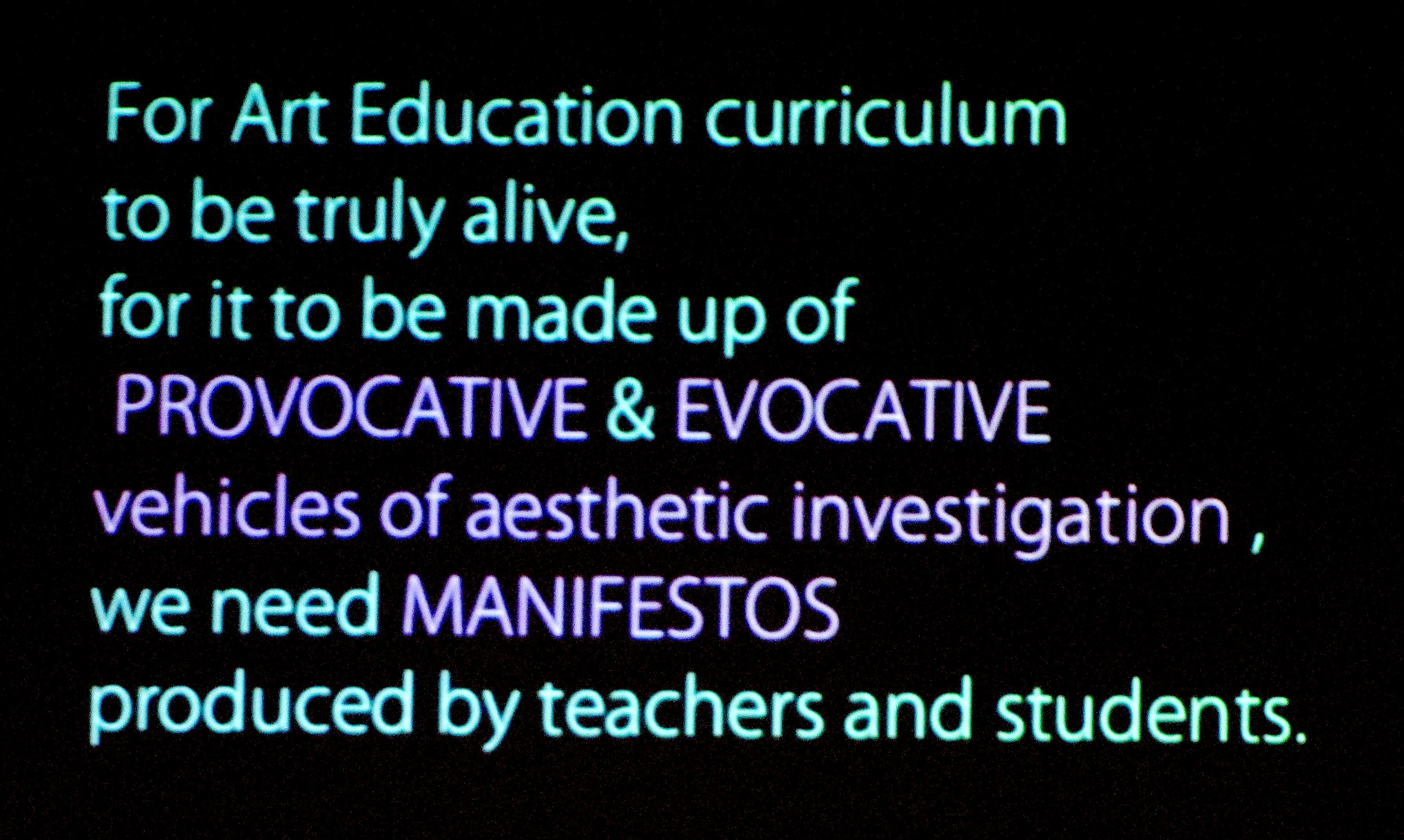
One of two final slides from Olivia Gude session- "Evocative and Provocative Pedagogy: Toward a Culture-Changing Curriculum"

Energized and exhausted………

…..and it is NOT the middle of June.

This is a good thing……..I have time to implement these discoveries…….not a moment to loose!

(2013 convention scheduled for Fort Worth and 2014 is in San Diego……….see you there?)

Thank you Suzanne for sharing the highlights of your trip. I can almost imagine being there!