Posts Tagged ‘UMaine’

h1

MLTI Student Conference

April 3, 2013

May 16, 2013

Screen shot 2013-03-25 at 2.02.25 PMRegistration for the 2013 MLTI Student Conference is open!

This year’s conference will be held on Thursday May 16, 2013 at the University of Maine at Orono.

We’ve made a few changes, including an increase in the number of students you can bring, and a reduction in participant cost!!

  • Schools may register 40 Students and 8 adults in a 5:1 ratio. With 4 students you may bring 1 adult, with 12 students, you may bring 3 adults, with 37 students, 8 adults, etc.
  • Conference Cost: Thanks to a contribution from ACTEM dedicated to reducing participant costs, the registration fee has been reduced to $15 per adult or student participant.
  • If, on April 26, 2013 at 12 Noon any places still remain unfilled, schools may register an additional 10 students and 2 adults. This will continue until 1,140 registrations are received.

Registration will close when 1,140 registrations are received or on May 6, 2013 @ 4 PM, whichever comes sooner.

Please visit http://www.maine.gov/mlti/studentconference/signup.shtml to register!

h1

MAEA Spring Conference

February 23, 2013

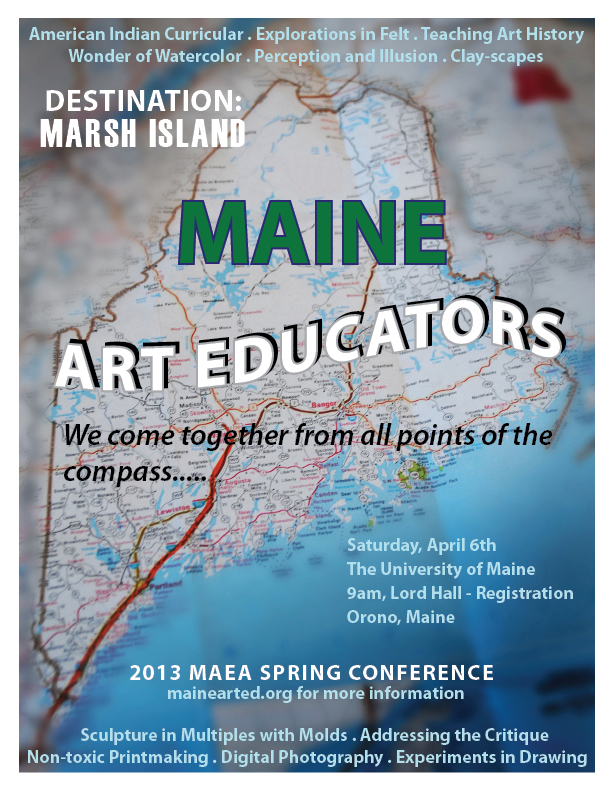
Maine Art Education Association, Saturday, April 6, Lord Hall, UMaine campus

Registration is now available at https://sites.google.com/site/maeaspringconference/
or you can get to registration through the MAEA website at
http://www.mainearted.org/MAEA/2013_Spring_Conference.html

Registration deadline: Monday, March 25, .8CEUs available for full participation in conference

MAEAspring13

h1

MAEA Spring Conference

February 8, 2013

Maine Art Education Association

The Spring conference will be held on the UMaine campus on Saturday, April 6, 2013. A variety of workshops are being offered and a keynote by Dr. Kerry Freedman who is a faculty member at the School of Art Northern Illinois University.

MAEAspring13

It’s all relative.
Travel Time to Orono:
Fort Kent  – 3:25
Kittery      – 3:15
Calais       – 2:25
Bridgton   – 2:50

Our spring conference will soon be here providing a stellar professional development opportunity.

Workshop offerings: American Indian Curricular, Explorations in Felt, Teaching Art History, Wonder of Watercolor, Perception and Illusion, Clay-scapes, Sculpture in Multiples with Molds, Addressing the Critique, Non-toxic Printmaking, Digital Photography, Experiments in Drawing.

Solo or Group: Will you be arriving as an individual? Commuting? Regardless, opportunities abound to network and create professional learning communities. If you are new to MAEA conferences and are not sure where to start, find me….I will connect you.

Ride Board: Driving north, south, east or west? Interested in commuting? Please let us know if you have a need or ride to share.

Lodging: Coming in Friday night?
Art in the Heart members may be available in advance to, “Adopt an Art Teacher”
Hotels abound in the Bangor area and Orono has lodging as well.

Celebration: Please make a plan to join us Friday evening for a pre-conference event as we celebrate our Excellence in Teaching Award Event at the UMaine Museum of Art. Join us after at Seasons (where Millers once was) for a casual social event of drinks and or dinner.

For more information please contact: Suzanne Goulet at sgoulet@aos92.org

h1

Another Student’s Story: Wesley Raines

January 6, 2013

Featuring one student’s journey

This is the second in a series of blog posts telling students arts education story’s. If you have a student whose story should be told, please email me at argy.nestor@maine.gov. This is in the words of the student Wes Raines.
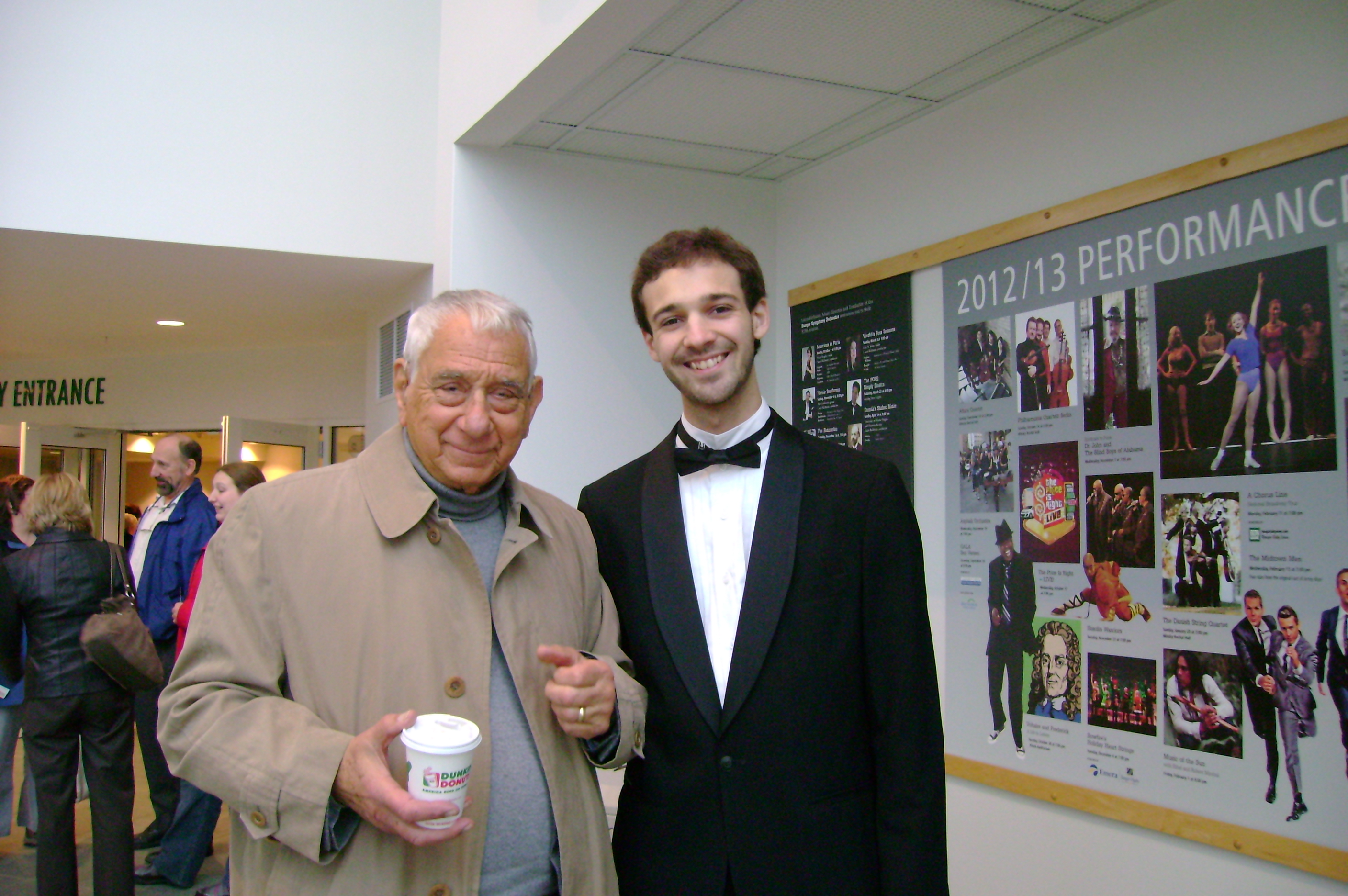
Wes Raines with the first person who inspired him to pursue music, grandfather Doc Lombardi, B.M. Boston Conservatory '50.

Wes Raines with the first person who inspired him to pursue music, his grandfather Doc Lombardi, B.M. Boston Conservatory ’50

My name is Wes Raines and I am a sophomore at the University of Maine studying vocal music education. I come from York, Maine and I attended York High School. I graduated in June of 2011. Being in the music program at York was a life-changing experience for me. I would not be where I am today and doing what I’m doing if it was not for Rob Westerberg and Dan Sovetsky’s music program.

Courses in any of the arts, whether they are musical, visual, kinesthetic, or any combination of these are more than just for entertainment and fun. The arts teach us about our cultures and our past, where we come from and who we are. I can’t think of anybody I know who has never at one point in their lives been even just a little curious about who their ancestors were, the history of where they come from and what life was like back then. You can learn all of these things in a history class, sure, but you can’t really live it until you experience the music and art for yourself.

For many students, playing sports may be their emotional outlet in life. Football, basketball, soccer, etc. may be a passion for some students. Other students need equal outlets, but they choose the arts instead of sports. We, as educators or school administrators need to recognize these students and understand they are putting the same amount of energy, passion, and most importantly, dependence on the performing and visual arts as those others who play sports. Each and every day, we may, and probably do have kids who depend on the arts to be there for them when they need that outlet the most. For all we know, we could be saving a life, and not even be aware of it!

Everybody has heard about the study that was done and shows how arts education improves performance in each of the other core subjects. I am a firm believer of this, as well as the idea that music is absolutely an academic subject. Music draws from all the other core subject areas that you study in high school. I can’t think of any other subject that requires the use of math, science, history and culture, language, intra- and inter-personal skills, movement, and timing in the same subject, many of these simultaneously.

We learn all sorts of musical ideas and concepts in our music courses. We can also learn many of life’s lessons through music. For example, probably the most important of life’s lessons, and one of the most difficult to learn is patience. We’ve all said ourselves or heard our teachers say the phrase “slow down, you’re rushing”. What a rewarding feeling it is to finally get that piece to stay in tempo the whole way through. I couldn’t count the number of times I’ve called upon this discipline in my life outside of music!

Teamwork is an important part of any ensemble. If your basses (or for you instrumentalists out there, your percussion section) aren’t together working with the rest of the group, you’re going to have a problem. To parallel this with a real life scenario: Imagine you are working for a large corporation and you’re assigned to a project team, who’s members come from all different departments of the company. Your deadline is coming up in 2 weeks. If the project is successful, three members will be promoted. If you’ve ever spent time working for a company, you’ll know exactly what I mean.

As I mentioned above, learning about our past and our culture is another huge benefit to having a music program in your school. There are things I learned in my music history class in high school that were never even touched upon in my history classes. They were like the final pieces to the puzzle of a time period or country. You can’t fully understand a country or a period in history without studying their musical and artistic culture. This is one of the academic benefits you can achieve with a strong music program.

During my time in high school, I took every music elective that was offered. I took our non-performance class called foundations of music. I also took piano, music theory I and II, and music history. I also participated in chorus for my performance ensemble. Each of these courses were valuable in their own way, and I’m extremely lucky to have had the chance to take them, let alone fit them in my schedule (Arts teachers know how complicated that can get).

After taking some of the music classes offered, Rob convinced me to take chorus my junior year. As I’ve always said ever since, I’m so glad I caved into that peer pressure. That class changed my life forever and it is why I’m here doing what I’m doing at the University of Maine, writing this letter about music right now. I had been to the chorus concerts before and loved them, but there was nothing quite like sitting amongst the other students on the first day and hearing all four voice parts harmonize together – and being a part of it too! That moment changed my life forever; I had one of those moments where everything just clicked and I realized “This is what I need to do for the rest of my life.” That thought and feeling hasn’t left me since.

My family provides me with complete support with my career choice, especially my grandfather. He graduated from the Boston Conservatory in 1950 and is currently the oldest living alumni of the conservatory. I’ve been told that in some ways, I’m supporting and inspiring him pick up composing again, just by studying music here at college. Jeremy Milton, an alumni of the music program at the University of Maine was my mentor, voice teacher, and support during my audition process. And of course, Rob has been there for me the whole way, supporting me all the way through my rocky journey into the music program. I am so grateful for all of his support ant the continued support from him and my family.

My journey to the music program starts with my audition in March of my senior year. I drove up to the University of Maine for it, and it being my first college audition I was naturally very nervous. As a result, I was not accepted into the music department for the fall. With Rob’s help, I was granted an appeal, and worked on an audition CD days after the seniors were dismissed from attending classes due to graduation events. I sent in the CD, and around the middle of July received word that I was not accepted. I was upset about it but I decided I was going to go to the University of Maine regardless. Upon my arrival in the fall, I declared a music minor and took as many music classes as the department would allow me to take. I took music history and piano. My goal: to prove to the faculty that I was determined to get into the music department; that I wanted to be a music major more than anything. My plan was to reaudition in December before finals. I was in the process of setting a date for my audition when I was informed that due to my audition appeal, I would not be allowed to re-audition until the fall of 2012. Now this was bad news… I had to make a decision, because I couldn’t financially afford another year as an undecided major, taking classes just to maintain full-time student status. I decided that if I wasn’t able to audition in the spring, I would just have to look at auditioning at and transferring to another school. I explained my situation to the music faculty and I was granted another chance to audition! On the final day of January 2012, I auditioned for entrance to the music education program for the third and thankfully last time. I was accepted and was now a music education major, the title I had been searching for since my junior year of high school. The moral of this story is that no matter how many brick walls are put up between you and your goal; your dream, don’t ever let it sway your mind. So long as you are dedicated and determined, and no matter how long it takes, it will be yours.

*I would like to note here, to avoid any chance of misunderstanding; I do not and have never held any resentment towards the music faculty at the University of Maine. I believe it is important that I stress this because my story can be easily misinterpreted to imply a sense of animosity or dislike towards the faculty. I consider the music faculty my mentors, friends, and some day my colleagues. I am grateful for everything they do for me on a day-to-day basis. I could not think of a better place to go to school, and I am honored to be a part of this music program.

The arts have significantly improved my creativity in many areas, including improvisation and composition/arranging. I believe that these things are what really make music such a creative process. The opportunity to individualize something using methods you learn, and apply it in your own personal way is such a rewarding feeling and a wonderful process to go through, whether you’re composing, arranging, or simply improvising a song you already know.

The nice thing about being in college while answering these questions is listening to other students talk about their schools’ music programs and compare them to my own. As a result, I believe the York public school system needs to have a string program that extends throughout middle and high school. This includes having a quality high school orchestra. Orchestra is a growing interest for me and is something I would like to continue studying. If it was offered back in high school, orchestra is absolutely something I would have taken part in.

As I write this, I am halfway through my fall semester of my sophomore year in college. I plan on completing my bachelor of music education degree and go on to teach high school chorus, band, orchestra, or whatever is needed. I hope to teach and inspire kids to pursue music outside of high school for the rest of their lives, whether they join a community ensemble, study music in college, or just listen to and appreciate classical music, just as I was inspired in high school by my chorus teacher and mentor.

Thank you Wes for taking the time to write your story! Good luck in your journey!

h1

All-State Music Conference

May 27, 2012

UMaine campus

It was great to see so many music educators at the All-State conference last week participating in professional development opportunities. The workshops were enriching and provided a variety of topics and presenters to deepen music educators learning. I enjoyed hearing the keynote by Scott Shuler, president of  National Association for Music Education. Attending the session were several of our teacher leaders from the Maine Arts Assessment Initiative. Some from the first phase and some of our second phase. Included in this post is a photo of some.

I am always moved by the intensity of the students who are practicing for the Saturday performance. The energy of the conductors, the sustained focus of the students, and the sheer number of students is so impressive. I was only sad I couldn’t attend the performances on Saturday. All reports were that they were fantastic!

Attending the banquet on Thursday evening was a wonderful opportunity to connect wtih teachers. Musicians from the North Yarmouth Academy delighted us with a handful of songs. The evening ended with the presentation of awards to outstanding music educators. Congratulations to the following:

  • Carol Shumway, Mt. Blue High School – Hall of Fame recipient
  • Tom Lizotte, Cape Elizabeth High School – Hall of Fame recipient
  • Andy Forster, Messalonskee High School – Maine Music Educator Association Educator of the Year
  • Steve Orlofsky, George Stevens Academy – Maine Musice Educator Association Educator of the Year

Andy was nominated by Steve Muise

Carol was nominated by Karen Beacham

Steve was nominated by GSA Headmaster, Paul Perkinson

Enjoying the banquet: Pam Kinsey, Sam Moore-Young, Nancy Curran

h1

Media Release

May 24, 2012

1,000 students with laptops make music, learn

ORONO – What do you get when you put 1,000 students with laptops in the Collins Center for the Arts at the University of Maine in Orono? Music, literally.

At this year’s Maine Learning Technology Initiative Student Conference at the University of Maine on Thursday, students learned about innovative ways they can use their state-issued laptops.

During the afternoon “uber session,” students turned their laptop keyboards into musical keyboards and performed a world premiere musical composition, along with 12 live musicians on stage, and two members of the New World Symphony playing live from Miami. Some of the students had used software available on their MLTI devices to pre-program their machines to create their own recording of a full octave of notes – using anything from the sounds of birds to objects around the house or digital sounds of their own making. All – including those with no musical experience at all – contributed to the performance.

“We’ve done some pretty cool stuff at the uber session in years past,” said Jeff Mao, director of learning technology for the Maine Department of Education, which organized the event with Apple, the University and other partners. “The student energy and engagement this time topped them all.”

The New England School of Communications greatly enhanced the event by providing wall-to-wall video and audio coverage, some of it projected live on a large screen, all of it to be available for posting online and in future promotion.

The annual conference, now in its ninth year, is a way to generate energy and excitement about using technology to enhance learning. It’s also a way to give middle school (and some high school) students a glimpse into college life: students navigate themselves to breakout sessions around campus and eat in one of the school’s dining halls.

Helping students use technology to develop their own learning plans and to enhance their learning experiences is a cornerstone of the Maine DOE’s strategic plan, unveiled by Education Commissioner Stephen Bowen in February.

“We need to put students more in charge of their own learning,” Bowen said. “Technology is one way to do that.”

Students started the day with three student keynote speakers who addressed the entire gathering. Tim Walsh, a freshman at Kennebunk High School, shared how he leveraged his access to his MLTI MacBook to become a design professional along with a team at Middle School of the Kennebunks. Emily & Katie Morse, juniors at Machias High School, talked about their experience studying Japanese through an online course via their MLTI MacBooks to meet their world language graduation requirement.

Students then spread out across campus for more than 20 breakout sessions on everything from video game design with Scratch (software) to tips on using GarageBand music-making software to developing smartphone apps and searching for planets.

And it was all live-tweeted by students from Auburn Middle school using the Twitter hashtag #mlti2012.

All Maine Department of Education news releases can be found online at:
http://mainedoenews.net/category/news-views/press-releases/.

h1

Tomorrow at UMaine

May 23, 2012

Media Update from MDOE: Laptops, music, Orono – May 24th

What do you get when you put 1,000 students with laptops in the Collins Center for the Arts at the University of Maine in Orono? Music, literally.

This year’s Maine Learning Technology Initiative Student Conference will feature an “uber session” in which students will turn their laptop keyboards into musical keyboards and perform a world premiere musical composition, along with 12 live musicians on stage, and two members of the New World Symphony playing live from Miami. Each student has used software available on their MLTI devices to pre-program their machine to create their own recording of a full octave of notes – using anything from the sounds of birds to objects around the house or digita sounds of their own making. MLTI staff will capture the culminating performance and release audio and video to the public shortly after the performance.

Highlights
9:10 – 10:25 a.m. Three student keynote speakers will address the entire gathering. These student presentations are typically well polished and inspiring and help illustrate the ways in which technology can enhance the learning experience for students. Tim Walsh, a freshman at Kennebunk High School, will share how he leveraged his access to his MLTI MacBook to become a design professional along with a team at Middle School of the Kennebunks. Emily & Katie Morse, juniors at Machias High School, are studying Japanese to meet their world language graduation requirement at Machias High, and they are doing it online through Brigham Young University in Salt Lake City, Utah via their MLTI MacBooks, and will talk about their experience.
10:40 – 11:40 a.m. Morning sessions on everything from video game design with Scratch (software) to tips on using Garage Band to developing smartphone apps and searching for planets. These sessions are held around campus.
1 -2 p.m. The uber-session, described above. The students are always pretty jazzed about this session (the activity varies each year) and from a photo perspective, you’re not likely to find better than this – with 1,000 students gathered with their laptops and working collaboratively on a project. (Tech geek note: getting the two live musicians from Miami linked in is a huge technical achievement requiring a robust network infrastructure implemented by Networkmaine specifically for the event. While there will be a slight delay in the video, the audio will be precisely in time with the group at UMO, something that was formerly almost impossible to execute.)
You might also want to catch up with the student tweeters: Students from Auburn Middle school will be live-tweeting the entire conference using the Twitter hashtag #mlti2012
Now a decade old, MLTI puts laptops in the hands of all Maine seventh and eighth graders and a majority of high-school students. The program focuses not on the technology itself, but on using technology as an integral part of student learning.

DETAILS AND MORE INFO

WHAT
9th annual Maine Learning Technology Initiative Student Conference
View the schedule of events: http://www.maine.gov/mlti/studentconference/index.shtml

WHERE
University of Maine at Orono

WHEN
Thursday, May 24, roughly 8:30 a.m. to 2:30 p.m. Suggested events, as noted above, at 9:10 a.m. (Collins Center), 10:40 a.m. (various) and 1 p.m. (Collins Center)