Archive for April, 2010

h1

Haystack Information

April 27, 2010

Mark your calendars!

“ART EVERYDAY: CONNECTING AND COLLABORATING”
MAEA Fall Conference 2010
Haystack Mountain School of Crafts
September 17, 18, & 19
Information with be posted in the mid-may spring newsletter (will send out an e-mail blast to let members know) and on both the maea wiki http://mainearted.wikispaces.com/ and web site http://www.mainearted.org/. The registration form will be printable and will need to be filled out and postmarked no sooner than June 1st.

h1

Graduate Student Research

April 27, 2010

Help a colleague

Here is an opportunity for art teachers to help an art colleague on her thesis project that will only take you 20 minutes. Please read Jessica’s message and email her for the survey she needs you to fill out.

Jessica’s message…

My name is Jessica Andresen and I am an art teacher at Orono High School and currently a graduate student at the University of Maine in the Art Education program. For my thesis project I am collecting data about the role that censorship plays in K-12 public schools in Maine.

The benefits of this research are that data will be collected on the types of censorship that occur in public art classrooms in the state of Maine, and it will help educators self-reflect on censorship in their own professional lives, and learn from other educators who have had censorship issues in their schools. From these data, the nature of censorship in Maine art classrooms, and how censorship is represented in the public school setting can be analyzed. Possible ways of responding to a material challenge can be drawn. It is also important for post-secondary schools that are preparing art educators because it is important to make sure students are ready to address how censorship occurs and how to be ready when it does.

I would greatly appreciate it if K-12 art educators would take the time, approximately 20 minutes, to fill out the survey on censorship and email it to me at jessica.andresen@umit.maine.edu. It will only take a moment and all feedback would be greatly appreciated. After the survey is completed, you may be contacted to participate in an interview. Please note that no real names will be associated with the data collected, and pseudonyms will be provided for all who choose to participate. Once participants have returned the survey, the survey will be saved as a word document on the computer with a pseudonym attached and the email will be deleted. The pseudonym will only be linked to the real name by a key that will only be accessible to the PI and graduate advisor, Dr. Laurie E. Hicks. All interviews will be recorded and the interviews will be linked to the pseudonym given. Recordings will be transferred to the PI’s computer as an MP3 file as well as kept on tape in the PI’s home office. These data will be kept on the PI’s computer in her home office and will kept by the PI until research has been completed, no later than May, 2011. At this time all tapes will be destroyed.

PLEASE EMAIL JESSICA @ jessica.andresen@umit.maine.edu FOR THE SURVEY.

h1

70 Million

April 27, 2010

Music video by Hold Your Horses

This video features many paintings.


Thank you Stephanie for sending me this!

h1

National Art Education Conference

April 26, 2010

Baltimore, Maryland

I had a great opportunity to present with some of my colleagues from the other states at the National Art Education Conference last week in Baltimore. I am really proud of the work that takes place in Maine and I was happy to share the information.

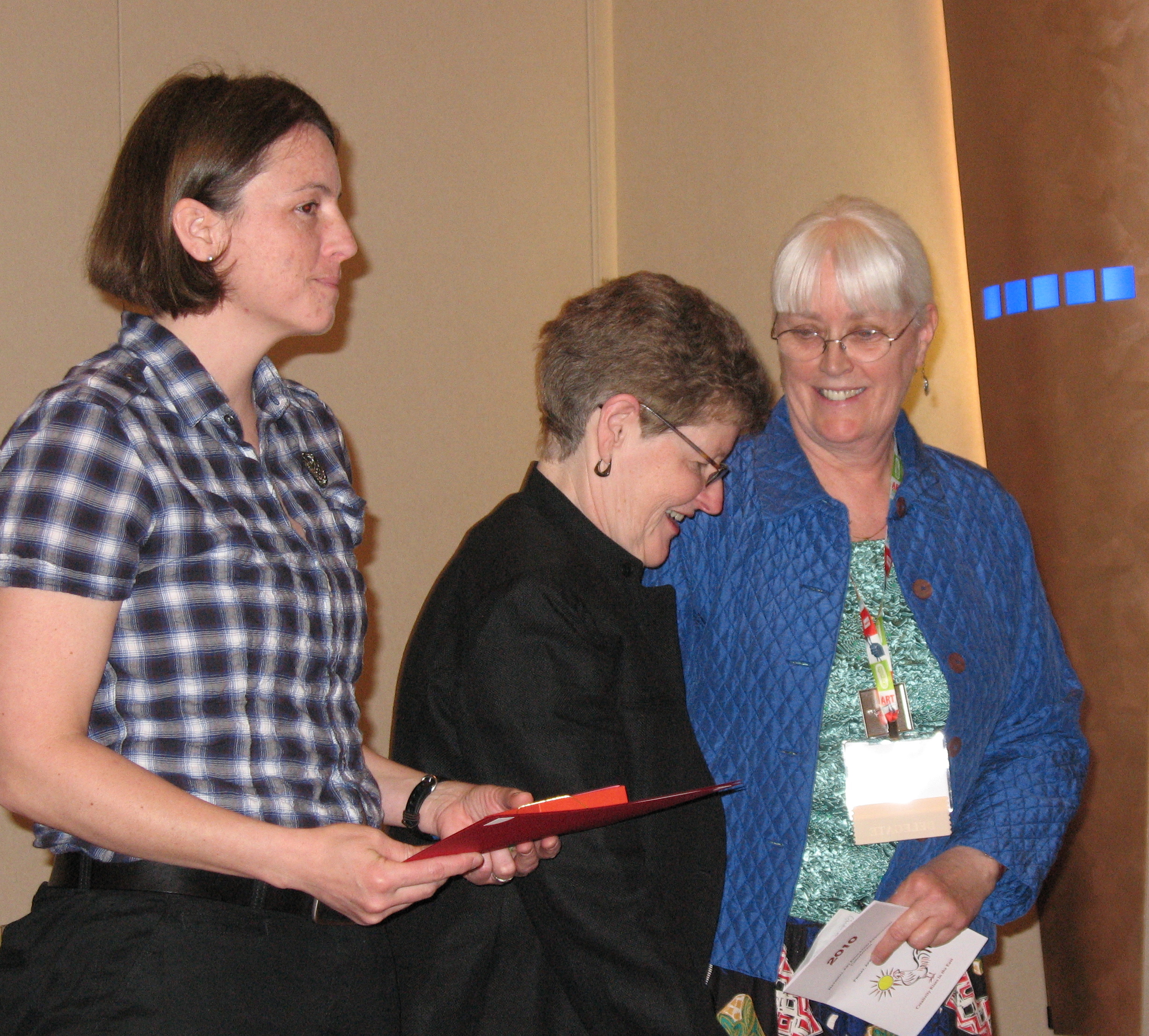
Shalimar receiving her award

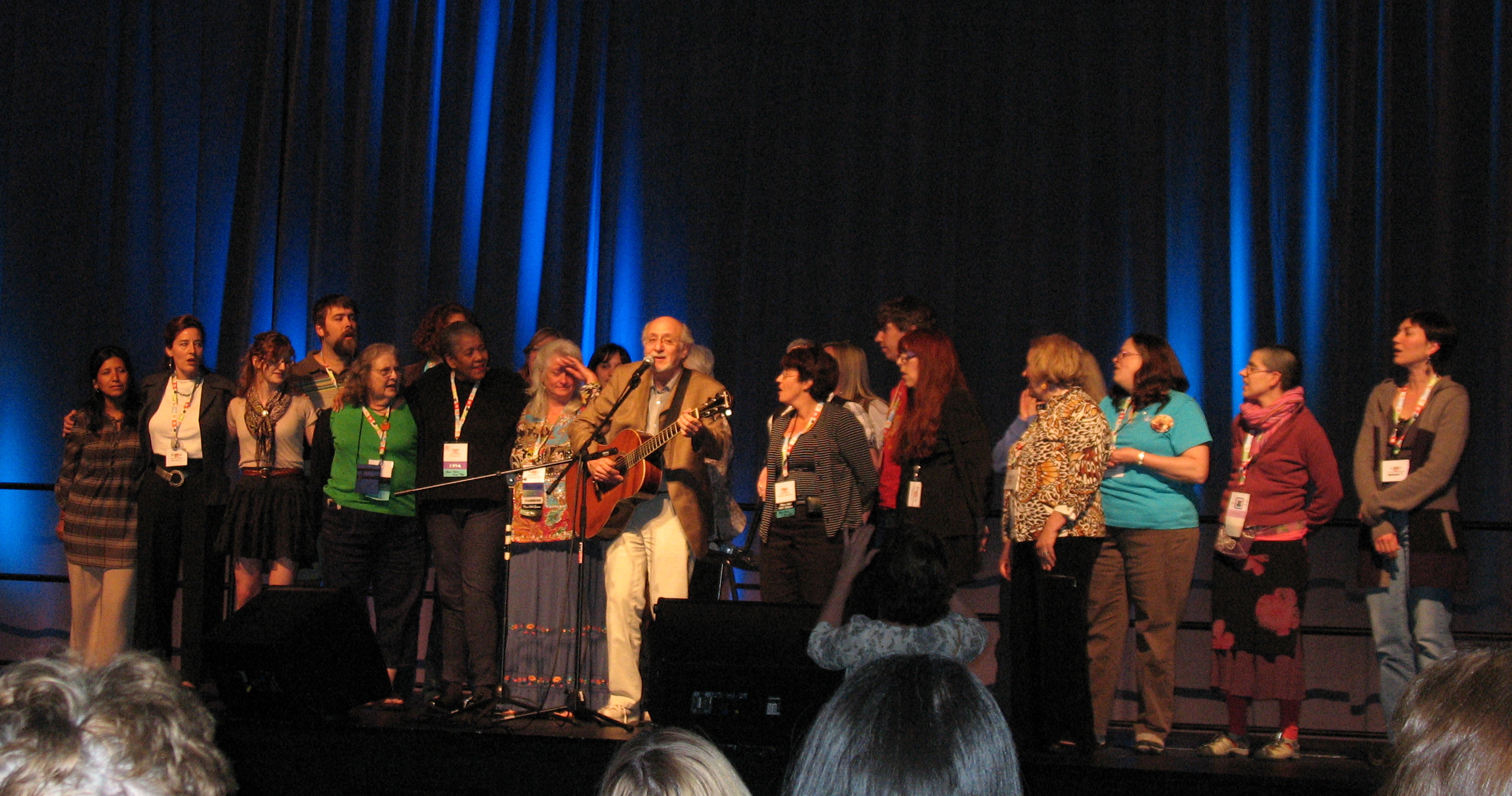
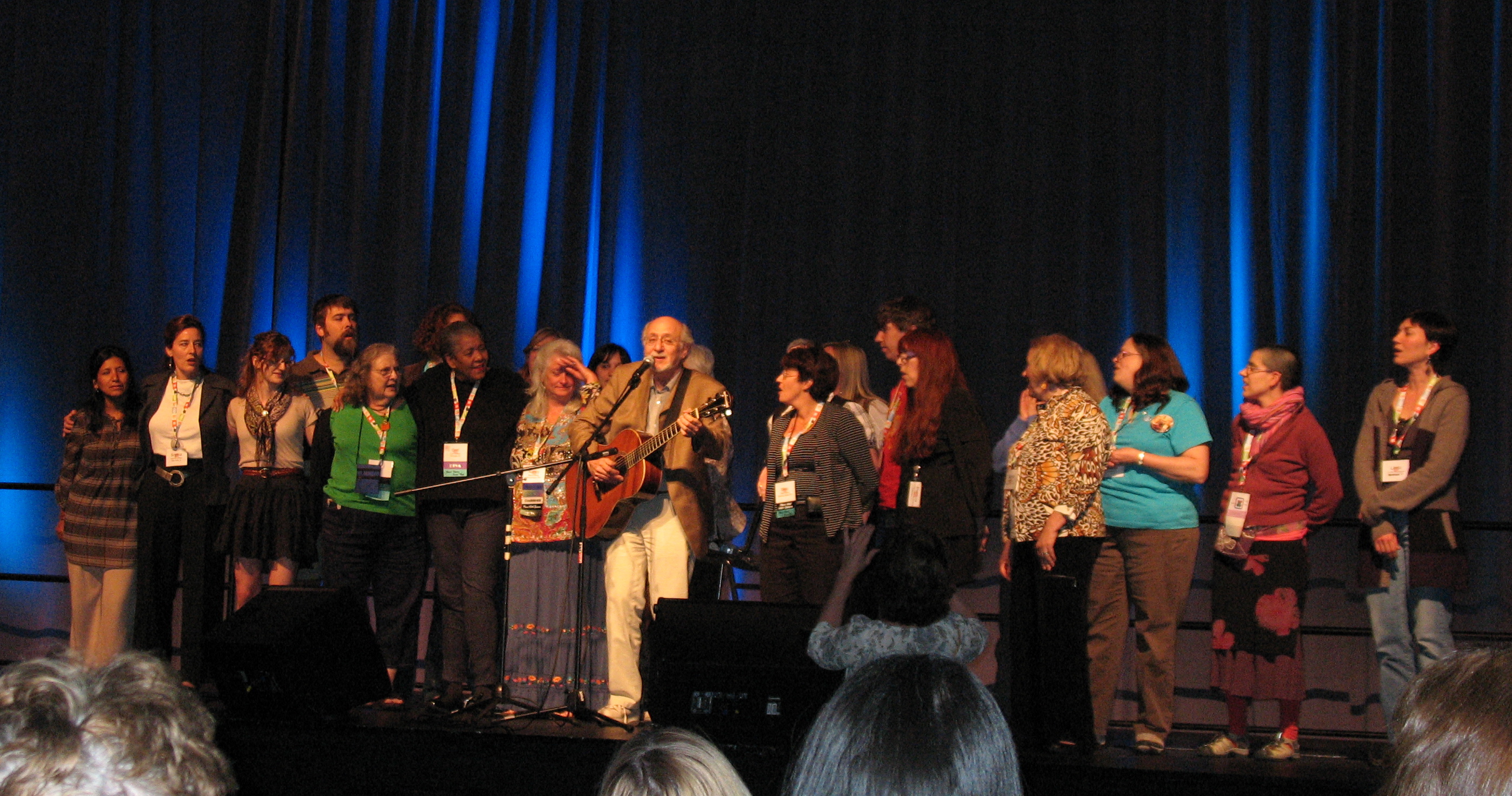
I also attended a few outstanding workshops and met interesting educators. There were two highlights at the conference for me. One was seeing Shalimar Poulin being recognized at a reception as Maine’s art teacher of the year and the other was attending a performance and sharing session by Peter Yarrow (of Peter, Paul and Mary).

Shalimar made tiny gifts with the smell of Maine to share with other teachers.

Peter Yarrow is an amazing person Peter Yarrow and very passionate about arts education and the impact it has on our world. He has founded a program called Operation Respect. The website has an enormous amount of resources. The program is designed to inspire children, along with their teachers and other educators, to transform their classrooms and schools into “Ridicule Free Zones.”

Peter shared his beliefs that around what a difficult place the world is in right now and how the arts “will lead us out of the darkness”. He believes that we need to “lead with our hearts and the intellect will follow.” He also urged us to “let the kids inspire us to be our best.” What a wonderful spokesperson he is for arts education.

h1

And the Orchestra Played On

April 26, 2010

Great story from the New York Times – February 28, 2010 written by Joanne Lipman

The other day, I found myself rummaging through a closet, searching for my old viola. This wasn’t how I’d planned to spend the afternoon. I hadn’t given a thought to the instrument in years. I barely remembered where it was, much less how to play it. But I had just gotten word that my childhood music teacher, Jerry Kupchynsky – “Mr. K.” to his students – had died.
In East Brunswick, N.J., where I grew up, nobody was feared more than Mr. K. He ran the town’s music department with a ferocity never before seen in our quiet corner of suburbia. In his impenetrably thick Ukrainian accent, he would berate us for being out of tune, our elbows in the wrong position, our counting out of sync.
“Cellos sound like hippopotamus rising from bottom of river,” he would yell during orchestra rehearsals. Wayward violinists played “like mahnyiak,” while hapless gum chewers “look like cow chewing cud.” He would rehearse us until our fingers were callused, then interrupt us with “Stop that cheekin plocking!”
Mr. K. pushed us harder than our parents, harder than our other teachers, and through sheer force of will made us better than we had any right to be. He scared the daylight out of us.
I doubt any of us realized how much we loved him for it.
Which is why, decades later, I was frantically searching for an instrument whose case still bore the address of my college dorm. After almost a half-century of teaching, at the age of 81, Mr. K. had died of Parkinson’s disease. And across the generations, through Facebook and e-mail messages and Web sites, came the call: it was time for one last concert for Mr. K. – performed by us, his old students and friends.
Now, I used to be a serious student. I played for years in a string quartet with Mr. K’s violin-prodigy daughters, Melanie and Stephanie. One of my first stories as a Wall Street Journal reporter was a first-person account of being a street musician.
But I had given it up 20 years ago. Work and motherhood intervened; with two children and long hours as an editor, there wasn’t time for music any more. It seemed kind of frivolous. Besides, I wasn’t even sure I would know how.
The hinges creaked when I opened the decrepit case. I was greeted by a cascade of loose horsehair – my bow a victim of mites, the repairman later explained. It It was pure agony to twist my fingers into position. But to my astonishment and that of my teenage children – who had never heard me play – I could still manage a sound.
It turned out, a few days later, that there were 100 people just like me. When I showed up at a local school for rehearsal, there they were: five decades worth of former students. There were doctors and accountants, engineers and college professors. There were people who hadn’t played in decades, sitting alongside professors like Mr. K’s daughter Melanie, now a violinist with the Chicago Symphony Orchestra. There were generations of music teachers.
They flew in from California and Oregon, from Virginia and Boston. They came with siblings and children; our old quartet’s cellist, Miriam, took her seat with 13 other family members.
They came because Mr. K. understood better than anyone the bond music creates among people who play it together. Behind his bluster – and behind his wicked sense of humor and taste for Black Russians – that was his lesson all along.
He certainly learned it the hard way. As a teenager during World War II, he endured two years in a German internment camp. His wife died after a long battle with multiple sclerosis. All those years while we whined that he was riding us too hard he was raising his daughters and caring for his sick wife on his own. The his younger daughter Stephanie, a violin teacher, was murdered. After she vanished in 1991, he spent even years searching for her, never giving up hope until the day that her remains were found.
Yet the legacy he had left behind was pure joy. You could se it in the faces of the audience when the curtain rose for the performance that afternoon. You could hear it as his older daughter Melanie, her husband and their violinist children performed as a family. You could feel it when the full orchestra, led by one of Mr. K’s protégés, poured itself into Tchaikovsky and Bach. It powered us through the lost years, the lack of rehearsal time – less than two hours – and the stray notes from us rustier alums.
Afterward, Melanie took the stage to describe the proud father who waved like a maniac from a balcony in Carnegie Hall the first time she played there. At the end of his life, when he was too ill to talk, she would bring her violin to his bedside and play for hours, letting the melodies speak for them both. The bonds of music were as strong as ever.
In a way, this was Mr. K.’s most enduring lesson – and one he had been teaching us since we were children. Back when we were in high school, Mr. K had arranged for Melanie and our quartet to play at the funeral of a classmate killed in a horrific car crash. The boy had doted on his little sister, a violinist. We were a reminder of how much he loved to listen to her play.
As the far-flung orchestra members arrived for Mr. K/’s final concert, suddenly we saw her, that little girl, now grown, a professional musician herself. She had never stopped thinking about her brother’s funeral, she told me, and when she heard about his concert, she flew from Denver in the hope that she might find the musicians who played in his honor. For 30 years, she had just wanted the chance to say, “Thank you.”
As did we all.

Joanne Lipman is the former deputy managing editor at the Wall Street Journal, was the founding editor in chief of Conde Nast Portfolio magazine.

Thank you Anne for sharing this story.

h1

MAINE’s Imagination Intensive Communities Announced

April 16, 2010

NEWS RELEASE

The Maine Alliance for Arts Education and the Maine Department of Education have collaborated to identify nine Maine communities where schools and a range of partnering organizations invest in the imaginative development of children and youth. Funding from the Kennedy Center; the Betterment Fund, the Maine Arts Commission and the Maine Department of Education made the search possible.

The six finalist communities include Arundel, Blue Hill, Camden-Rockport, Deer Isle/Stonington, North Haven and York. The three semi-finalist communities are Brunswick, Denmark, and Portland (Reiche School).

The search for these communities grew out of a statewide census of arts learning and documented that children’s access to education in music, visual art, dance and theater is not equal throughout the state. The census rasied teh question, “where are the communities that even in hard times use their available resources to support the development of young people’s creativity and innovation?”

The process was also fueled by Maine’s participation in The Education Leaders Institute (ELI) an innovative think tank and design process for state leaders supported by the National Endowment for the Arts.  Through ELI, the Maine team met with national and other states’ school leaders, legislators, policy makers, educators, consultants, and scholars to envision a healthy education environment founded on powerful arts education programs.

Though an open application and juried selection process, nine communities that vary in size, location, and resources were selected to be honored and to be visited and studied by teams of Maine citizens from all walks of creative work. The purpose of these visits is to:

  • Acknowledge a set of Maine communities that value and invest in the creative interests of young people
  • Learn about the creative opportunities they offer children and youth
  • Find out how these communities sustain and grow these opportunities
  • Figure out how more Maine communities could do the same.

One result of this initiative, available to all Maine educators and youth advocates, will be a website that showcases and describes Maine’s top Imagination Intensive Communities. The website will include contact information for dialogue with or visits by other communities for the purpose of creating a network to incubate ideas for future innovations.

The Maine Alliance for Arts Education (MAAE) is a statewide nonprofit that works to strengthen education in all of the arts for all Maine students. For more information on this project and other activities of MAAE, visit http://www.maineartsed.org or email info@maineartsed.org .

h1

Commissioner Gendron Leaves Her Post

April 14, 2010

Commissioner accepts new position

AUGUSTA – Governor John E. Baldacci announced today that Susan A. Gendron will leave her position as Commissioner of the Maine Department of Education at the end of April.

Governor Baldacci also announced that Deputy Commissioner Angela Faherty will be named Acting Commissioner following Commissioner Gendron’s departure.

“Sue has helped to build a culture in Maine that all students need to graduate ready for college, career and citizenship,” said Governor Baldacci. “She does not accept that any of us have the right as educators, parents or politicians to decide some kids will never succeed or to lower our expectations for students. She has been a tremendous asset to the State, and I’m proud of the work she has done as Commissioner.”

Gendron is leaving the Department to become policy director for the Smarter Balanced Assessment Consortium, a group of more than 35 states working to develop common assessments and to compete for a share of $350 million in federal Race to the Top education reform funds.

Gendron was sworn in as Commissioner in March 2003. During her tenure, Maine has joined with three other states to administer the New England Common Assessment Program, a common assessment for reading and mathematics.

Commissioner Gendron expanded Maine’s laptop program, which has provided notebook computers to all Maine middle school students since 2002 – making Maine the first and only state with a statewide 1:1 computing program, making laptops a possibility for every student in grades 7-12. The high school expansion, announced in June 2009, marks the world’s largest educational technology program of its kind, once again putting Maine at the leading edge in using technology to support education.

In 2005, Gendron worked with the Governor and Legislature to pass a new Essential Programs and Services formula, a model for funding education based on adequate and equitable resources for all students, to replace the former model which was based on prior year spending.

Commissioner Gendron has consistently pushed for high standards and aspirations for students. The number of high school students who have taken college courses has increased significantly; she helped craft legislation that requires high schools to offer multiple pathways for students to graduate and strengthened Career and Technical Education.

She worked to oversee the successful implementation of School Administrative Reorganization, the most sweeping education restructuring in Maine since the Sinclair Act of 1947. Under the reorganization law, Maine has reduced the number of school districts and streamlined operations so that more state and local tax dollars can go into programming, rather than to non-classroom operations.

She introduced the ReInventing Schools Coalition model of standards-based education to Maine. This method, which allows students to progress at their own speed and only move forward to new material after mastering previous material, is being piloted in two Maine school districts, with six to eight more strongly considering adoption. Commissioner Gendron oversaw a major expansion of early childhood programming, with 35 to 40 new programs in schools around the State, and worked closely with the First Lady to secure funding and implementation of the first Educare site in Maine, the first in New England, scheduled to open in Waterville this fall. This comprehensive early childhood program is designed to serve between 150 and 200 mostly low-income children from before they are born to age 5, during this most critical brain development stage. The goal is to measurably increase their school-readiness and significantly reduce unnecessary special education costs.

Commissioner Gendron has been a member of the Council of Chief State School Officers (CCSSO) Board since 2006 and is currently President of the national organization. In that position she has been at the forefront of national efforts to develop common standards and common assessments.

Gendron has received many honors, including the Maine School Superintendents’ Distinguished Educator Award, 2001; the Maine Superintendent of the Year Award, 2002; the Maine Education Association – Friend of Education Award, 2005; the University of Southern Maine Distinguished Alumni Award, 2006; and the State Education Technology Directors Association – Pushing the Envelope Award, 2008.

Governor Baldacci praised Gendron for her work advancing standards-based education and innovative high school reforms.

Governor Baldacci said Maine will benefit from Commissioner Gendron’s continued high profile on the national education stage in her new work.

“Maine is a recognized world leader in technology and in the forefront of standards-based education. Sue’s involvement at the national level, bringing her experiences from Maine, will influence and guide national policy. Sue’s involvement gives Maine a seat at the table.”

Governor Baldacci said Faherty’s appointment as Acting Commissioner following Gendron’s departure will assure a seamless transition.

“Deputy Commissioner Faherty is committed to continuing the shared vision for improving student achievement across the state,” Governor Baldacci said.

“She has a bold vision for excellence and equity, and has achieved results through effective management and collaboration. She has demonstrated expertise in supervision, evaluation, consultation, teaching, facilitation and development of quality professional development for educators and leaders. She is a true believer in establishing clear goals with a clear purpose, and building consensus.”

Faherty earned her bachelor’s degree from the City College of New York and received her master’s in Education from the City University of New York and a doctorate in Education from the University of Missouri.

She has been a classroom teacher at the elementary, middle and high school levels in literacy development, special education, and gifted and talented in the New York City, Missouri and Salt Lake City school systems. She was assistant professor at the University of Northern Iowa and adjunct professor at the University of Southern Maine, St. Joseph’s College and Walden University.

h1

RSU 54 – MDOE Art Exhibit

April 14, 2010

Canaan, Cornville, Mercer, Norridgewock, Skowhegan, Smithfield

Mei, Grade 12

During January and February students from RSU 54 had artwork on display at the Maine Department of Education. Congratulations to the students and their art teachers for the outstanding work that you can view by clicking here or by scrolling down on the front page and look under ‘Pages’ for RSU 54-MDOE artwork.

A GREAT BIG THANK YOU to art teachers Rebecca Dow, Lisa Ingraham, Joanna Hopkins, Iver Lofving and Paul LeBrun. A SPECIAL THANK YOU to art teacher Frank Chin for organizing the exhibit!

h1

TED talk: Natalie Merchant

April 14, 2010

Poetry put to music

This is a wonderful TED talk and is a great example of the ‘E’ in TED….. Technology, Entertainment, Design. Natalie Merchant has put old poems to music. I recommend you take a few minutes and check this out, you won’t be disappointed.

h1

My Visit to Jordan Acres School

April 13, 2010

Jordan Acres 4th grade, Brunswick

Music teacher Cindy Brown

Music educator Cindy Brown invited me to the 4th grade music performance at Jordan Acres in Brunswick and I am glad I made the trip. I was exhausted from a busy week on the road and it was a great way to end the week. With smiles on their faces and each having an important role the 4th graders had poise and confidence as they performed for family and staff.

Cindy had the young musicians prepared so well that she was hardly visible throughout the performance. The students combined singing, playing their recorders, and speaking.

Cindy adapted the script by Teresa Jennings from the Music K-8 magazine (Vol. 20, No. 3). The show opened with the song “Music Class” which set the tone for the 30 minute performance. “Hot Cross Buns”, “Merrily We Roll Along”, and “Gently Sleep” were the first three recorder pieces. The script contained the importance of music in our lives, how it impacts people, and why we have music class in school.

The tunes became more difficult as students had a chance to share their skills and knowledge. The performance closed with the students singing “Why Music?” by Teresa Jennings. Loud applause as students filed off the stage with smiles on their faces.

Cindy gave me a tour of the interesting “open school”, I met the principal Scott Snedden, and  visited with art teacher Sharon McCormack and saw the marvelous art work on display. I couldn’t help but smile as I drove back to my cubby in Augusta. The answer to the question “why do we teach music?” came through loud and clear!