Maine College of Art’s (MECA) Office of Continuing and Professional Studies in collaboration with the college’s Master of Arts in Teaching program are pleased to offer two fully online courses for this May term. These Graduate-level courses offer 3 credits each at a discounted, non-matriculated rate. The two art education classes are certification requirements for folks seeking a Visual Art teaching endorsement. If you know any community artists or educational technicians that may be interested in becoming an art teacher, this would be a perfect opportunity for them to move closer to that endorsement.
May Term at MECA is five weeks, from May 15 to June 20. May Term 2021 offers: MAT 806: Teaching Exceptionality in the Art Classroom with Heather Nunez-Olmstead. MAT 815: Methods of Teaching Art in the K-12 Classroom with MAT Program Chair, Dr. Rachel Somerville, Ed.D.
Below is a video that provides information on the two courses being offered.
If you have questions please contact Rachel E. Somerville, Ed.D. Interim Chair & Director of Art Education Outreach at rsomerville@meca.edu. For more information about May Term classes, visit: https://cs.meca.edu/ or call us at 207.699.5061.
In one day in the middle of February I received two emails about a project to create lesson plans that would accompany the film Natasha Mayers: an Un-Still Life. After a phone call with filmmakers Anita Clearfield and Geoffrey Leighton the project sounded so fun I couldn’t say no. The film is fabulous and has messages for every grade level.
During the last month I’ve been working with retired art teacher Kal Elmore and educator Nancy Frohlich-Harris on 3 lessons – one each for elementary, middle and high school. They are aligned with the Maine Learning Results and the National Arts Standards. Also included in the resources are a glossary, lists of artists, websites and books.
The goal is to have all of the work completed and online by April 3 so those attending the virtual Maine Art Education Association conference can get the first look at them. During two workshops on that day participants will view all of the materials that we’re creating and have grade level conversations about the possibilities for teaching and learning.
In addition to the two workshops, during the morning artists Natasha Mayers and Rob Shetterly will be providing the keynote. Natasha Mayers has been called “the heart and soul of activist art in Maine.” She is widely known for her work supervising more than 600 school and community murals from Maine to Nicaragua. Natasha has been a Touring Artist with the Maine Arts Commission Artist-in-Residency Program since 1975. She has taught students from nursery school to college and in diverse populations: immigrants, refugees, prisoners, the homeless, and the “psychiatrically labeled,” with whom she has worked since 1974, and has organized many exhibits of their artwork.
Natasha’s portrait was painted by Robert Shetterly as part of his Americans Who Tell the Truth series, featuring her words: “We need artists to help explain what is happening in this country, to tell the truth and reveal the lies, to be willing to say the emperor has no clothes, to create moral indignation, to envision alternatives, to reinvent language. We need artists to help us come together and share our voices and build community around powerful issues concerning our roles in the world and our planet’s survival. Compassion must be translated into action.”
Rob has been painted over 250 people who stand for the truth. Robert Shetterly’s American’s Who Tell The Truth series should be included in every art teacher’s curriculum. The voices of young people are strongly represented in the paintings and in this day and age we know how important it is to elevate our student voices and provide role models for inspiration. Rob is a Maine treasure.
Rob and Natasha have been friends for many years and in the film you hear and see Rob sharing his feedback to Natasha about recent art she has created. The film will be available for conference goers and is recommended you view it before April 3. It will be available until 48 hours after the conference.
They have made it available to conference goers and recommend that you view it before the conference on April 3. It will be available u
CONFERENCE DETAILS
The conference will be held virtually using zoom on Saturday, April 3, 9:00 am – 2:30 pm.
CONFERENCE PRESENTERS Joseph Cough – Midcoast Music Academy Cory Bucknam – Brunswick Junior High Lori Spruce & Holly Houston – Brewer High School & Yarmouth High School Samara Yandell – Biddeford Middle School Hope Lord – Maranacook Middle School Argy Nestor – Sweetland Middle School
Ours schools and communities continue to cultivate the arts and teachers have a crucial role in encouraging and teaching our youth to become creative thinkers. The 2021 Maine Region Scholastic Art Awards honors one of our state’s outstanding art educators who is also a mentor, an arts leader, and brought Scholastics to the State of Maine 32 years ago. (Margaret) Peg Maxwell’s first teaching job was in 1983 in a 3-room schoolhouse in Otis, a small town on the outskirts of Ellsworth, Maine. She eventually settled into a position at Bonny Eagle where she taught for nearly 38 years. An innovator, she crossed boundaries creating engaging curricula. She invited the Martha Graham Dancers to USM and Merrill Auditorium after working with them at Monmouth College. She was integral at bringing Alvin Ailey dancers to Maine and Arthur Hall of Sesame Street, a friend from Philadelphia, who eventually moved his dance studio to Camden, Maine, permanently. She created a multidisciplinary curricula, integrating the arts into education.
Continuing her personal artistic growth throughout her career, she studied a dizzying list of courses from book arts at Bennington College to Marine Biological Illustration to Documentary Film here in Rockport, and so much more. She generously shared her knowledge with her community and students, reshaping art education and curricula.
Today we honor Ms. Maxwell, who brought the Scholastic Awards program to Maine in 1989!
Peg began teaching at Bonny Eagle High School that same year. She noted that they had to pay an additional fee and go through an additional board of jurors due to not being sponsored by a major corporation or post-secondary institution. She spent many years seeking support for the program through colleges and even the Boston Globe, as they supported Massachusetts and New Hampshire schools. Maine College of Art eventually took hold of the opportunity followed by Heartwood School in Kennebunk for a couple of years with MECA.
Many of Peg’s students have continued in the arts as well working in creative fields like directing animation for Nickelodeon and PBS, or interning with Dale Chihuly, and designing websites for Disney, Oprah and ESPN. Other alumni are Fulbright scholars, and even a young artist was featured in Esquire as one of the top 10 Rogue Artists in the US. The list is exhaustive.
It is fitting that this art educator and State Arts leader should be honored with our first State of Maine Scholastic Art Educator Excellence Award. We thank Peg Maxwell for all her hard work and dedication in creating the foundation for our Scholastic program in Maine. We will be forever grateful for your presence in Maine’s Art Education Landscape. You have touched so many lives and it is with great pleasure that we congratulate you on these many achievements. We all look forward to seeing what important innovations you bring to the Maine Arts Scene in your next chapter.
Maine Music Educators Association is accepting nominations for their recognition program. Below are the following categories with links to the nomination form. Consider nominating a deserving colleague.
In addition, if you are a music teacher who is retiring or have a milestone last or this year complete the form to be recognized and send the form to the MMEA Executive Director Beth LaBrie at execdirector@mainemea.org. Likewise, if you have questions, please contact Beth.
This past year has held many challenges, but there are so many things to celebrate, and you are invited to join colleagues from across Maine for the annual art education conference. This year things will look a bit different as we will be apart. The conference will be coming to you safely via Zoom and we have an outstanding lineup of speakers for you and it is only $20.00 this year!
Keynote Address Presenters: Natasha Mayers & Robert Shetterly
About our Featured Keynote Speakers: Natasha Mayers has been called “the heart and soul of activist art in Maine.” She is widely known for her work supervising more than 600 school and community murals from Maine to Nicaragua.
Natasha Mayers
She has been a Touring Artist with the Maine Arts Commission Artist-in-Residency Program since 1975. She has taught students from nursery school to college and in diverse populations: immigrants, refugees, prisoners, the homeless, and the “psychiatrically labeled,” with whom she has worked since 1974, and has organized many exhibits of their artwork.
Her portrait was painted by Robert Shetterly as part of his Americans Who Tell the Truth series, featuring her words: “We need artists to help explain what is happening in this country, to tell the truth and reveal the lies, to be willing to say the emperor has no clothes, to create moral indignation, to envision alternatives, to reinvent language. We need artists to help us come together and share our voices and build community around powerful issues concerning our roles in the world and our planet’s survival. Compassion must be translated into action.”
Joseph Cough – Midcoast Music Academy Cory Bucknam – Brunswick Junior Hig) Lori Spruce & Holly Houston – Brewer High School & Yarmouth High School Samara Yandell – Biddeford Middle School Hope Lord – Maranacook Middle School Argy Nestor – Sweetland Middle School
Those that attend earn contact hours and get swag!! Conference Registration will Close April 1! Sign up today to save your spot! If you have any questions, please do not hesitate to reach out to me.
Teacher Leader voicesof Maineon the bright lights that the pandemic afforded
A year ago my school, like all schools in Maine, shut down because of the Covid outbreak. On Friday, March 13th staff left for the weekend without knowing what the next week was going to bring. Staff and parents and students quickly kicked into a complete ‘flex mode’ each day learning and building on our knowledge. In the beginning it was an amazing and unsettling feeling to watch, listen, and learn through a completely different lens. Everyone stepped up and each person, young and old, were terrific. The summer came and went with educators throughout the world considering the next steps. With open minds and a cooperative spirit the sharing of ideas flowed through the air waves (in most cases at no cost) and connected educators in a completely different way. I can only think of a couple of other times in my career when my pathways to learning were so rapid. As the 2020-21 school year progressed FLEXIBILITY continued to be necessary. And, as we pause for the one year anniversary of education changing drastically we are beginning to see the light at the end of the tunnel. My greatest hope is that our pathways of learning, sharing ideas, and collaborating will continue. And, I do hope that we simply don’t ‘go back’ to where we were before unless the pieces are in the best interest of every learner!
The following Maine Visual or Performing Arts Educators kindly provided their “silver linings” of the pandemic. We all have them, what is yours? Please email your silver linings at meartsed@gmail.com so we can continue to learn from each other.
I teach the littlest students. My silver lining is that, since class sizes are very small, there is time to hear all students’ stories, opinions, ideas, etc. There is also time for every student to have a turn at every activity. They get more individual attention than ever before. ~ Patti Gordan, Music Teacher, Raymond Elementary School
From Sue Barre, Grades 5-12 Band Director, Waterville Public Schools Like many school programs traveling with students to perform in other locations has been temporarily eliminated. Instead each high school ensemble commissioned a piece – reflective in some way to the last year we have all experienced. Ensemble members have had the opportunity for input and for interaction with the composers. “This experience has been so much more than I anticipated, really cool to watch students learn in a whole new way”!
In band I asked the students what dates were of importance to them and these are some that came forward: 3/31/20 – last day of school, 5/25/20 – death of George Floyd and 1/6/21 were some of the dates that came forward.
I asked for sounds that they connected to last year and ideas such as email arriving into the box, sirens and silence came up…
The most fascinating sessions were with the composer sharing ideas. The chorus and orchestra have had different experiences than the band.
In May we hope to have a socially distanced event to share the debuts and senior recognition night all wrapped into one.
From Kate Smith, Music Teacher Central Elementary School, So. Berwick
The pandemic has increased awareness of the value of reliable daycare and how it effects the wellbeing of an economy. I hope this will lead to additional and consistent financial support from the government.
Smaller class sizes have enabled more personalized, individualized and differentiated instruction. Students can ask more questions and have more turns. I am more likely to have enough instruments or resources for everyone.
Free professional development opportunities abound like never before. I’ve seen increased collaboration between educators within districts, states and even internationally. Everyone has had to learn how to use technology like video conferencing which means everyone now has the skills to connect online. I hope this continues.
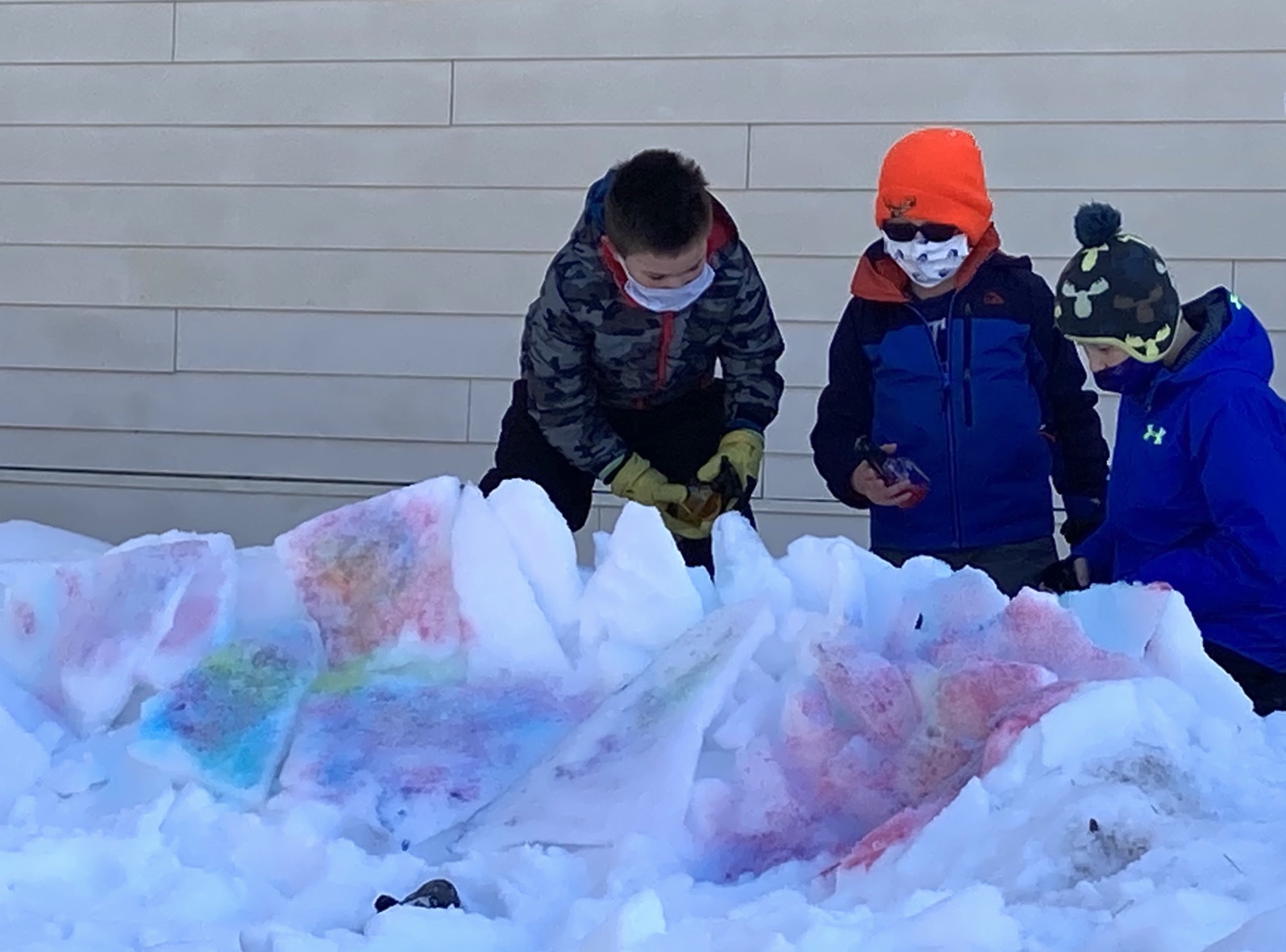
My silver lining is the freedom this chaotic moment in time has presented to try something completely different. I am sharing photos from one of my third grade classes this week. We went outside to make art as a whole-class reward for the great choices they’ve made during the last 6 weeks that we’ve all been back together at Madison Elementary. (Other classes will earn their “Outside Art”, too. It just may take a little longer : ) I gave these students snow block makers and spray bottles filled with watercolor paint and pointed them to the snow. It was a blast and it made my art teacher heart happy to see the creativity and teamwork this class demonstrated. ~ Lisa Ingraham, K-4 Art Teacher, Madison Elementary School, K-12 Gifted & Talented, MSAD 59
I have several silver fillings, I mean linings. But one came out the other day that I totally didn’t realize was there.In the pre-covidian era, it was a weekly inevitability that a first grader would raise their hand and say” Mrs. R., I lost a tooth!” Of course every other hand in the room would shoot up and a chorus ensued with the end result that we would lose 5 minutes of Art time. This has been missing for almost a year now and despite having the 5 minutes back, I really miss those gap-tooth smiles. So I guess it is more like a silver filling after all. ~Allie Rimkunas, Great Falls Elementary School Art Teacher
Thanks to Coronavirus – both the time I have gotten back with my family and the strides I have made in differentiated learning for my classroom. Technology resources have made it so learning can happen anywhere and for any student with the click of a button. ~Iva Damon, Leavitt Area High School Art Teacher, Humanities Network Leader
From Hope Lord, Maranacook Middle School Art Teacher
Zoom Parent Teacher Conferences are very efficient and I am able to attend multiple meetings to speak to parents of advisees and students in my classes. In traditional conferences I would have to decide which meetings to attend. Now I can join a meeting and share and then leave and join another student’s meeting within a few seconds. It’s been a great tool.
Another wonderful benefit from having to adapt to teaching during a pandemic is that most of my teaching resources, videos, assignments, and assessments are now available online through Google Classroom. If a student is absent, they will have access to the lesson online and can complete the work at home when they feel better and not fall behind.
Lastly, no more snow days that extend the school year way into June. Since we have had remote learning days, we have not had a snow day. We won’t have to be in school until the end of June!
My silver lining…….hmmm. No more photos turned in or left on the dryer in the darkroom : ” STUDENT ARTIST UNKNOWN”! Now that work is digital and submitted in Google CLassroom I ALWAYS know whose image it is! ~Jennie Driscoll, Brunswick High School Art Teacher
We all have the students that are quiet in school, do not talk, that seem to want to be invisible and they never participate in class discussions, nor would I make them. I always wondered and worried about these students. When we went to remote some of these students slowly began to come out of their armor they had built up. We began to have rich conversations about their art work and the deep meanings they put into them and they share the art they do on their own. They are comfortable in their own environment and slowly have come to life and I have the privilege of really getting to know them. I look forward to my zoom sessions with these students where they smile and laugh and share their ideas with me. Connecting with these students is my positive out of the negative, my “silver lining”. ~Holly (Leighton) Boyce, Mattanawcook Academy Art Teacher
I have been having – hands down – one of the most rewarding school years of my career. I’ve been creating my curriculum several weeks ahead of teaching it all year so far. And what it has done is:
reinforce that singing and playing is not content: it’s DELIVERY
when the delivery method changes that there are many other ways of delivering content
my program is not built on my students’ emotional dependence on it, so the transition away from singing was pretty easy
being a good teacher is not dependent on circumstances ~Rob Westerberg, Music Educator, York High School
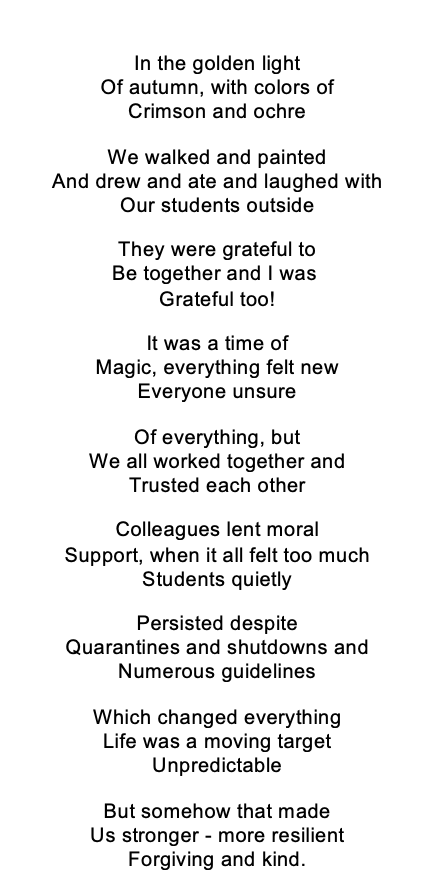
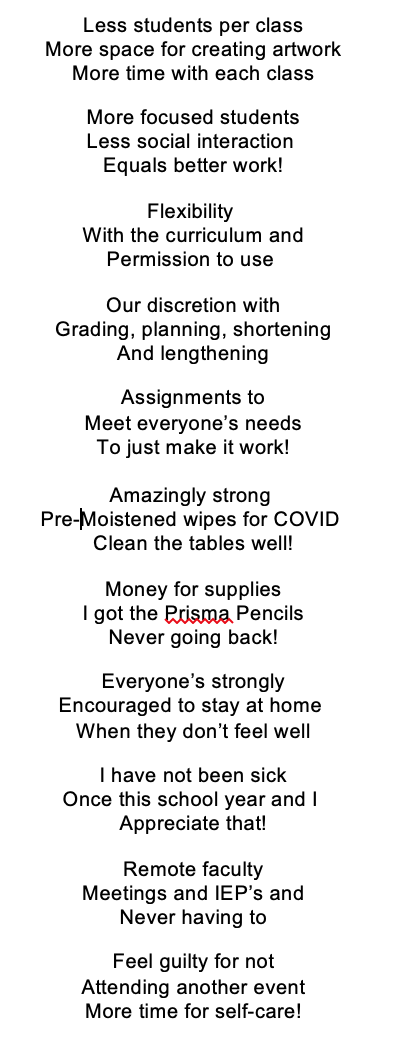
From Eva Wagner, Bangor High School Art Teacher Class size for sure, so much better in the art room to have smaller class sizes. Eva wrote these amazing Silver Linings – Haiku Style:
From Leah Olson, Ellsworth High School Art Teacher
The silver linings that I’ve discovered in the age of covid are many! Since March 13th, life has been a bumpy journey to say the least! The hybrid of learning for students has forced me to rethink projects differently in regards to curriculum, material use and social interactions in and out of the art room. In regards to curriculum, I had to change my units as immediately as school started in the fall. I realized that my units were not going to work as well for students who were completely remote. So, I met them where they were at. Units were and are chunked down with reinforcing the basic concepts of ceramics and jewelry. It has worked out so well that I may rethink the sequential curriculum for next year!
In regards to using technology, I’ve been using Google Folders for years as portfolios to grade student work, so that was easy to keep track of student progress. I started using Google Classroom last year after March 13th to post Zoom Meeting links and reminders. The newest learning tool to navigate around was creating a Google website that students could access rubrics, videos and links most relevant to the lesson. It’s been so helpful for students to access this if they miss a class or need a review of the techniques. The silver lining is that I finally created a website that can be used in the years to come! : )
Another silver lining is that through the covid grant, I was able to purchase materials so that Ellsworth High School students could work from home and from school. Because of this, students would create two projects using the same technique – the easier project would be done at home and the more difficult one would be done at school. This reinforced fluency and confidence using the tools and materials.
Having no more than ten students in class allows me to demonstrate techniques for students remotely and physically. I’ve been able to work alongside with students in a way I never could before. While they are working with their works, I am too. We talk with each other, laugh, and at the same time, the bar is raised. The social connections with students could not be experienced in the same way as a class of twenty. You all know what I mean! There is time to talk with one another.
Finally, I’m also learning more about teaching ceramics through trial and error. Like, don’t travel with bone dry projects. Telling students to not leave clay in the freezing cold car overnight, and cheese graters at the Dollar Tree work great for downsizing thick places in pots and evening out the surfaces. I learned that cutting pinch pots in half to see the thickness of the walls make for better pinch pot luminaries, raku clay is an excellent starter clay for slab containers because you don’t have to wait to join the walls, watercolor underglazes are a game changer for creativity and traveling back and forth from home to school. This is just to name a few! I often wonder what students will think of learning about jewelry and ceramics through the pandemic years from now. Hopefully, they will look at something they made and see the year 2020 or 2021 scratched into their work and feel a sense of relief, pride, and nostalgia! I am reminded daily by the phrase, “The Darkest Nights Produce The Brightest Stars”.
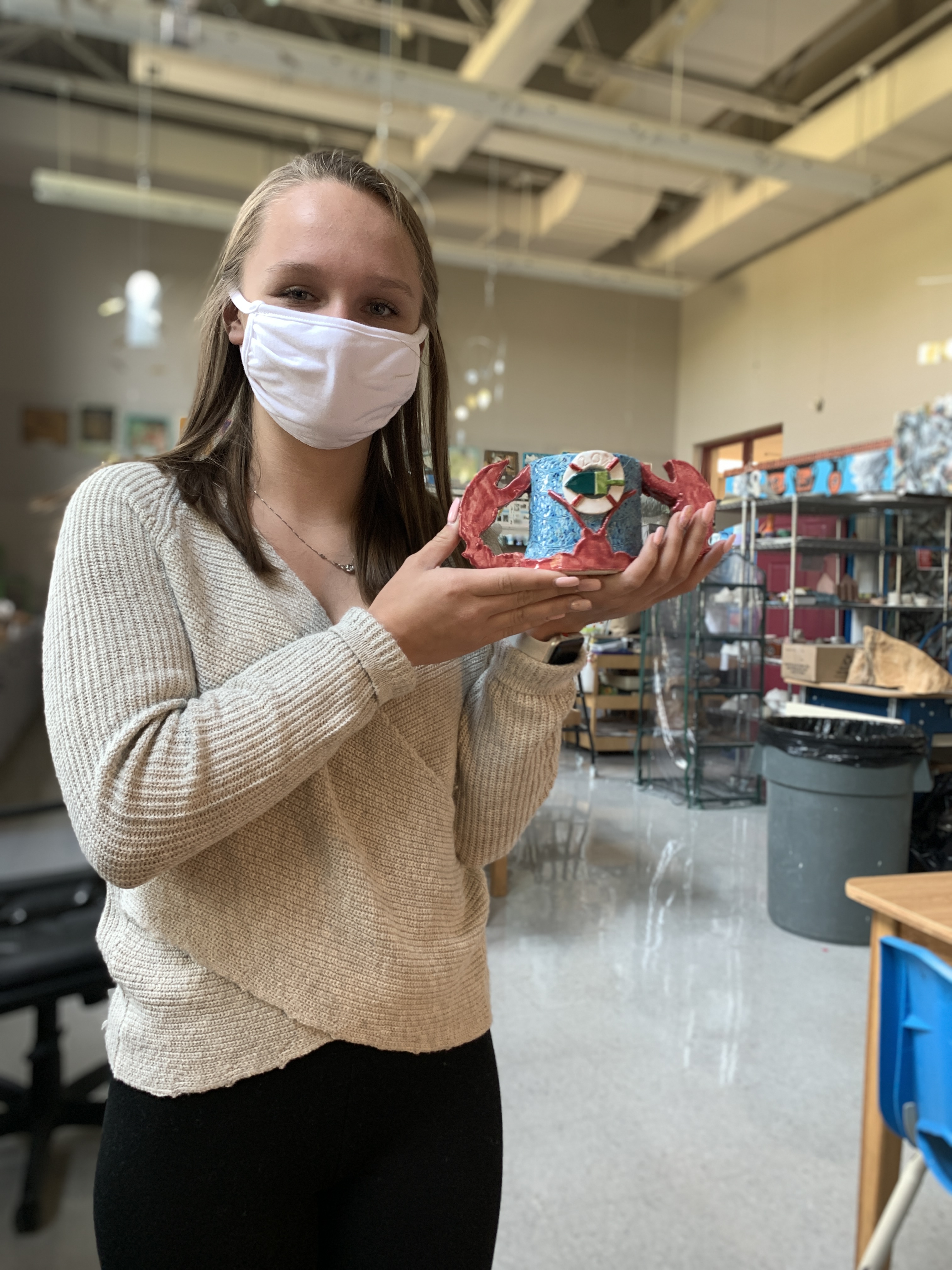
Sierra Andrews) who absolutely loves her “Mainely Mug” Think you can “Handle It” assignment
Every years, Bay Chamber presents a free matinee for over 1,000 students from around the state. Due to the pandemic, they’re not able to offer a live performance, but instead they are excited to offer a free virtual program by Warp Trio called Black Voices that will be accessible from a private link on Bay Chamber’s YouTube channel.
ABOUT THE PROGRAM
Black Voices, features the music and writings of musicians, poets and authors from the African Diaspora—illuminating the breadth of influence from artists of color on our contemporary culture and landscape. The 45-minute program showcases a variety of genres from hip hop and classical to spoken word and jazz. Presented in conjunction with the award winning emcee LiKWuiD, the program includes poetry by Langston Hughes, Ntozake Shange, Maya Angelou paired with music by Duke Ellington, William Grant Still, Harry Burleigh, and original compositions from Warp Trio.
AUDIENCE
This program is recommended for high school audiences but may be suitable for younger audiences at the teacher’s discretion.
DETAILS
The program will be available through Bay Chamber Concerts & Music School’s YouTube channel and can be viewed at any time between March 1- April 16, 2021. To sign up, please email Monica Kelly at monica@baychamberconcerts.org.
WARP TRIO
Learn about Warp Trio who are described as “A talented group that exemplifies the genre-obliterating direction of contemporary classical music (Columbia Free Times)”, Warp Trio is an internationally touring cross-genre chamber music experience. Reflecting the combination of Juilliard trained members juxtaposed with members steeped in rock and jazz styles, the one of a kind trio (that even has a fourth member!) can be seen performing classical works in prestigious halls on the same tour where they headline a standing room only show at a rock venue. In addition to their electrifying public performances, they have gained a reputation for their innovative educational workshops with students from grade school through university level.
We all know how important relationships are in education, especially the ones that we form with our students. Probably the most challenging part of ‘schooling away from school’ last spring was how to maintain and continue building relationships. Social Emotional Learning has been key to understanding the challenges of our learners. That term has moved to the center of educational conversations in the last several months.
Not only is the teacher-to-student relationship important but so is the student-to-student relationship. As the work at my school evolved last spring we brainstormed ways that we could bring learners together so they’d have that social component at the same time that they were learning. We considered how we do that ‘IN’ school and ways to adapt that. We started by gathering first thing in the morning by zoom for ‘breakfast club’ which lasted for about 15 minutes. This helped all of us with a routine and for those that need that ‘social time’ they had it with all of their classmates. They used the chat box and some days started with one ‘word’ to describe how they were feeling. No judgement, no feedback was provided, just a moment to share one word. Some days we started with it and sometimes we said one word before we signed off for the day. During the day each learner had a short time with one teacher for instruction. The piece that was missing was the collaborative learning.
Edutopia published THIS ARTICLE called 7 Ways to Maintain Relationships During Your School Closure written by Sarah Gonser.
We learned enormously from the situation that we were all suddenly thrown into last March. Our goal this year was to take what we had learned and build and expand on it. This year we have put small group instruction and collaborative learning at the heart. Learners are exchanging ideas, learning from each other and building on their knowledge together. We utilize technology tools more effectively at the same time we’re mindful that the human connection is critical. Is it perfect? No, but we’re always tweaking and learning from each other as well as from the students. Watching, listening, and learning from them is always at the heart.
The Maine Department of Education hired Kellie Bailey to develop Social Emotional Learning tools and opportunities to help support the field. You can access their tools and information for trainings at THIS LINK.
Most importantly for teachers and students is that we are mindful of the continuous shift. We need to reach out to others and remember we are not alone. We’re all in this together!
This is a great opportunity for teachers and artists to practice your art in a beautiful location. This opportunity is saved for Maine K-12 art teachers and for Maine artists. The Maine Artist Residency was established in 1989 for artists only by a couple who imagined the opportunity for Maine artists. Six years later the arrangement turned into a non-profit called Monhegan Artists Residency Corporation (MARC) and donors came forward to help support the idea. In 2013 a second residency was established just for Maine art teachers.
2-week summer residency from Saturday, July 2 through Friday July 16, 2021 – designated for Maine K-12 art teachers
5-week fall residency from Monday, September 6 through Monday October 11, 2021.
Both residencies are located at Elva’s Old PO, in the center of the village overlooking the meadow. The building offers both studio and living space, along with a private deck that overlooks the meadow filled with migratory birds in the fall. There is a stipend of $150 per week to support living expenses while you are on the island.
Applications, including images of your work and a narrative, are made through the Submittable website at THIS LINKand are open through March 19. Applicants will be notified by April 19.
Artwork by Jody Dube
Last year Lewiston High School art teacher Jody Dube was selected for the residency and he said the following:
“My time on Monhegan was as much a spiritual retreat as an artist residency. It afforded me time… time away from all the cares, pressures, and distractions that tend to clutter the mind and make it difficult to gather ones thoughts properly in the cause of making art. I had a rare opportunity to step aside from time itself and experience genuine immersion into a creative mindset. I’d been moving with clear intention toward two-dimensional work since springtime and the isolation of COVID-19, preparing for the residency by establishing a drawing practice. The physical beauty of Monhegan’s rocky shores and the majesty of Cathedral Woods profoundly inspired me. The freedom of my island life allowed me to delve deeper and explore ideas more than I ever could amidst the distractions of my routines back at home. The Monhegan Artist Residency board thoughtfully addressed challenges brought on by the pandemic and I was provided with excellent accommodations and careful planning for my physical safety, for which I am deeply appreciative. I began several pieces on the island that will be completed over the next several months. The experience will remain with me for a lifetime.”
Maine Art Education Association andPortland Museum of Art
For almost 30 years, the Portland Museum of Art and the Maine Art Education Association (MAEA) have collaborated to bring National Youth Art Month (YAM) to Maine. This annual exhibition showcases the incredible work produced by K-12 students throughout the state, representing a wide variety of youth perspectives and artistic practices in Maine. MAEA member teachers – the dedicated individuals at the forefront of Maine’s quality school art programs – each select one piece of exemplary work from their classrooms to represent the creative efforts of their students and to empower students with a passion and talent for art.
For the first time, YAM is digital, which brings exciting opportunities to share the artwork of Maine’s youth with a wider audience. We hope that the artworks in this exhibition inspire more creativity, spark more conversations, and garner support for more arts education in our schools and in our communities. Art is a powerful, expressive tool through which people of all ages find their voice, their passion, and their power.
The exhibit is always an opportunity to share the pride of what each student experiences making art. The digital exhibition is LIVE and available to be viewed, shared, admired, and all the other things we will do in celebrating the artwork on display throughout Youth Art Month. You can find the exhibition by clicking on this link: https://www.portlandmuseum.org/yam-2021.
Over 80 artworks were submitted to YAM 2021 from students and teachers across the state of Maine. The art on view explores themes around identity, the natural world, home, and portraiture. View the art work by grade levels or in its entirety by clicking below.
Youth Art Month is supported by the Onion Foundation and the Peggy L. Osher Education Endowment at the Portland Museum of Art, with corporate Support from Norway Savings Bank.
Argy Nestor
Arts Educator, Blogger, Artist, Connector meartsed@gmail.com
https://sites.google.com/view/anestor/
Argy’s Blog
The purpose of this blog is to share stories about people and places; and to celebrate the amazing work (and play) that students, educators, and organizations are doing in and for arts education. In addition, the blog has a plethora of resources and innovative ideas. This forum gives blog readers the opportunity to learn from each other. It is essential that we listen, learn, and collaborate in order to build on teaching practices for the benefit of every learner in Maine and beyond.










 me arts ed