Archive for May, 2012

h1

In Today’s News

May 18, 2012

Galloping bronze sculpture

Read in the Living section of the Bangor Daily News today, May 17th, about the work of sculptor Forest Hart and how he is connecting with students from Hampden Academy to create the sculpture for their new school. Article written by Robin Clifford Wood. Click here for the article.

h1

Literacy for ME

May 18, 2012

Maine’s Comprehensive State Literacy Plan

Lisa Gilman teaches visual arts at the Winthrop Middle School. During the last year she has served as a content specialist on the State Literacy Committee. Recently she wrote this post for the meartsed blog to provide information to arts educators of the work the committee has done.

The committee was formed during the Fall of 2010. The MDOE applied for a Striving Readers Comprehensive Literacy (SRCL) formula grant to be used to establish a Statewide Literacy Team charged with assisting the MDOE to develop a Statewide Literacy Plan. The Maine Department of Education was awarded the SRCL grant in November 2010. 

Along with many state literacy specialists and classroom specialists we began this journey by looking at other states that had completed their literacy plans. At the helm is Leeann Larsen, Literacy Specialist, MDOE, who has been a great leader for this daunting task of creating a plan for the state.   

“Literacy for ME outlines steps and identifies resources to help educators and others provide children with a strong early childhood foundation in literacy, provide students with effective literacy training throughout their years in school, and provide adults with low levels of literacy with the adult-level training they need.”

The literacy plan is organized around the following 6 components:

  • Strong leadership
  • System-wide commitment and partnerships
  • Standards and curriculum
  • Instruction and intervention
  • Assessment
  • Professional learning

These same components are familiar to Maine educators because they have the same components as other initiatives such as RTI and standards based education. This plan is not in addition to literacy efforts but a guide for ongoing work at the State and local level. Literacy for ME hopes to develop a cultural shift in how we think of literacy. Literacy for ME intends to broaden literacy for all residents of Maine. The plan is designed to initiate partnerships beyond the classroom walls.

The state of Maine defines literacy as: The ability to construct and convey meaning for a variety of purposes through an array of contextual forms and symbols, including reading, writing, speaking, listening, and viewing.  As an art educator who has taught reading along with my regular visual arts curriculum, literacy must not be designated to just Language Arts classes. Literacy is continually defined and expanded in our contemporary world.

Be looking for the formal plan to be launched in August 2012. 

Thank you Lisa for providing this information!

h1

News Release

May 18, 2012

Bowen statement of passage of ed bills

Education Commissioner Stephen Bowen issued the following statement Thursday following legislative approval on Wednesday of several key education bills, including: LD 1422, which requires that the state’s public schools transition to a proficiency-based diploma; LD 1779, which moves Maine career and technical education programs toward the full adoption of national industry standards; and LD 1865, which makes it easier for students to access career and technical education courses.

“Our vision for education in Maine is a system in which everything is built around the student. How do we engage students and make school relevant and challenging? How can we give students and families choices in finding the right learning environment and developing an education plan that works for them?

“With the passage of these bills, the Legislature has given students more options and access to career and technical education courses, and have endorsed the concept that students should graduate when they’ve mastered the skills they need to be successful after high school. We have more work to do, especially in the area of giving students and families more options, but this is a great start.”

All Maine Department of Education news releases can be found online at:
http://mainedoenews.net/category/news-views/press-releases/.

h1

In Today’s News

May 17, 2012

YAY for Andrew!

In a surprise all-school assembly at Messalonskee High School earlier this week Andrew Forster was honored as the Maine music educator of the year, an award presented by the Maine Music Educators Association. He has worked tirelessly for many years creating opportunities for students to excel in music. You can read the entire article from today’s Kennebec Journal by staff writer Beth Staples by clicking here.

h1

In Today’s News

May 17, 2012

Bonny Eagle dedicating theater

P. Michael Bourgoin was the theater teacher for many years at Bonny Eagle High School and impacted the lives of many many students. Mr. Bourgoin passed away last year and his students requested he be honored. On Saturday night the theater will be named for him and the dedication will include an alumni variety show. Read the entire article from today’s Bangor Daily News by staff writers Seth Koenig and Troy R. Bennett by clicking here.

h1

After School Enrichment Program

May 17, 2012

Kids Express

Lisa Wheeler is an artist and art educator who has been working with an afterschool program called Kids Express. The program was held at the A.S. Hall School in Waterville. She believes that art and other content should be connected. The information below, in Lisa’s own words, describes the program.

Kids Express is an after school program of arts and culture serving up to seventy 4th and 5th graders a year at the Albert S. Hall School in Waterville. Started in 2006, it has always had a strong visual arts component. Each year the program seeks to produce at least one piece of public art that is given as a gift to the school. It begins as a joint effort among the student artists in a given class.

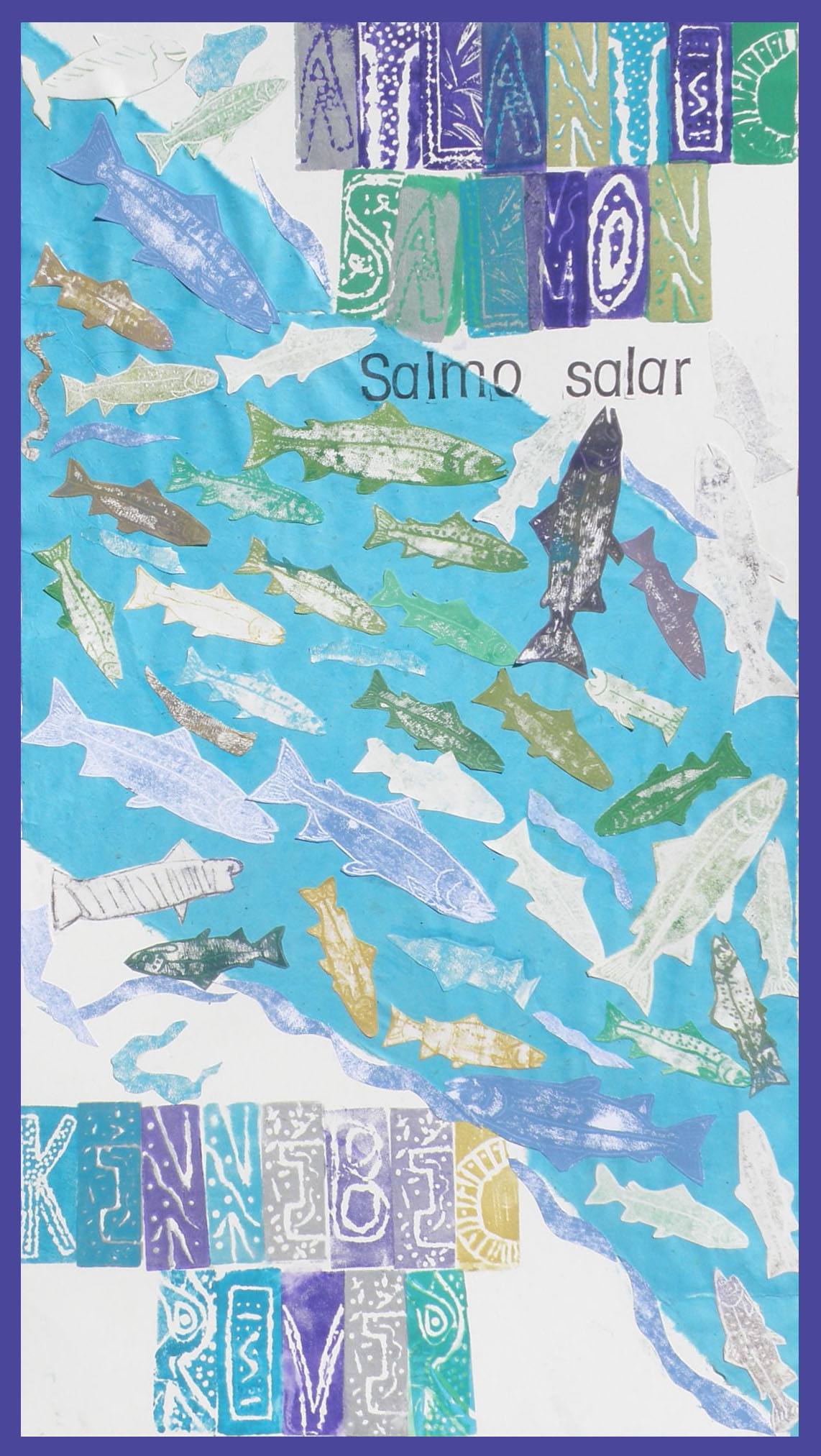
During the spring session of a Printmaking class, teaching artist Lisa Wheeler was approached by 4th grade teacher, Mrs.Dunn, about Atlantic Salmon. You see, the entire school is learning about the life cycle of Atlantic Salmon on the Kennebec River. All 250 students have been watching salmon eggs gestate in a special aquarium in the school lobby, excited that the eggs finally hatched in late March. Mrs. Dunn asked Mrs. Wheeler if there was some way to incorporate that into a printmaking project. “I was thrilled to be asked to participate in this school-wide learning activity, long believing that a collaboration with other content areas provides extra value in learning for the students and also an extra boost for the arts.” says Mrs. Wheeler.

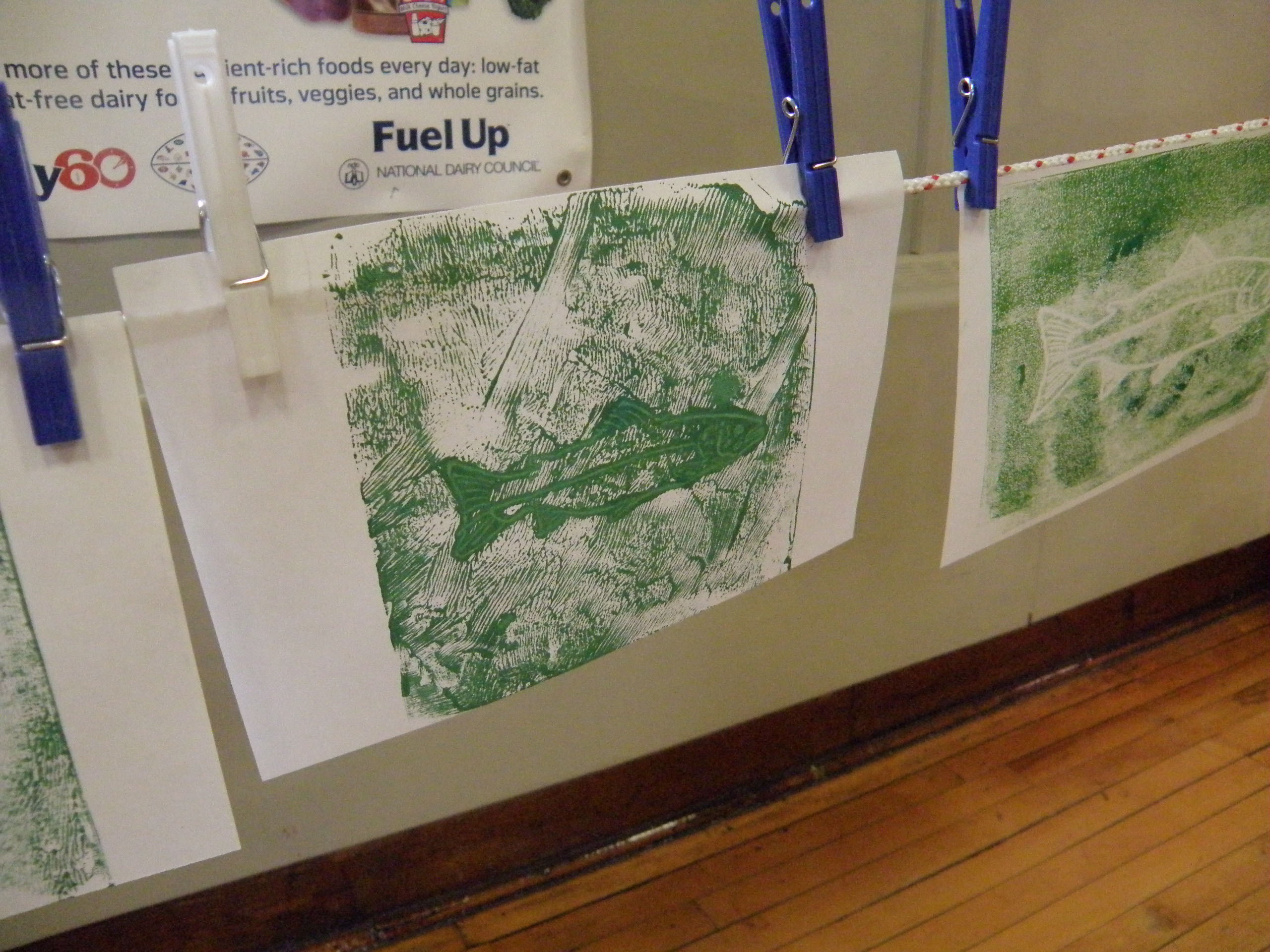
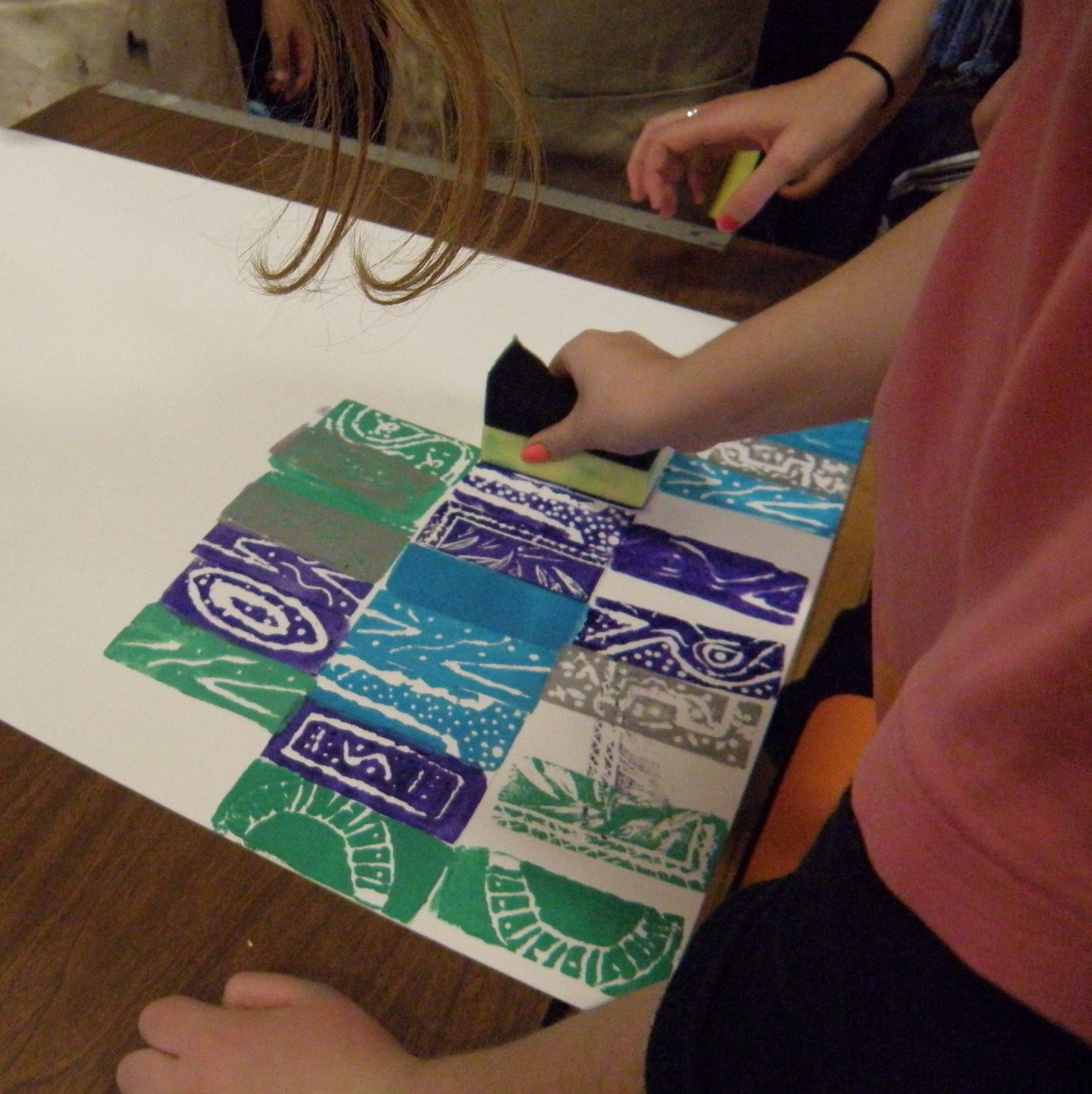
The hand-printing processes lent themselves perfectly to this group project. Student artists each created multiple trace monotypes of Atlantic Salmon which were cut out to be used on a large collage. They learned about reverse printing of words as they created hand stamps of the words ‘Atlantic Salmon’ and ‘Kennebec River.’ They assembled the cutouts onto a large piece of illustration board that had been stamped over a bright turquoise paper river. The result is a colorful piece that exemplifies the natural relationship between art and science, a piece that already has student artists proudly saying, “I made that one!” and one that will join the other pieces of public art in this special school. And hopefully this hands on learning project will have the students “swimming” with knowledge.

Follow-up: As a follow up to the science part of this story, the salmon eggs were released last Friday morning, 5/4, and the Waterville Morning Sentinel ran a photo of the students on the front page. Exciting stuff!

Thank you to Lisa Wheeler for sharing this story for this blog post.

h1

The Math Gates

May 16, 2012

Team teaching art and math works!

The following was written by art teacher, Dona Seegers, and RSU#38 district math coach, Sarah Caban, who created a unique team teaching and student learning opportunity at Mt Vernon Elementary School this year. They provided the following information for this blog post sharing their collaborative work.

We are motivated by the excitement of new ideas for presenting our subjects to the students, are eager to experiment and have infectious enthusiasm.

We are interested in having the students discover how integral math is for an artist and how a mathematician benefits from creative thinking abilities with 2D and 3D design vocabulary and concepts.

Math and art share many core features focused on thinking and problem solving. Students become better at math through visual investigations.

Students and teachers alike benefit with two instructors in the room. Dona and Sarah are better able to address students of all levels and to increase student participation. It personalizes the learning experience and students witness us learning from each other.

Students experience the myriad of connections between disciplines while doing creative movement, making Venn Diagrams, using math manipulatives  and participating in art projects.

Algebra and Art were the focus for our 3 week interactive hallway installation titled The Math Gates.

Sarah had been reading about the importance of introducing algebraic thinking in the early grades, inspired by Robert Moses who started The Algebra Project.

Dona was inspired by Christo and Jeanne-Claude’s 2005 art installation of The Gates in New York City’s Central Park. Students learned to temporarily transform an environment through art installation. With the help of the janitor, Craig Dunn, and the district volunteer coordinator, Nancy Mormon, the front hall became a learning lab for algebraic equations K-5. Cloth flags with dots (K), whole numbers (1-4) and fractions (5) hung four across to demonstrate a variety of equations of increasing difficulty.

Object Lessons: Teaching Math Through the Visual Arts K-5 by math educator Caren Holtzman, and art teacher, Lynn Susholtz, has been a fantastic resource this year and the source for all of our collaborations.

Next year we plan to do a project based on the Fibonnaci sequence including a field trip to an art show on this theme at The Emery Community Arts Center in Farmington.

Student comments about The Math Gates; “You are able to do both tasks at the same time. Math and Art are my favorite subjects so it is double the fun.”  “ Sometimes you do art and sometimes you do math, so it evens out in the end.” “Installation is a lot different because you have never heard of it; you need to know both subjects because they come in useful.” “We don’t have other subjects combined.”

Thank you Dona and Sarah for providing this blog post!

.

h1

Another Arts Teachers’ Story: Jen Nash

May 15, 2012


Featuring one teacher’s journey as an arts educator

This is the ninth in a series of blog posts telling arts teachers’ stories. The series contains a set of questions that provide the opportunity for you to read and learn from others.

Jen Nash currently teaches K-8 music at the Etna-Dixmont School and has been there for the last 4 years. There are approximately 220 students from K-8.  Classes include: K-6 general music, 3rd grade recorders, beginner band, second year band, and middle school band, jazz band and chorus. Jen is a teacher leader with the Maine Arts Assessment Initiative, phase I.

What do you like best about being a music/art/drama/dance educator?

Watching the learning phases that students go through. I love being able to teach students the skills to become independent and self driven. The advantage of being a K-8 music teacher is watching them grow up, and mature in all things musical. It is wonderful when a student can identify mistakes, plan out a way-of-attack, and smile at what they have accomplished. When given the opportunity, students can be inquisitive, insightful and take ownership in the process.

Tell me what you think are three keys to ANY successful arts ed program?

  1. Direction                                                                                                                              – long term and short term goals (educator produced and student produced)
  2. Drive

-a clear philosophy of why the program exists and who it serves

-after setting goals, planning how to accomplish goals

3.    Gas

-Students fuel the program.

*recruiting, helping in events, sharing with younger students,     student leaders

*establishing expectations and creative assessments

-Parents and community

*without their support, arts programs would not exist

-Making sure your teacher tank does not hit “empty”.

*we run ourselves ragged for what we believe in. We must find balance.

What specific way(s) do your assessment practices tie into the success of your program?

I have student self reflect at the end of every class. Most the days I ask them to assess their overall performance for the day. Examples: Where you on task? Did understand the topic? Did you apply the new concepts? Did you follow directions? Did you put forth 100% effort?

I used to give them an overall individual assessment at the end of every class last year (no input from students). Since using the student driven method for the 2011-2012 school year, I have had students practicing more, on task, and asking about how they may improve.  I use a chart labeled 1-4, and clothes pins with students names on them.  It takes less than 2 minutes to take note of their scores, and I use GoogleDocs to keep it organized.

What have been the benefits in becoming involved in the arts assessment initiative?

It has been said over and over again: collaboration. Collaboration among all arts educators is essential to the survival and growth of programs across this state. I have learned so much from the many effective, wise (I do not mean “old”) teachers. Imagine what a truly unified front of Maine arts teachers would look like? How could we fine tune, or, perhaps revolutionize our methods, to reach this new generation of students?

What are you most proud of in your career?

Keeping students first. Teaching means trying things, and when I find they do not work, I do something else to reach them. I am content in knowing that I will always be seeking answers. Oh! And keeping a smile. Even on the tough days.

What gets in the way of being a better teacher or doing a better job as a teacher?

 Attitude.  If one does not like a situation: “fix it” or “get over it”.  If one can not, “fix it” or “get over it”, then move on.  Life is too short, and the people in immediate proximity suffer.

Apple or PC?

Macbook

iPad

Always have my Droid Incredible (PC based) close by.

Use what works for you.

What have you accomplished through hard work and determination that might otherwise appear at first glance to be due to “luck” or circumstances?

“You’re such a techie”. Back in middle school, I remember taking my first computer class.  We learned all about floppy disks, Oregon Trail, and typing. At some point, I was hooked on Mavis Beacon Teaches Typing.  Occasionally in high school, I would be asked to type out a paper.

In college, I received a very, very old laptop that had the worst screen of any computer at that time. It worked-I could AOL instant message, so all was well.  The Form and Composition class I took, demanded computer lab time in the music building. This is where I learned about Sibelius (a music notation software). Third year of college, thanks to Mom, a wonderful Dell desktop graced my dorm room.

So, I received my first MLTI laptop 5 years ago.  Since then, I have spent hours just trying out new software, playing with spreadsheets, web browsers and etc.  Last summer, I took the UM Summer Technology Institute course where I learned all about Google and it’s endless blessings.

What intrigues me is finding a program that can make my job more organized, and communication easier.  I also love being able to help other people when they feel they just can not handle this whole “machine” thing.  I almost feel like it is part of my job to share all the stuff I have learned. So, yes, it seems as if, being young equals understanding computers.  It mostly has to do with the fact that I want to learn and I have had lots of practice.

Look into your crystal ball: what advice would you give to teachers?

Love what you do. Find joy in every day. Have peace knowing that most situations work out. Be kind to every student. Faithful to your friendships and family. Self control, even when it is a full moon and the kids are wild.  Compassion and gentleness in approaching all difficult situations.

I think back to all of the leaders that had an impact on my life. They were patient, calm, sincere in their intentions and slow to temper. I really think those people had it figured out.

If you were given a $500,000.00 to do with whatever you please, what would it be?

            Take a tropical vacation

            Buy a really nice piano

            Start a string program

            Give to missionaries

            Pay off student loans and mortgage

            Start college fund for niece and nephew

            Refinish the school stage

Links with resources: Etna-Dixmont School Webpage

Jake Sturtevant and Jen Nash Web Resources

Thank you Jen for taking the time to tell your story!

h1

Arts Assessment Teacher Leaders: Phase 2

May 14, 2012

Look to your arts education leaders

Almost exactly one year ago the teacher leaders were announced for the first phase of the Maine Arts Assessment Initiative. I am excited to write this blog post to let you know who has been selected for the second phase of the initiative. During the summer they will attend a 4-day professional development institute at Maine College of Art in Portland expanding their knowledge in assessment, leadership, and technology. During the 2012-13 school year the teacher leaders will lead regional workshops throughout Maine. Watch for the blog posts with more information on the opportunities provided by the second phase of the initiative! CONGRATULATIONS to the following arts educators for stepping forward and taking on this important work across Maine! Continuing with the initiative for the second phase are almost all of our teacher leaders from last year! Thank you for your continued support, interest, and for taking on the role of leader!

DANCE EDUCATOR

  • CARMEL COLLINS, Lake Region High School

MUSIC EDUCATORS

  • ANDREA WOLLSTADT – Biddeford Intermediate School, grades 4 and 5, John F. Kennedy School, grade K
  • ANDRIA CHASE – Corinth Schools, grades 4-12
  • ASHLEY SMITH – Brunswick High School, grades 9-12
  • BONNIE ATKINSON – Machias School District, grades K-5
  • DREW ALBERT – Maranacook School District, grades 5-12
  • JANE KIRTON – Sanford High School, grades 9-12
  • JARIKA OLBERG – Waynflete School, grades 4-12
  • MARI-JO HEDMAN – Ft. Fairfield Schools, grades K-12
  • SARAH WILLIAMS – Glenburn School, grades 2-8

VISUAL ART EDUCATORS

  • BARB WEED – Gray-New Gloucester Middle School, grades 6-8
  • DANETTE KERRIGAN – Sacoppee Valley Middle School, grades 6-8
  • GLORIA HEWETT – Mount View Middle School, grades 6-8
  • LEONE DONOVAN – Messalonskee High School, grades 9-12
  • PAM OUELLETTE – Lisbon High School, grades 9-12
  • SAMANTHA DAVIS – Sumner Memorial High School, grades 9-12
  • SUSAN BEAULIER – Ashland Schools, grades K-12
  • SUZANNE SOUTHWORTH – Camden Hills Regional High School, grades 9-12

The Maine Arts Assessment Initiative wiki is located at http://maineartsassessment.pbworks.com. The Maine Department of Education has a webpage devoted to the initiative at http://www.maine.gov/education/lres/vpa.

h1

Honoring Teachers!

May 14, 2012

Thank you for the work you do!

Happy Teachers Appreciation Week (a couple of days late). You are being honored and being thanked for your work each day. I wish it were possible to drive to every school in every district throughout Maine during Teacher Appreciation week and personally thank you for the work you do each day educating students.

I’ve given some thought as to what gift I would give you to honor the work you do with students. I am not able to select only one so here is my list:

  1. A GREAT BIG THANK YOU from each student and parent.
  2. A day off (with no strings attached) to go and do whatever you please.
  3. An attitude change (from the public) that would make teachers heroes.
  4. Most importantly, I’d provide the opportunity for you to learn.

Why do I think that giving you the opportunity to learn is so important? I have watched young teachers blossom and establish themselves when they continue their learning while starting out in their first teaching jobs. I have listened to veteran teachers who have gone from being unhappy teaching to filled with renewed energy because of attending a professional development opportunity.

Since I can’t actually give you any of the items on the list I can ask you to give yourself a learning opportunity. The Maine Arts Assessment Initiative (MAAI) has provided many opportunities this year. The Teacher Leaders presented at the statewide conference in October at USM and continue to offer regional workshops all over the state. Six webinars are archived with meeting plans that you can access. And there is one more webinar scheduled for May 23rd with Maine’s Commissioner of Education, Steve Bowen, as the guest. You can learn more about the MAAI by going to the wiki. I invite you to get involved with the MAAI so you can have ongoing learning opportunities that might just make your teaching a little bit better and your life more fun!

I hope that your week is filled with appreciative moments and lots of fun!

A blog post from Education Week called Building Support for Professional Learning provided by Learning Forward you might want to read.

The”Teachers are Heroes” Infographic is posted on the University of Southern California Rossier School of Education blog. The statistics are grabbing and the teacher hero stories are really inspiring!